
Microsoft says its October 2026 Windows security update addressed more than 1,100 Common Vulnerabilities and Exposures, while enterprise deployment data reveal that many computers remain unpatched for weeks. The company published the figures in a November 5 Windows vulnerability-management briefing, describing the role of artificial intelligence in finding, testing and remediating software weaknesses. The count refers to CVEs addressed across Windows updates, not 1,100 successful attacks or proof that every affected device has installed the fixes.
The announcement reflects a dual challenge for Microsoft. AI can accelerate vulnerability discovery and patch engineering, but also help adversaries reverse-engineer newly disclosed fixes. For organizations administering thousands of endpoints, reducing the time between an available update and actual installation can matter more than how quickly a vendor publishes a bulletin. The operating cycle and monthly schedule are explained in our Patch Tuesday overview.
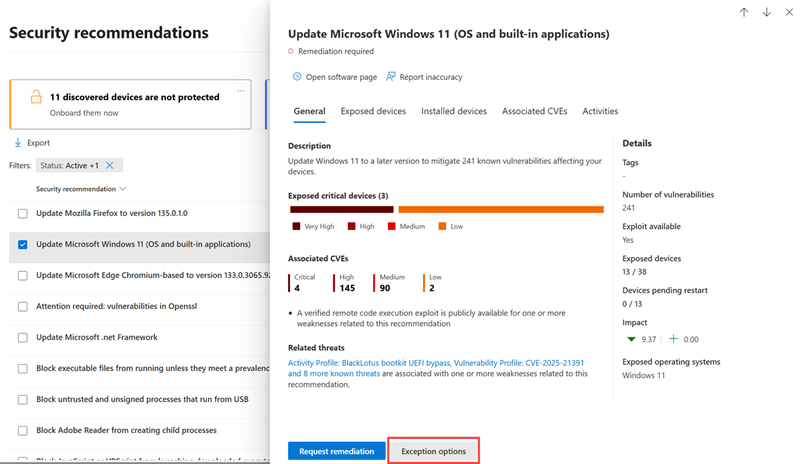
AI-assisted repair still depends on human review
Microsoft identified MDASH, a multiagent scanner, as one tool used to locate and evaluate potential flaws. It also described AI-assisted work on analyzing affected Windows versions, searching for similar code defects, developing backports and producing security regression tests. The company says engineers retain responsibility for decisions and final patches. No independent benchmark in the announcement establishes how many of the October CVEs were discovered exclusively by MDASH.
Testing continues through internal flighting, proof-of-concept security checks, application-compatibility testing and validation with manufacturers and enterprise partners. Microsoft also uses optional preview updates to detect problematic changes before they enter a following monthly update. That matters because defective fixes can create operational failures even when they close genuine vulnerabilities, as recent Windows recovery feature coverage illustrates.
The patch gap is measurable
Microsoft reported that in an August 2026 measured enterprise sample, fewer than half of devices had installed a released security update after two weeks. About one in four had not installed the update even after four weeks. Those are sample observations, not representative estimates for all Windows computers, and the company did not publish an exact two-week share in the briefing.
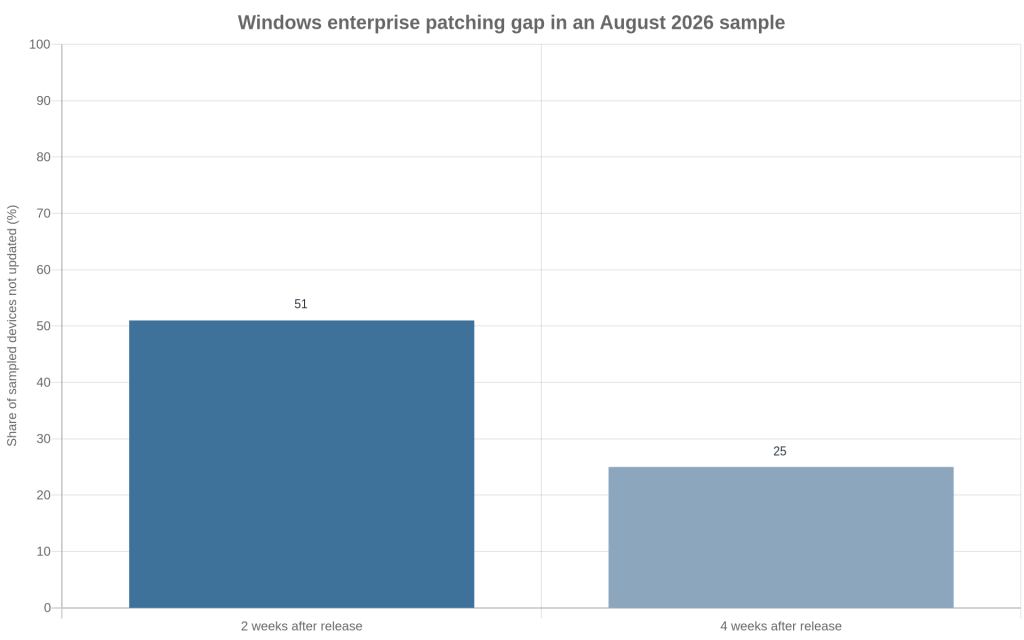
For attackers, the exposed interval begins once a fix is public and an unpatched device can be targeted. Microsoft warns that analyzing a released patch may enable exploit development within hours. Earlier reporting on AI-assisted vulnerability research in Linux shows why faster discovery and shorter remediation windows matter beyond Windows. It does not establish exploitation of the Windows CVEs discussed here.
What administrators can actually change
Microsoft recommends supported Windows versions, staged but timely deployment, tested security baselines, endpoint detection and documented recovery procedures. Windows Autopatch through Intune can sequence deployment and report status. On eligible Windows endpoints, hotpatching can apply some monthly security fixes without a restart; periodic cumulative baseline updates are still required. Windows Server 2025 has separate eligibility and servicing rules, not a blanket no-restart guarantee.
Enterprise teams should inventory exposed devices, test critical workflows, set deadlines for high-value systems and verify the actual installed build rather than assume a patch was delivered. Our Windows performance-monitoring lesson provides a related operational baseline for investigating unexpected slowdowns after updates.
The unresolved questions are the per-CVE breakdown behind the 1,100-plus figure, independent measurements of AI-assisted patch quality, and the share of enterprise devices that can close the deployment gap. Microsoft’s statement describes a security-development and servicing strategy, not a new standalone Windows release.
Editor’s Note. The October 2026 CVE figure and August patch adoption sample come from Microsoft’s November 5 company briefing. The two-week chart bar represents an illustrative lower bound, not an exact published percentage. The Defender screenshot is an official interface example, and the featured cover is editorial illustration. No video was used because no relevant playable recording was validated.

Scan the donation code from another device if your phone cannot scan its own screen.
We volunteer daily to improve the credibility of the information on this platform. If you would like to support the research, please donate here: 3C9o19EH5HSiwEPyCTmEKzxhNCbo2X6TTb
BitcoinVersus.tech is not a financial advisor. This media platform reports on technical and financial subjects purely for informational purposes.


Leave a Reply