
Jason P. Lowery is again calling for Bitcoin’s proof-of-work network to enter the U.S. national security conversation, now focusing on the risks posed by increasingly autonomous AI systems. In an X post dated November 20, 2026, Lowery says he is ready to support the country in confronting the threat of “agentic superintelligence” and describes the effort as his singular focus since 2021. The post expresses an individual proposal, not an announced government program.
Primary social source: Lowery’s November 20 X post. The original X statement is embedded for attribution. No government adoption or contract is implied.
Lowery is the author of Softwar, a February 2023 MIT thesis arguing that proof of work merits study as a form of physical cost imposition in cyberspace. The proposal matters because AI agents can generate instructions, probe services and coordinate tasks at software speed, while physical computation still consumes scarce hardware, electricity and time.
How Bitcoin’s work could fit into AI security
Bitcoin miners repeatedly compute candidate block hashes, seeking a result below a difficulty target. The network can verify a qualifying result efficiently, while producing it demands substantial expected work. Bitcoin’s consensus mechanism protects the ordering of valid transactions; it does not automatically authenticate AI operators, protect an API endpoint or prevent an agent from issuing harmful commands.
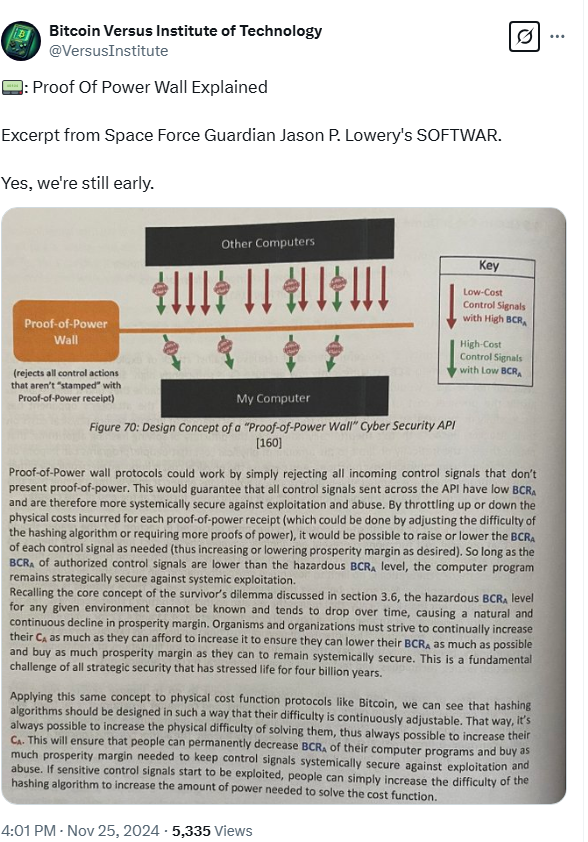
A more limited experiment could require request-specific computational puzzles before high-risk systems accept certain operations. The Proof-of-Power Wall concept proposes a related cost barrier. However, a puzzle at an API gateway is a distinct protocol, not merely Bitcoin mining redirected at a firewall. Engineering details, including challenge freshness, authorization and replay protection, determine whether any design works.
Anthony Scaramucci’s November 15, 2026 X post argues that proof of work could become a defense against AI-driven hacking. The statement is commentary, not a verified deployment or measured security result.
Archival discussion: Adam Back and Jason Lowery discuss the history of proof of work and cyber power projection on Robert Breedlove’s What Is Money? Show. The recording is background, not evidence of a 2026 government deployment.
The threat does not require superintelligence
The Congressional Research Service’s July 2026 analysis describes agentic AI as both a potential cybersecurity threat and a defensive tool. Autonomous systems can discover vulnerabilities or execute complex intrusions, while defensive agents can rapidly detect and contain attacks. Superintelligence remains a speculative capability; practical agent security risks already exist without it.
BitcoinVersus.Tech recently examined hijacked AI API credentials and real-world proof-of-work anti-abuse systems. The Tor Project’s 2023 onion-service defense demonstrates one narrower use: a client spends computation to compete for service priority under attack. Tor uses its own puzzle protocol, not Bitcoin’s mining algorithm or shared hashrate.
Archival interview: Lowery explains the Softwar thesis to Robert Breedlove. Published before the current agentic AI debate, the video establishes the theory’s history rather than present-day efficacy.
What a real national-security pilot would need
Before a proof-of-work control could be recommended, independent researchers would need to measure malicious requests deterred, legitimate requests delayed, energy consumed and attacks that still succeed. A stolen credential or compromised device can satisfy a puzzle while retaining dangerous access. Attackers may also distribute work across botnets. OWASP recommends resource controls and authorization safeguards instead of relying on one admission mechanism.
Lowery’s proposal raises a legitimate research question about making automated aggression more expensive. Yet a demonstrable security benefit requires a defined threat model and reproducible tests. Bitcoin’s energy-backed consensus cannot, by association alone, become an AI containment system. Readers can compare the argument with our earlier critical review of Softwar and the independent technical critique by Jameson Lopp.
Sources and verification
Original social source: Jason P. Lowery on X, November 20, 2026. Technical background: MIT thesis, February 2023; CRS cybersecurity report, July 2026; Tor Project, August 2023. No demonstrated deployment of Lowery’s proposed system was independently identified.
Editor’s Note: We volunteer daily to ensure the credibility of the information on this platform is Verifiably True. If you would like to support to help further secure the integrity of our research initiatives, please scan the QR code below

BitcoinVersus.tech publishes independent technology journalism for informational purposes. No financial, investment, legal or cybersecurity assurance is offered.


Leave a Reply