
Bitcoin mining decentralization has a difficult accounting problem: a mining pool can be open to small miners but still struggle to pay them directly. Bitcoin Optech’s November 20, 2026 newsletter highlighted research by developer 7d5x9, published November 11, explaining why limited coinbase transaction space creates both economic and security problems for decentralized pools. The paper proposes a framework for discussion, not a deployed Bitcoin protocol upgrade.
A coinbase transaction creates the block reward and pays its designated outputs. A conventional pool generally receives rewards and settles its members later. Decentralized pool designs try to place miners’ entitlements closer to the block itself, reducing reliance on an operator. Every additional output, however, consumes transaction space and can encounter ASIC firmware limits.
Stephan Livera’s September 2025 interview with P2Poolv2 developer jungly explains sharechains, atomic swaps and why direct mining-pool payouts are technically difficult. Historical explanation, not a demonstration of the November 2026 research proposal.
What happens when there are more miners than payout slots?
Imagine a pool with 16 available coinbase payout positions but 100 eligible miners. Choosing the 16 largest contributors sounds fair, yet a powerful miner can split its hashrate among several identities that still outrank small participants. The attacker takes additional slots without contributing additional work. Researcher 7d5x9 calls the mechanism a rich-list attack, a form of payout-settlement griefing.
Affected miners may be excluded or forced to accumulate claims until later. The proposed attack is a theoretical design weakness, not evidence that an identified Bitcoin pool carried out an attack. Moreover, a payout threshold can exclude small miners even without malicious conduct.
Historical P2Pool data shows the practical constraint
A former P2Pool operator reviewed 2,545 historical coinbase transactions. Typical blocks reportedly paid about 200 addresses in 2012 and 390 in 2014. The observed maximum was 553 recipients, in block 236,962 on May 19, 2013, with a roughly 19 kB coinbase transaction. Only 42 sampled blocks paid 500 or more outputs.
The operator found that the old software raised share difficulty when a miner’s expected per-block payout fell below 0.001 BTC. In July 2014, 1,749 of 15,865 recorded payouts fell between 0.001 and 0.002 BTC, with none below 0.001. The evidence reveals a payout threshold, but cannot count the miners who stopped participating. P2Poolv2’s Lightning-related payout work aims to address some of those economic constraints.
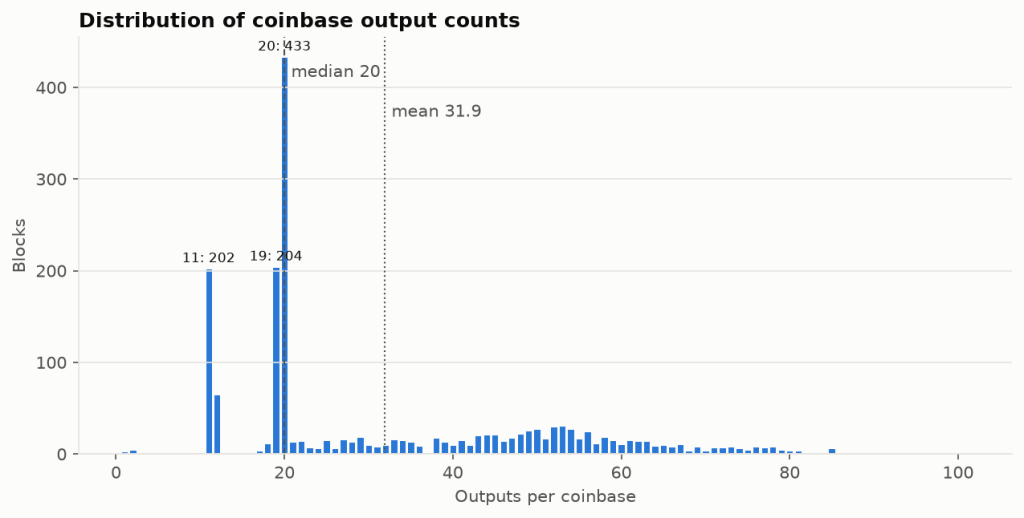
Could new protocols solve the payout problem?
Braidpool proposes combining rewards into a rolling output controlled by a threshold of signers. P2Poolv2 considers market makers that acquire small miners’ sharechain claims and aggregate enough value to receive a direct payout. Both arrangements reduce certain costs while introducing new questions about signing power, liquidity and claim settlement. Neither is established as a complete defense against every attack described in the research.
Bitcoin Magazine, August 2024: Braidpool developer Kulpreet Singh discusses transparent mining-pool accounting and challenges in decentralized payouts. Original speaker presentation, predating the November 2026 analysis.
The research also examines Ark-like and Spark-like payment trees. Their difficulty is that miners change coinbase data to expand nonce space, leaving the final transaction ID unknown before a block is found. Pre-signing unilateral exit transactions becomes difficult. Proposed rebindable signatures could change the design space, but would require further Bitcoin protocol work rather than a routine software update.
What miners should watch
The practical test is not simply whether a pool supports Stratum or lets miners create block templates. Template selection and payout settlement are separate responsibilities. MARA’s first Stratum V2 block illustrates progress in pool communications, without independently establishing a decentralized payout system.
For small operators, the relevant questions are who controls rewards, what happens below the payout threshold, how claims are enforced, and whether a payout remains economical when onchain fees rise. Comparing centralized, decentralized and solo pools requires inspecting those details rather than assuming a label guarantees fair treatment. The new discussion makes the obstacles more concrete, but a broadly deployed, independently tested solution remains ahead.
Sources and documentation
- Bitcoin Optech Newsletter #432, November 20, 2026
- 7d5x9, DCPP research, November 11, 2026
- Historical P2Pool transaction analysis, November 11, 2026
- jungly, Ocean histogram, November 12, 2026
- Stephan Livera, P2Poolv2 developer interview, September 2025
- Bitcoin Magazine, Braidpool developer presentation, August 2024
Editor’s Note: We volunteer daily to ensure the credibility of the information on this platform is Verifiably True. If you would like to support to help further secure the integrity of our research initiative, please scan the QR code below

For mobile scanning, open the article on another display and scan the QR code with a Bitcoin wallet. The voluntary donation amount is 5,000 sats. Verify the receiving address 3C9o19EH5HSiwEPyCTmEKzxhNCbo2X6TTb before sending.
BitcoinVersus.Tech publishes technology and financial journalism for informational purposes and does not provide financial, investment, or legal advice.


Leave a Reply