
Centralized, decentralized, and solo Bitcoin mining can all point ASICs at the same Bitcoin network, but they divide control and rewards very differently. A centralized pool concentrates coordination in a pool operator. A decentralized pool design pushes some or all of that authority back toward miners. Solo mining removes shared rewards entirely: if you find the block, the reward is yours; if you do not, there is no payout.
The comparison is more nuanced than “centralized bad, decentralized good.” Centralized pools can offer predictable cash flow, mature monitoring, support, and efficient infrastructure. Decentralized designs can reduce dependence on a single coordinator but may require more software, local nodes, or operational knowledge. Solo mining gives the miner the cleanest reward ownership but also the highest variance by far.
What a traditional centralized pool does
In a conventional mining pool, many independent miners point hashrate at infrastructure operated by the pool. The pool distributes work, measures submitted shares, determines each miner’s contribution, and calculates payouts under a reward system such as FPPS, PPS, PPLNS, or a related model.
Historically, the pool operator has also built the block template—the candidate set of transactions miners are hashing. Under that model, thousands of physical miners can appear to the Bitcoin network as one large logical block producer because the pool decides what transactions go into the candidate block.
This concentration question is not new for BitcoinVersus. We were already examining mining and infrastructure concentration in our 2023 analysis of centralization and oligopolies in the Bitcoin industry.
Why miners use centralized pools anyway
The main reason is variance reduction. Bitcoin produces a new block only probabilistically. A miner with a small share of global hashrate may wait an extremely long time before finding one independently. Pooling combines many miners’ work so rewards can be distributed in much smaller and more frequent amounts.
Centralized pools can also make operations easier. They often provide dashboards, worker monitoring, alerts, payout accounting, regional servers, technical support, APIs, and established payment infrastructure. For commercial miners that need predictable cash flow to cover electricity and operating expenses, those services can be valuable.
A proprietary pool can push centralization even farther because the mining company and pool operator become closely aligned. Our 2025 look at Marathon’s proprietary mining pool is an example of how mining infrastructure can be brought directly inside a large operator’s own stack.
Decentralized pools are a spectrum
“Decentralized mining pool” does not describe one single architecture. Different projects decentralize different jobs.
One design may leave payout accounting with the pool but let individual miners choose their own transactions. Another may decentralize block-template construction, share accounting, and payout settlement. That distinction matters because Bitcoin mining has several separate control points: who constructs the block, who validates shares, who holds rewards, who decides payouts, and who can disconnect or censor a miner.
Stratum V2’s Job Declaration Protocol is designed so miners can declare custom jobs rather than having a pool unilaterally impose every block template. The pool can continue handling share accounting and rewards while miners gain more control over transaction selection.
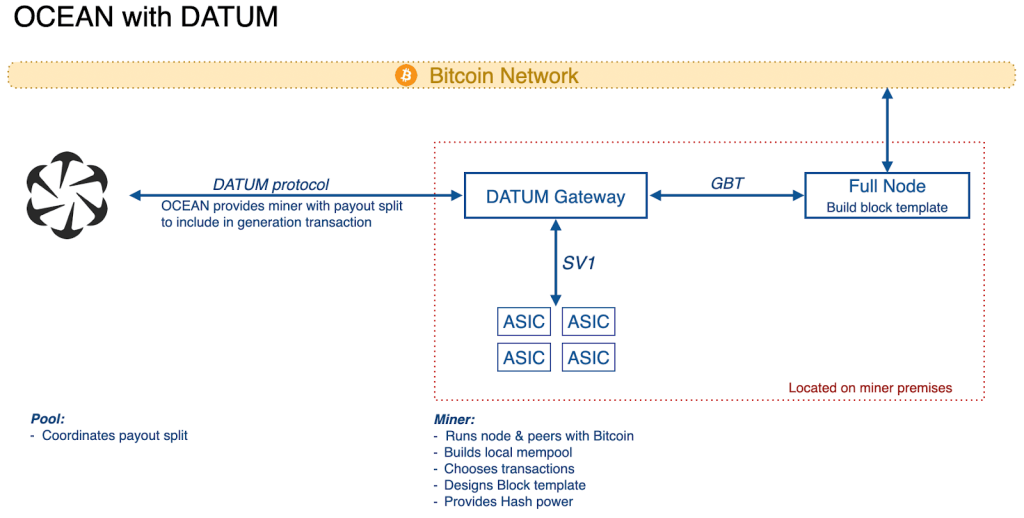
OCEAN and DATUM separate pooling from block construction
OCEAN’s DATUM architecture is a good example of that middle ground. A miner can run a local Bitcoin node and construct its own block template while still participating in pooled rewards. The pool coordinates the reward split and validates work, but it does not have to be the entity choosing every transaction in the miner’s candidate block.
Braidpool tries to decentralize even more of the pool
Other designs go further. The Braidpool project describes a peer-to-peer mining pool that aims to decentralize transaction selection, share accounting, and payout coordination rather than leaving those functions with one pool operator.
Braidpool should be understood as a developing architecture rather than proof that every pool function has already been decentralized at global industrial scale. Its importance is conceptual: a mining pool can be broken into separate functions instead of treating “the pool” as one indivisible coordinator.
Solo mining is different again
Solo mining does not pool the economic reward with other miners. Your ASICs are trying to find a Bitcoin-valid block for you. If your miner finds the winning hash, you receive the block subsidy and transaction fees, minus any fee charged by the infrastructure service you may be using. If you never find a block, you receive nothing.
This is why some services are called “solo pools” even though they are not pooled mining in the reward-sharing sense. A service such as Solo CKPool or Braiins Solo can provide Stratum servers, monitoring, block propagation, and low-latency infrastructure, but every miner is still independently trying to win its own block rather than sharing revenue with all other participants.
BitcoinVersus has watched that model grow for years. In 2024 we reported on a solo-mining service surpassing 9,000 users, an early sign that miners were interested in taking block-level variance directly rather than automatically smoothing it through conventional pool payouts.
Centralized vs. decentralized vs. solo
| Question | Centralized pool | Decentralized pool design | Solo mining / solo service |
|---|---|---|---|
| Are rewards shared? | Yes | Usually yes | No |
| Payout variance | Low to moderate | Low to moderate, depending on design | Extremely high |
| Who builds the block template? | Traditionally the pool | May be the miner or distributed participants | The miner or solo-service infrastructure, depending on setup |
| Who tracks shares? | Pool operator | Pool, protocol, or peer-to-peer accounting | Shares may be tracked for monitoring, but they do not earn proportional payouts |
| Operational complexity | Lowest for most miners | Usually higher | Low with a service; higher with a fully self-hosted node and mining stack |
| Reward if your hardware finds a block | Your pool payout share | Your protocol-defined pool share | Entire block reward for you, minus service fees if applicable |
| Main advantage | Predictable revenue | More distributed control | Maximum individual reward ownership |
| Main disadvantage | Dependence on pool coordinator | Greater complexity and less mature infrastructure in some designs | Extreme variance |
A pool can be centralized in one dimension and decentralized in another
This may be the most important distinction. Mining architecture is not binary.
A pool can centrally calculate payouts but allow miners to choose block templates. It can decentralize transaction selection while retaining centralized share accounting. It can pay miners directly from the coinbase while still operating central servers. A solo-mining service can give each miner an independent reward while still using centralized networking infrastructure.
So when someone calls a mining setup “centralized” or “decentralized,” the useful follow-up question is: which function? Block construction? Payout custody? Share accounting? Network infrastructure? Miner identity? Transaction selection? Those answers tell you much more than the label alone.
Which model is better?
For a commercial operator that needs stable daily revenue and minimal administrative overhead, a mature centralized pool may still be the most practical option. For a miner that wants pooled rewards while retaining more control over transaction selection, decentralized-template systems such as DATUM or Stratum V2 Job Declaration can change the balance. For a hobbyist, experimental miner, or operator willing to accept long stretches of zero revenue in exchange for the possibility of keeping a whole block reward, solo mining is fundamentally different.
There is no architecture that wins every category. The trade is between payout stability, operational simplicity, trust in coordinators, miner autonomy, and variance.
Bottom line
Centralized pools pool both hashrate coordination and rewards. Decentralized pool designs try to distribute some or all of the coordination while preserving pooled economics. Solo mining keeps the economics individual: one miner, one chance, one block reward—or zero.
The future of Bitcoin mining may not be one model replacing the others. It may be miners choosing different combinations of payout smoothing, block-template autonomy, open protocols, self-hosted nodes, and solo exposure depending on what they value most.
BitcoinVersus.Tech Editor’s Note: “Centralized” and “decentralized” describe multiple independent design choices in mining. This article compares architectures rather than endorsing a specific pool or mining strategy. Solo mining has extreme variance, and past solo block finds do not increase the probability of a future hash succeeding.
Follow BitcoinVersus.Tech for Bitcoin mining, ASIC hardware, firmware, networking, energy, data-center, and open-source infrastructure coverage.
Support independent technology reporting: Bitcoin donations help fund BitcoinVersus.Tech research and publishing.
Disclaimer: BitcoinVersus.Tech provides technology news and education for informational purposes only.


Leave a Reply