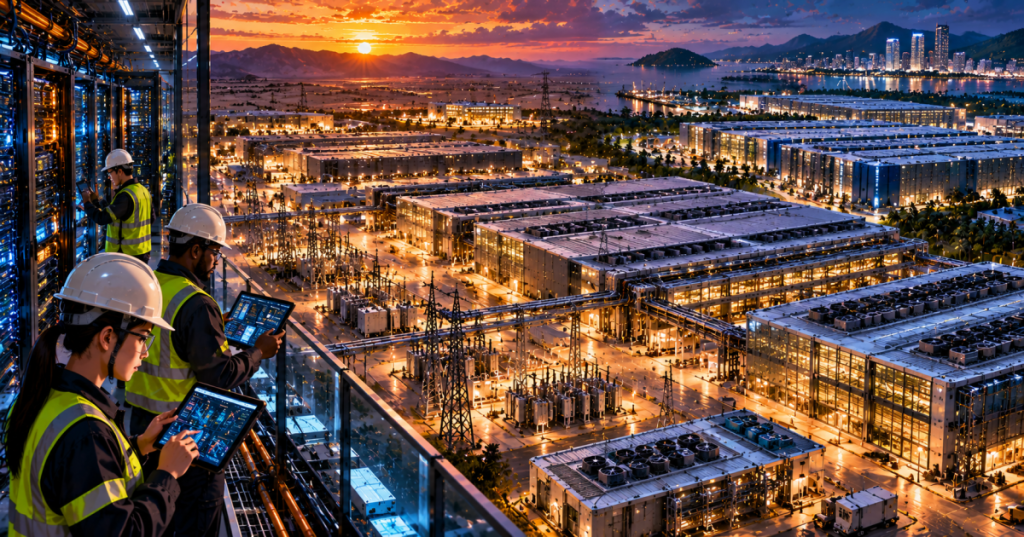
The world’s largest operating AI data-center campus is not necessarily the one with the most ambitious announced expansion. As of October 27, 2026, the Epoch AI frontier data-center register estimates that Amazon’s New Carlisle campus has 1,037 megawatts of AI IT capacity already online, ahead of Colossus 2 and Fairwater Atlanta. This countdown ranks the seven largest tracked, operating AI campuses by that measured-in-megawatts capacity estimate rather than planned gigawatts, corporate spending or sites that have yet to open.
What “actually operating” means here: The rankings use Epoch’s modeled IT power online, not instantaneous facility electricity use. Epoch infers the amount of compute power likely available to run using satellite imagery, permits, hardware-efficiency assumptions, company statements and cooling infrastructure. Actual electrical draw fluctuates with server utilization and requires meter data. The dataset covers about 95 prominent frontier AI sites, not every data center in the world. Site overhead and power usage effectiveness (PUE) are also separate from the IT-power metric. The differences from planned end-state megaproject rankings are the entire point of this comparison.
| Rank | AI campus | Modeled IT MW online |
|---|---|---|
| 1 | Amazon–Anthropic New Carlisle / Project Rainier, Indiana | 1,037 MW |
| 2 | SpaceXAI Colossus 2, Memphis/Southaven | 946 MW |
| 3 | Microsoft Fairwater Atlanta, Fayetteville, Georgia | 636 MW |
| 4 | DayOne Nusajaya Tech Park, Johor, Malaysia | 473 MW |
| 5 | Meta Prometheus, New Albany, Ohio | 471 MW |
| 6 | DayOne Kempas Tech Park, Johor, Malaysia | 422 MW |
| 7 | OpenAI Stargate Abilene, Texas | 421 MW |
7. OpenAI Stargate Abilene, Texas — 421 MW Online
Oracle, Crusoe and OpenAI’s flagship Stargate campus has computing halls in service while more sections progress through construction and commissioning. Epoch estimates 421 MW of currently operational IT capacity; this is not the 1.2 GW campus buildout figure or the whole multiyear Stargate investment program. Elsewhere in the Stargate network, additional proposed gigawatts have different timelines and must remain separate from energized Abilene halls. Review the site-level Epoch data.
Bloomberg’s Emily Chang interviewed developers and visited the actual Abilene complex. The documentary confirms the site’s location and large-scale work, but dates to an earlier construction phase. The site’s 2026 operating-megawatt estimate is attributed to Epoch’s subsequent model.
6. DayOne Kempas Tech Park, Johor, Malaysia — 422 MW Online
DayOne’s Kempas Tech Park is one of two major operator campuses in Johor. Epoch’s site profile estimates 422 MW of AI IT capacity online after commissioning several new buildings during 2026, using satellite imagery, cooling-equipment observations and the operator’s disclosures to infer capacity. The company does not certify 422 MW as its actual instantaneous draw. Review the site-level Epoch data.
In Epoch’s site notes, moving fans appear in the 2025 footage even before several buildings were considered fully operational. The transition from a roofed building to a commissioned, electrically supplied compute hall matters: visible fans are only part of the evidence.
5. Meta Prometheus, New Albany, Ohio — 471 MW Online
Meta’s October 19 engineering report independently confirms that the first operational Prometheus phase trained its Muse-family foundation models. The company describes hundreds of thousands of NVIDIA GPUs, multiple interconnected buildings, NVL72 systems and closed-loop cooling. Epoch estimates 471 MW of currently online IT capacity. Meta’s goal of around one million GPUs is a future full-scale objective rather than the current installed inventory. Review the site-level Epoch data.
Meta reports goodput exceeding 85% in pretraining and 90% in reinforcement learning for its new models. Those are workload-reliability metrics, not electricity utilization percentages. The distinction also matters in our coverage of the Muse models built with this infrastructure.
4. DayOne Nusajaya Tech Park, Johor, Malaysia — 473 MW Online
DayOne’s Nusajaya operation started serving customers in 2023 and subsequently expanded into AI workloads. Epoch estimates 473 MW of currently online AI IT power from later campus phases, drawing on physical cooling infrastructure and accelerator assumptions while excluding three older non-AI Phase 1 buildings. The operator’s Johor information emphasizes campus certifications and low-latency links to Singapore. Review the site-level Epoch data.
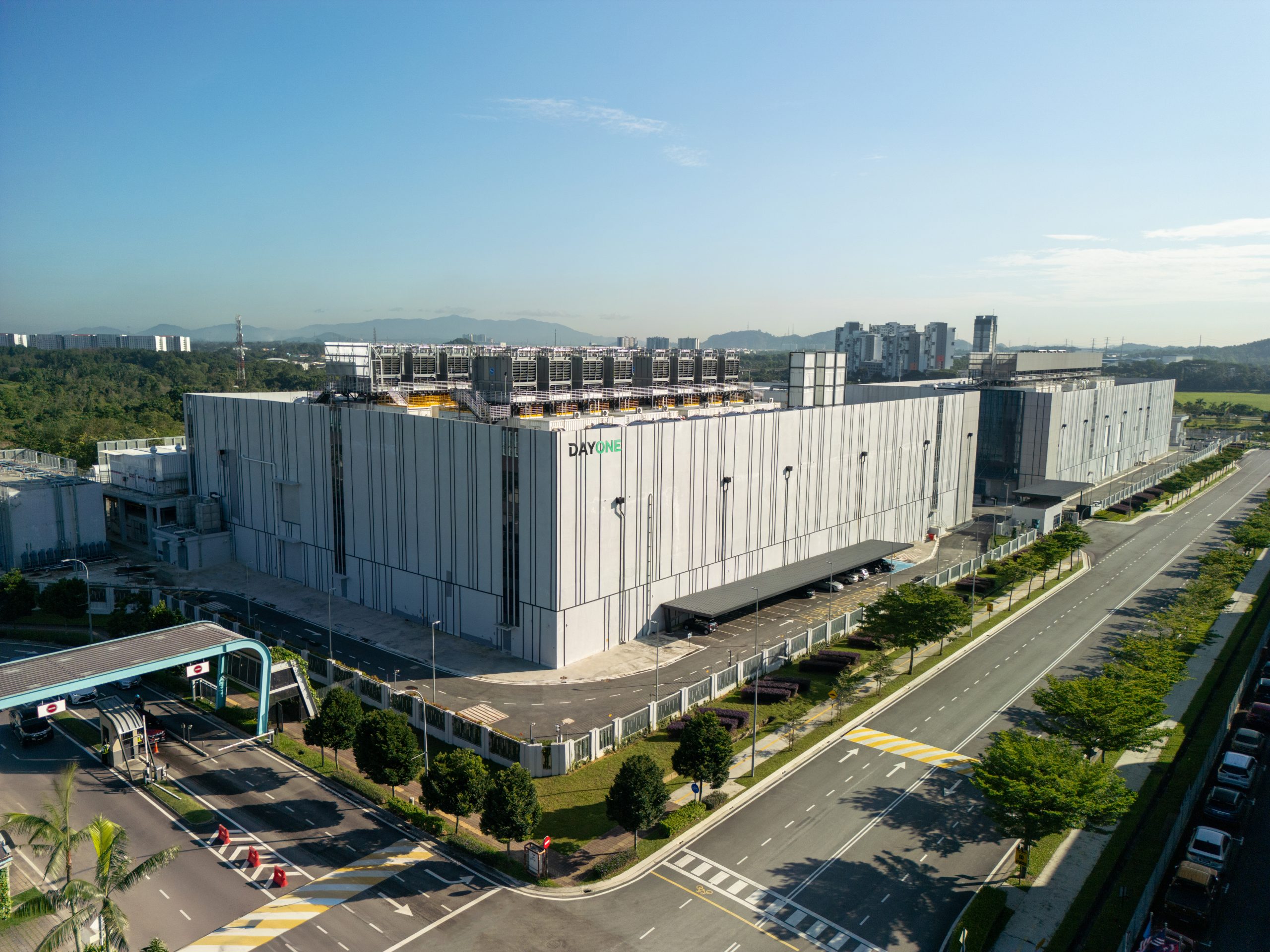
Important unresolved discrepancy: DayOne markets over 478 MW operational across its two Johor campuses combined, whereas Epoch independently models 895 MW of AI IT power for Nusajaya and Kempas combined. The definitions, dates, or estimated operating state may differ. These figures have not been reconciled, and neither is represented here as a utility-meter reading. DayOne’s corporate growth and bookings do not independently establish actual delivered megawatts.
3. Microsoft Fairwater Atlanta, Fayetteville, Georgia — 636 MW Online
Microsoft’s Fairwater AI campus south of Atlanta, developed with QTS, has multiple buildings operating while adjacent phases continue to expand. Epoch’s satellite-based estimate reached 636 MW in June 2026. Microsoft’s engineering overview describes high-density GB200/GB300 architectures, flat GPU networks, liquid-cooled racks and closed-loop water systems. Such facility-wide power and network design provides the physical context for the accelerator chips used in large training clusters. Review the site-level Epoch data.
The 636 MW figure is a model of IT capacity that can operate, not a number for one rack or a live reading of the grid. The photo-video evidence verifies buildings and site expansion; Microsoft Fairwater campuses in other states remain separate sites in this ranking.
2. SpaceXAI Colossus 2, Memphis/Southaven — 946 MW Online
Colossus 2 has expanded near Memphis with NVIDIA Blackwell accelerator hardware, rapid server-hall construction and an evolving power architecture. Epoch estimates 946 MW of IT capacity online and projects about 1.53 GW at later buildout. The operator’s Mid-South campus overview discusses Colossus I and II, but their numbers should not be merged into a Colossus 2-only value. Grid supply, on-site turbines and local air-quality concerns are important parts of its electrical story. Review the site-level Epoch data.
This newer on-location video is about Colossus 2, not a recycled 2024 tour of the first Colossus machine. Power-generation nameplates and gas-turbine permits alone do not prove the site’s real electricity load; independent generation comes with reliability and emissions constraints.
1. Amazon–Anthropic New Carlisle / Project Rainier, Indiana — 1,037 MW Online
At 1,037 MW modeled online IT power, AWS’s New Carlisle facility leads the October 2026 frontier data-center register. Its Project Rainier infrastructure runs Amazon’s custom Trainium2 AI chips for Anthropic, with additional buildings planned. Anthropic’s April 20 compute collaboration covers up to 5 GW of future capacity across multiple locations—not 5 GW already operating here. Epoch models roughly 1,925 MW for the Indiana campus at a possible 2028 completion point. Review the site-level Epoch data.
CNBC documented the actual server buildings and Trainium2 system while also exploring local power and water questions. The tour is older than the October 2026 capacity estimate and does not measure 1,037 MW itself. The campus’ progression began with an earlier Indiana infrastructure investment and continued through multiple commissioned phases.
How much power do these seven operating campuses represent?
Together, the seven sites represent approximately 4,406 MW (4.406 GW) of modeled online AI IT capacity. If that entire capacity drew its rated power continuously for 8,760 hours, the hypothetical annual electricity use would be 38.6 TWh before data-center support equipment and electrical losses. That is an illustrative upper-load scenario, not a statement about actual 2026 consumption. At real workloads, scheduled maintenance and changing utilization, electricity use can differ substantially.
The DayOne discrepancy deserves particular scrutiny: its own marketing states over 478 MW operational across Nusajaya and Kempas combined, while Epoch’s separate modeled site estimates total approximately 895 MW. The difference is unresolved. Reporting it explicitly is more defensible than assuming either data source is a verified meter reading. The same caution applies to the nuclear power agreements meant to secure future electricity: contracted power and built generation are not the same as operating AI servers.
A functional AI supercluster requires more than powered buildings: high-voltage interconnection, distributed computing racks, memory, networking, liquid cooling, firm power, and applications that can actually use the hardware. Performance per watt at the chip, at the rack and at the facility can diverge, as our equipment-versus-site efficiency research explains in the related world of Bitcoin mining. The underlying principle applies to both industries: neither nameplate capacity nor approved expansion proves delivered computation.
Editor’s Note: BitcoinVersus.Tech distinguishes modeled online IT capacity from metered site consumption, customer contracts, announced campus plans and hardware benchmarks. Each ranked site includes its own documentary video or actual campus image, with dated context. To support independent infrastructure reporting, consider donating 5,000 sats by scanning the QR code below with your Bitcoin wallet.

View the donation code on a separate screen and scan it from a Bitcoin wallet to send 5,000 sats.


Leave a Reply