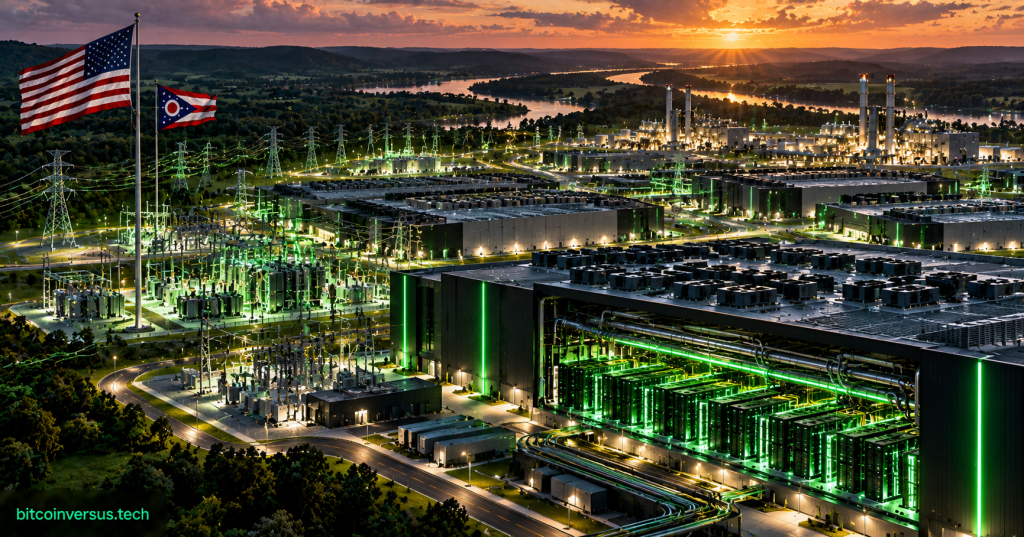
Follow-up: BitcoinVersus.Tech reported in May on the emerging Stargate buildout in southern Ohio. The project has since become far more concrete: OpenAI has signed a 20-year agreement for approximately 8 gigawatts of IT capacity at the PORTS-Pike Technology Campus, with SB Energy building and operating the site and NVIDIA positioned as its exclusive AI-compute infrastructure provider.
The August agreement turns an enormous Ohio infrastructure concept into a phased customer commitment. OpenAI says the first 800 MW is expected in 2028, largely using existing AEP infrastructure, while the six-year buildout is expected to continue through 2032.
The May Stargate story now has an 8 GW customer
When BitcoinVersus.Tech covered the Ohio Stargate project in May, the central story was the conversion of former federal industrial land into a next-generation AI and energy campus. The follow-up answers a critical question that early megaproject announcements often leave unresolved: who will actually consume the compute?
OpenAI will. The company says it has contracted for approximately 8 IT-GW at PORTS-Pike. SB Energy will build, own and operate the data center under the 20-year lease, while the campus will exclusively host NVIDIA AI compute infrastructure.
A widely circulated announcement on X captured the structure on the day of the deal: an initial 4.25 IT-GW, an option covering another 3.75 IT-GW, and phased availability beginning in 2028.
Eight IT gigawatts requires an energy project of its own
This is not simply a collection of server buildings. The parties say SB Energy and SoftBank plan at least 10 GW of new generation to support the campus, plus approximately ₿48,443 ($4.2 billion) of new regional grid infrastructure through AEP Ohio. The planned generation mix includes new natural-gas capacity and additional transmission infrastructure.
That scale puts the Ohio project directly inside the power-supply problem BitcoinVersus.Tech examined when reporting that U.S. data centers could face a 33 GW power shortfall by 2028. PORTS-Pike is effectively being designed as an AI campus and an energy-infrastructure program at the same time.
NVIDIA is providing more than GPUs
NVIDIA is not merely selling accelerators into the project. It is investing approximately ₿17,301 ($1.5 billion) in SB Energy and providing credit support for the land, power and shell associated with the initial 4.25 IT-GW. Reuters reported that NVIDIA’s broader guarantee could reach approximately ₿1.21 million ($105 billion), illustrating how AI hardware vendors are becoming entangled with the financing of the infrastructure that will buy their hardware.
The campus is expected to use NVIDIA’s full-stack AI factory platform across GPUs, CPUs and networking. OpenAI and NVIDIA also plan to publish technical lessons from the deployment around resiliency, component qualification, software-level workload management and cluster-scale reliability.
The community package is now measurable too
OpenAI says the six-year construction program is expected to support 35,000 construction jobs and 2,500 long-term operating jobs. OpenAI added approximately ₿461 ($40 million) to SB Energy’s existing community commitment, creating an initial approximately ₿923 ($80 million) community benefits pool. It also announced approximately ₿969 ($84 million) in Codex credits for eligible Ohio college, community-college and technical-school students.
The companies say project-specific grid costs will not be shifted to regional ratepayers and that the campus will use closed-loop, air-cooled cooling systems designed to recirculate water. Those are commitments that can now be tracked against actual construction and operating data as the project advances.
This is why the old story was worth revisiting
In May, PORTS-Pike was primarily a giant infrastructure vision. By August, the commercial architecture had become much clearer: a 20-year OpenAI lease, NVIDIA compute, an initial 4.25 IT-GW financing structure, an 8 IT-GW OpenAI commitment, at least 10 GW of planned generation and a first 800 MW delivery target for 2028.
It also reinforces the argument behind BitcoinVersus.Tech’s earlier explanation that data centers are physical infrastructure for the digital economy. At PORTS-Pike, that physical layer becomes impossible to ignore: compute, power plants, substations, transmission, cooling, financing and workforce development all have to arrive together.
The next meaningful checkpoint is no longer another announcement. It is whether the first 800 MW actually reaches service in 2028, and whether the power, transmission, financing and construction program can scale from that first phase toward the extraordinary 8 IT-GW commitment.
BitcoinVersus.Tech
Advertisement
Editor’s Note
We volunteer daily to ensure the credibility of the information on this platform is Verifiably True. If you would like to support to help further secure the integrity of our research initiatives, please donate here: 3C9o19EH5HSiwEPyCTmEKzxhNCbo2X6TTb
BitcoinVersus.tech is not a financial advisor. This media platform reports on financial subjects purely for informational purposes.


Leave a comment