Kopin Corporation hosted an AI-infrastructure panel at Nasdaq MarketSite in New York City on October 20, 2026, examining why growing GPU capacity alone cannot eliminate networking, energy and data-movement bottlenecks. The YouTube event, “The Trillion Dollar AI Bottleneck,” brought together Kopin CEO Michael Murray, Fabric.AI adviser James Altucher and emerging-technology expert Cortney Harding.
The event partner’s website links to the official recording. The panel was a discussion of infrastructure challenges and potential technologies—not a verified live demonstration of a completed optical interconnect. Its themes apply to the large AI data centers already operating, where useful computation depends on how quickly accelerators exchange information.
Official event replay: Kopin/Fabric.AI — “Live From NYC: The Trillion Dollar AI Bottleneck”, October 20, 2026. Kopin’s original announcement and Fabric.AI link to this same recording; this is a panel discussion, not a hardware benchmark.
Why moving data matters
The engineering problem is straightforward: when thousands of GPUs synchronize training work, network transfers and communication delays can leave expensive processors waiting. Conventional copper links face reach, signal-integrity and power limits at very high speeds. Our optical transceiver explainer describes the broader fiber and module technologies that address some of those constraints.
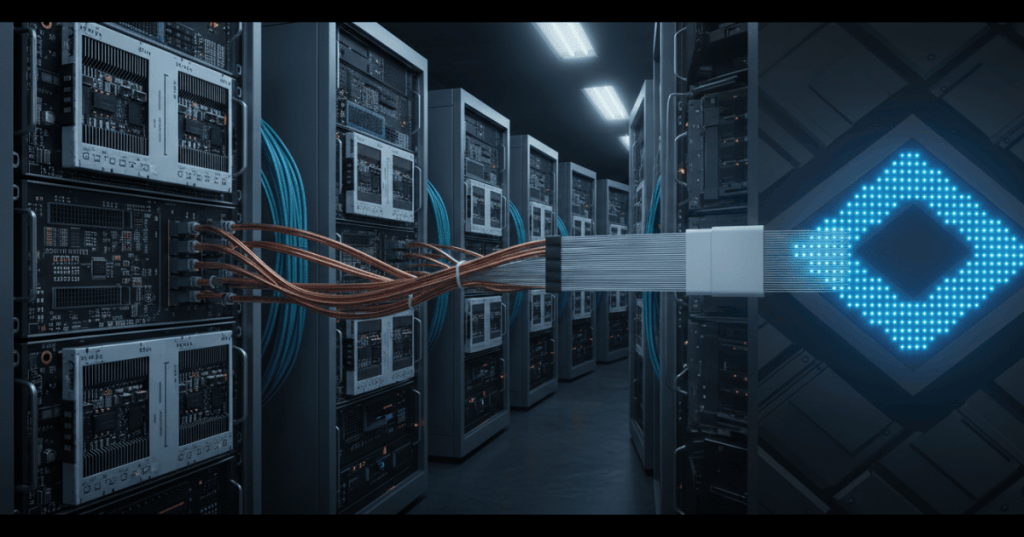
Kopin and Fabric.AI propose Neural I/o, a MicroLED-based optical interconnect using many parallel optical channels to carry data between compute components. Unlike a standard laser-driven link, the proposed system repurposes programmable MicroLED emitters. It belongs to the same broader technology conversation as co-packaged optics demonstrations and other MicroLED interconnect developments, but their maturity and architecture differ.
Additional technical context: Stockhouse interviews Kopin CEO Michael Murray (April 28, 2026) about MicroLED optical links, copper limitations and the development partnership. This earlier interview was produced in partnership with Kopin; it is not independent validation.
From modeled gain to physical deployment
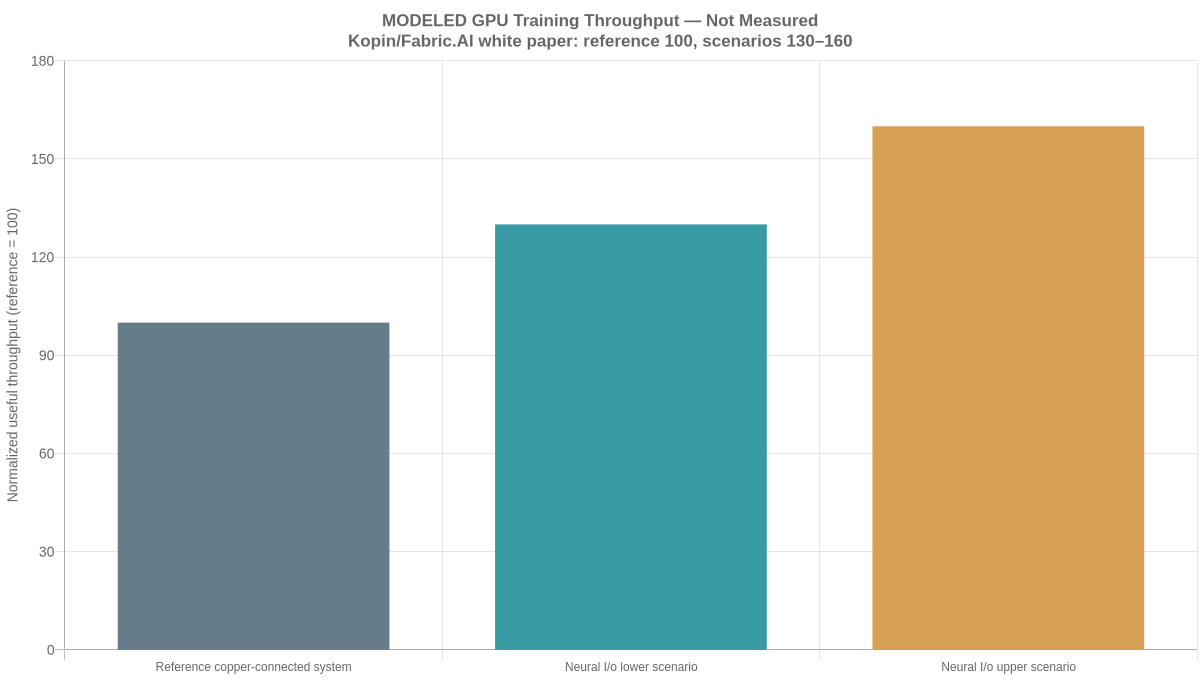
A separate October Kopin–Fabric.AI white paper models 1.3–1.6 times higher useful training throughput in a 10,000-GPU system, corresponding to roughly 23%–38% less training time for an unchanged workload. These are modeled gains attributed to reduced communication overhead, not measured production results. The chart indexes the reference system at 100.
The paper also proposes 3.2 Tbps payload links and larger one-hop compute domains extending beyond a single rack. Those specifications and larger topologies remain development assumptions; they should not be confused with installed hardware. For context, shipping Ethernet-switch bandwidth and future chip-to-chip optical fabrics are different layers of networking.
Kopin reports initial link testing, with a public demonstration targeted for January 2027 and first-generation production silicon targeted for 2028. The next meaningful evidence will be independently reproducible bandwidth, bit-error-rate, latency, joules-per-bit and end-to-end training results. Until then, the panel helps frame a real infrastructure challenge without proving that its proposed solution has reached commercial scale.
Editor’s Note: We volunteer daily to ensure the credibility of the information on this platform is Verifiably True. If you would like to support our work and help further secure the integrity of our research initiatives, please scan the QR code below to donate 5,000 sats.

For mobile scanning, open this story on a laptop or larger screen and scan the original QR image with a compatible Bitcoin wallet. Verify the destination before sending: 3C9o19EH5HSiwEPyCTmEKzxhNCbo2X6TTb.
BitcoinVersus.tech is not a financial advisor. This media platform reports on financial subjects purely for informational purposes.


Leave a Reply