Power Efficiency Theory examines the relationship between computational growth, energy efficiency, and market valuation.
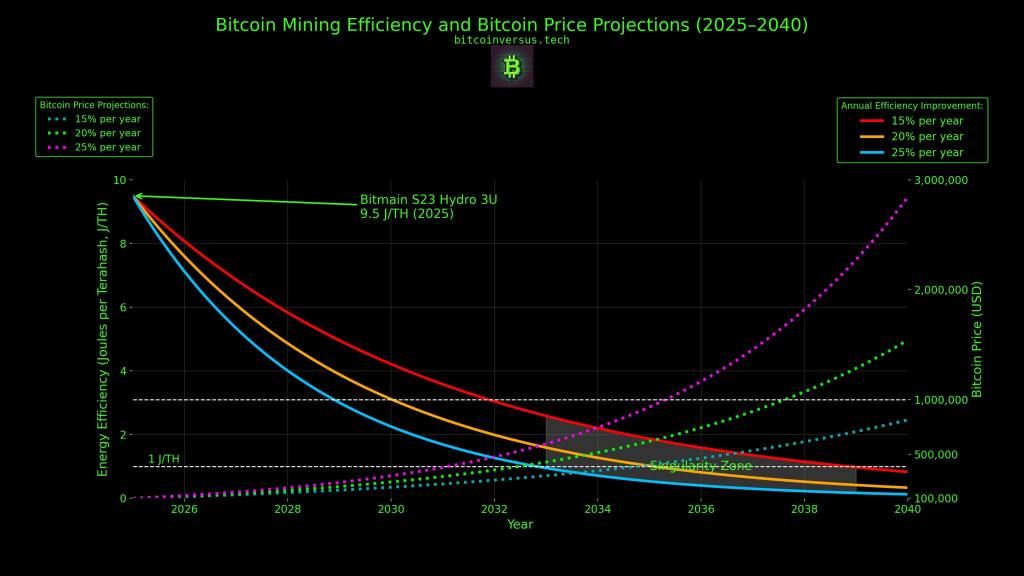
Using the Power Efficiency Index (PEI), two independent calculations measure Bitcoin’s technological progress between March 21, 2025, and September 21, 2026.
One evaluates total network hashrate, while the other measures advances in leading Bitcoin mining hardware. Both calculations provide efficiency-adjusted valuation benchmarks that can be compared with Bitcoin’s market price.
1. Bitcoin’s 18-Month Total Hashrate PEI
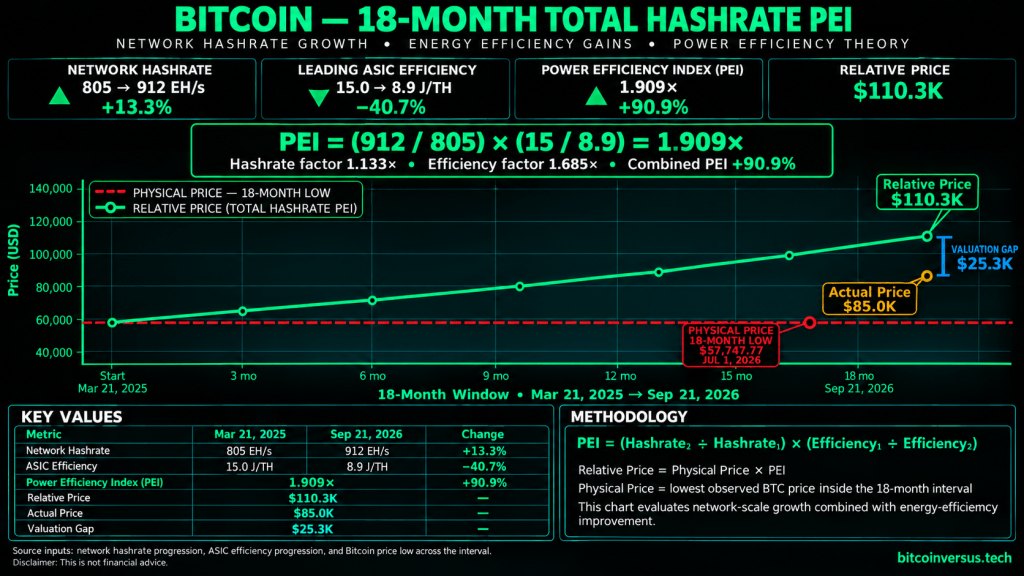
Over the selected 18-month period, Bitcoin’s network hashrate increased from 805 to 912 EH/s, representing 13.3% computational growth.
Using leading ASIC efficiency figures of 15 to 8.9 J/TH, Power Efficiency Theory calculates a Power Efficiency Index of 1.909×, representing a 90.9% increase. Applying the index to the selected Physical Price of $57,747.77 produces an efficiency-adjusted Relative Price of approximately $110,264.
Against the chart’s $85,000 market-price benchmark, the model identifies a valuation divergence of approximately $25,264. The calculation demonstrates how network expansion and improving energy efficiency can establish a quantitative reference for examining Bitcoin’s market valuation.
2. Bitcoin’s 18-Month Leading-Machine PEI
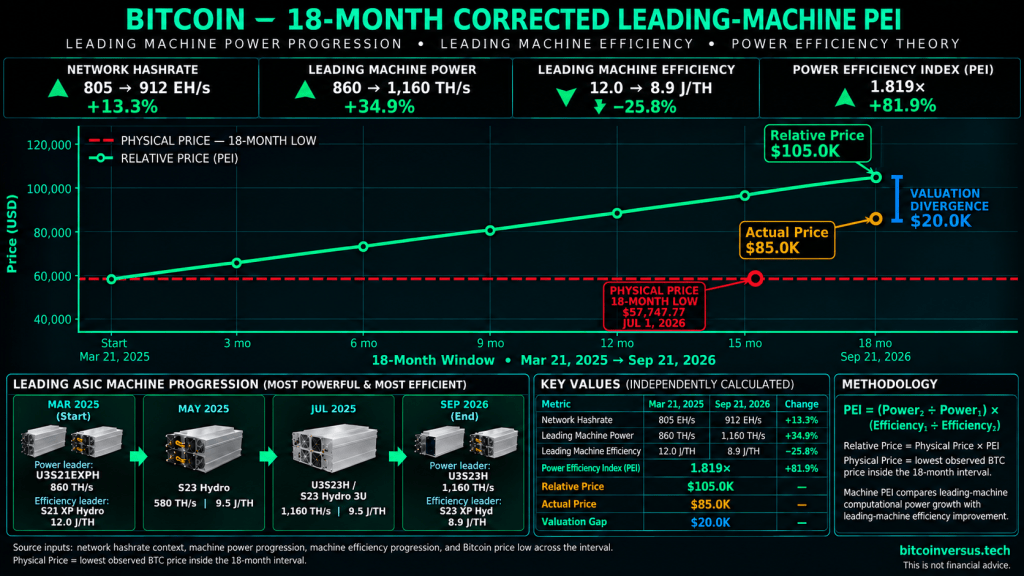
The second calculation examines technological advances in individual Bitcoin mining machines independently of total network expansion.
Leading ASIC computational performance increased from 860 to 1,160 TH/s, representing 34.9% growth. Independently, leading energy efficiency improved from 12 to 8.9 J/TH, reducing energy consumption per terahash by 25.8%. Combining both improvements produces a Power Efficiency Index of 1.819×, representing an 81.9% increase.
Applying the index to the same Physical Price of $57,747.77 produces an efficiency-adjusted Relative Price of approximately $105,023. Compared with the $85,000 market-price benchmark, the calculation identifies a valuation divergence of approximately $20,023.
The leading-machine methodology provides an additional perspective on Bitcoin’s underlying technological progress by separating hardware innovation from overall network growth.
BitcoinVersus.Tech Editor’s Note:
We volunteer daily to ensure the credibility of the information on this platform is Verifiably True. If you would like to support to help further secure the integrity of our research initiatives, please donate here: 3C9o19EH5HSiwEPyCTmEKzxhNCbo2X6TTb
BitcoinVersus.tech is not a financial advisor. This media platform reports on financial subjects purely for informational purposes.
Research disclaimer: Power Efficiency Theory is an experimental valuation framework. Both calculations use the selected input figures and price benchmarks. The resulting valuations do not establish fair market value or predict future prices. The intermediate chart trajectories are illustrative rather than independently calculated historical observations. Not financial advice.


Leave a Reply