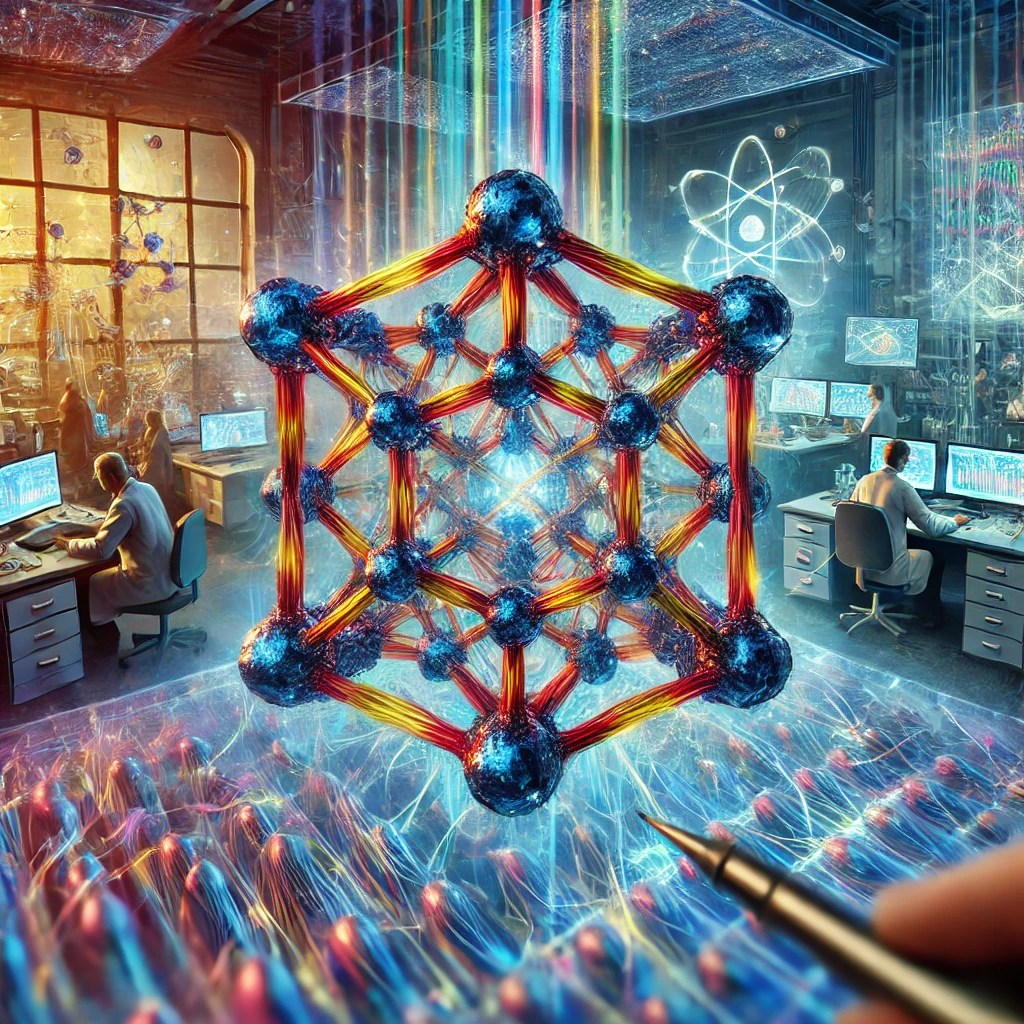
Researchers at MIT have developed a groundbreaking machine-learning framework designed to predict heat movement through semiconductors and insulators with unprecedented speed and accuracy. This innovation has the potential to revolutionize energy generation systems by addressing the inefficiency that results in approximately 70 percent of generated energy being lost as waste heat. By better understanding thermal properties of materials, engineers can significantly improve energy conservation and reduce carbon emissions.
The key to solving this problem lies in the complex behavior of phonons, the subatomic particles responsible for carrying heat. The phonon dispersion relation (PDR) describes the relationship between energy and momentum of phonons within a material’s crystal structure and is notoriously difficult to model. MIT’s new machine-learning framework predicts PDRs up to 1,000 times faster than existing AI techniques and up to 1 million times faster than traditional methods. This advancement is detailed in a paper published in the journal Nature Computational Science.
Mingda Li, an associate professor of nuclear science and engineering at MIT, highlighted the challenges in obtaining phonon properties computationally or experimentally, stating, “Phonons are the culprit for thermal loss, yet obtaining their properties is notoriously challenging, either computationally or experimentally.” To address this, the researchers developed a virtual node graph neural network (VGNN), which introduces flexible virtual nodes to the fixed crystal structure, enabling efficient prediction of phonon behaviors.
Abhijatmedhi Chotrattanapituk, a graduate student at MIT and co-author of the paper, explained the efficiency of this method: “The way we do this is very efficient in coding. You just generate a few more nodes in your GNN. The physical location doesn’t matter, and the real nodes don’t even know the virtual nodes are there.”
The VGNN can rapidly estimate phonon dispersion relations and offers slightly greater accuracy in predicting a material’s heat capacity. This efficiency allows for the calculation of phonon dispersion relations for thousands of materials within seconds on a personal computer, potentially accelerating the discovery of materials with superior thermal properties.
Looking ahead, the researchers plan to refine their technique, enhancing virtual nodes’ sensitivity to capture minute changes affecting phonon structures. “Graph nodes can be anything,” Li said. “And virtual nodes are a very generic approach you could use to predict a lot of high-dimensional quantities.”

 Bitcoin Versus
Leave a comment