
In a significant legal development, the New York Supreme Court has ruled in favor of Greenidge Generation Holdings Inc., allowing the cryptocurrency mining facility to continue operations at its Seneca Lake site.
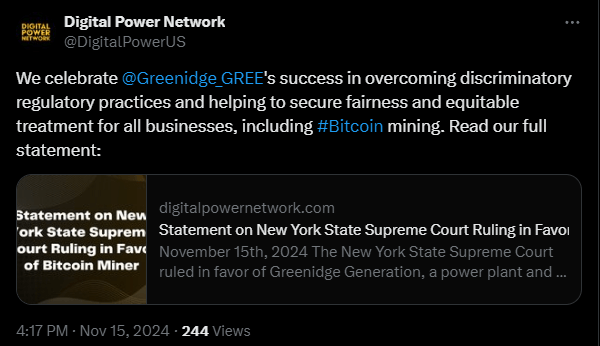
The court found that the New York State Department of Environmental Conservation (DEC) acted arbitrarily and capriciously in denying Greenidge’s air permit renewal, stating that the DEC’s decision lacked a rational basis under the state’s Climate Leadership and Community Protection Act (CLCPA).
Greenidge Generation, which operates a natural gas-fired power plant to fuel its bitcoin mining operations, had faced opposition from environmental groups concerned about greenhouse gas emissions and potential impacts on local ecosystems.
The DEC’s initial denial of the air permit was based on claims that the facility’s emissions were inconsistent with New York’s ambitious climate goals.
Judge Vincent M. Dinolfo’s ruling emphasized that while the DEC has the authority to deny permits under the CLCPA, it must provide a clear and justified rationale for such decisions. The court’s decision effectively annuls the DEC’s previous denial and remands the case back to the department for further proceedings, allowing Greenidge to maintain its operations in the interim.
Greenidge Generation welcomed the ruling, asserting that it operates in full compliance with state and federal laws and highlighting the economic benefits provided to the local community through job creation and energy contributions to the grid. The company also criticized the DEC’s actions as politically motivated and lacking legal foundation.
Environmental advocates, including groups like Earthjustice and Seneca Lake Guardian, expressed disappointment with the court’s decision, voicing concerns over the facility’s environmental impact and its alignment with the state’s climate objectives.
These organizations have pledged to continue their efforts to challenge Greenidge’s operations and advocate for stricter environmental oversight.
The case underscores the ongoing tension between economic development interests and environmental protection efforts, particularly in the context of emerging industries like cryptocurrency mining.
As New York continues to pursue its climate goals, the outcome of this legal battle may set a precedent for how similar cases are handled in the future.
BitcoinVersus.Tech Editor’s Note:
We volunteer daily to ensure the credibility of the information on this platform is Verifiably True.If you would like to support to help further secure the integrity of our research initiatives, please donate here
BitcoinVersus.tech is not a financial advisor. This media platform reports on financial subjects purely for informational purposes
 Bitcoin Versus
Leave a comment