In the context of embedded systems and hardware-level communication, UART, or Universal Asynchronous Receiver-Transmitter, is a fundamental protocol for serial data transfer.
It allows devices to communicate by transmitting data one bit at a time in a sequential fashion. Unlike synchronous protocols, UART does not rely on a shared clock signal but instead uses a system of start and stop bits to define the beginning and end of each data packet.
The protocol operates using dedicated transmit (TX) and receive (RX) lines, making it well-suited for simple, point-to-point communications between microcontrollers, sensors, or peripheral devices. Its widespread adoption stems from its simplicity and flexibility, often serving as the foundational communication layer for many embedded devices.
The Bitaxe mining device utilizes UART communication over a USB-C port to manage its firmware and mining operations. Instead of adhering to industrial protocols such as Modbus or SNMP, the Bitaxe employs a custom serial bootloader protocol developed by Espressif, the manufacturer of the ESP32 microcontroller embedded within the machine.
This proprietary protocol handles tasks such as firmware flashing and command-based control of the miner’s functionality. Utilities like bitaxetool and esptool, written in Python, serve as the interface layer for sending commands and firmware images.
However, it is important to note that while these tools are Python-based, Python itself is not the communication protocol.
The tools merely facilitate the transmission of binary data via UART to the ESP32, where the firmware interprets the incoming commands directly.
The simplicity of this UART-based system enables straightforward and efficient control of the Bitaxe hardware without introducing the complexity and overhead associated with more layered communication protocols. Commands can be transmitted and executed with minimal latency, allowing for effective real-time control, firmware updates, and diagnostics.
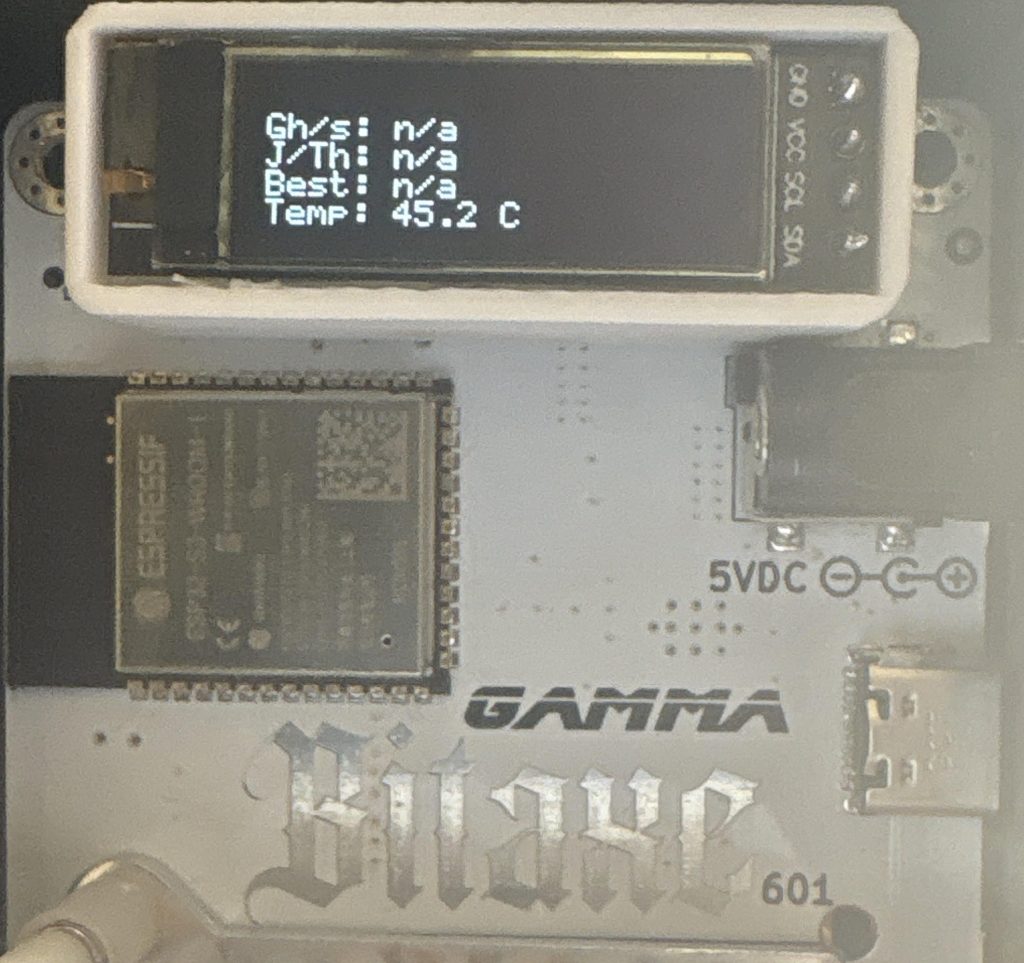
TROUBLESHOOTING THE “N/A” OR “–” on LED Screen.

In a troubleshooting scenario, such as when a Bitaxe machine displays a “n/a” or “–” status on the LED screen after a firmware update, the UART communication channel becomes essential for recovery.
A failed or incomplete firmware update may leave the device in an unresponsive or undefined state. Standard practice involves attempting a firmware upgrade to restore proper functionality.
If the issue persists, a full system reset, including a firmware rollback to the factory version, may be necessary.
This process would utilize the UART link, again through bitaxetool or esptool, to restore the firmware and configuration to default settings. Such methodologies demonstrate the critical role of UART communication in the maintenance and management of Bitcoin mining devices like the Bitaxe.

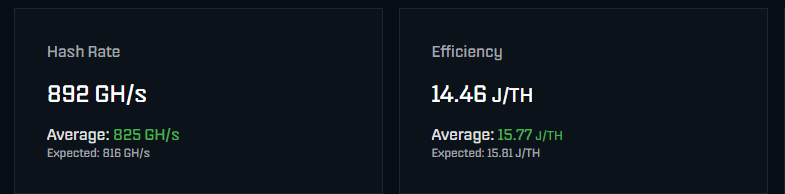
After performing the firmware update, the machine remained unable to hash, indicating that the issue was not resolved through a standard firmware upgrade alone. The effective solution involved manually adjusting the operational parameters by underclocking the device. By lowering both the voltage and frequency settings, the system was stabilized, allowing it to resume hashing properly.
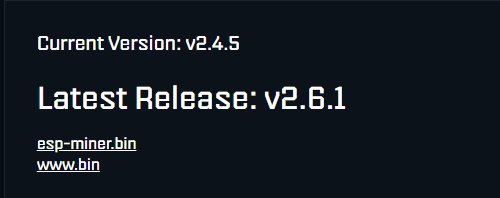
The recommended procedure is as follows:
Set the voltage to 400 and the frequency to 1000, applying these changes through the device’s configuration menu.

Once the settings are adjusted and saved, it is critical not to restart the machine immediately. Allowing the machine to continue operating without rebooting after saving these settings enables the changes to take full effect, restoring proper mining functionality.
This adjustment reduces the stress on the system, compensates for potential hardware inconsistencies or degradation, and has proven effective in restoring normal hashing performance on affected units.
(Editors Note: If that solution did not work for you, please provide another solution in the comments that may be possible. Thank you).
We volunteer daily to ensure the credibility of the information on this platform is Verifiably True. If you would like to support to help further secure the integrity of our research initiatives, please donate here
BitcoinVersus.tech is not a financial advisor. This media platform reports on financial subjects purely for informational purposes.
 Bitcoin Versus
Leave a comment