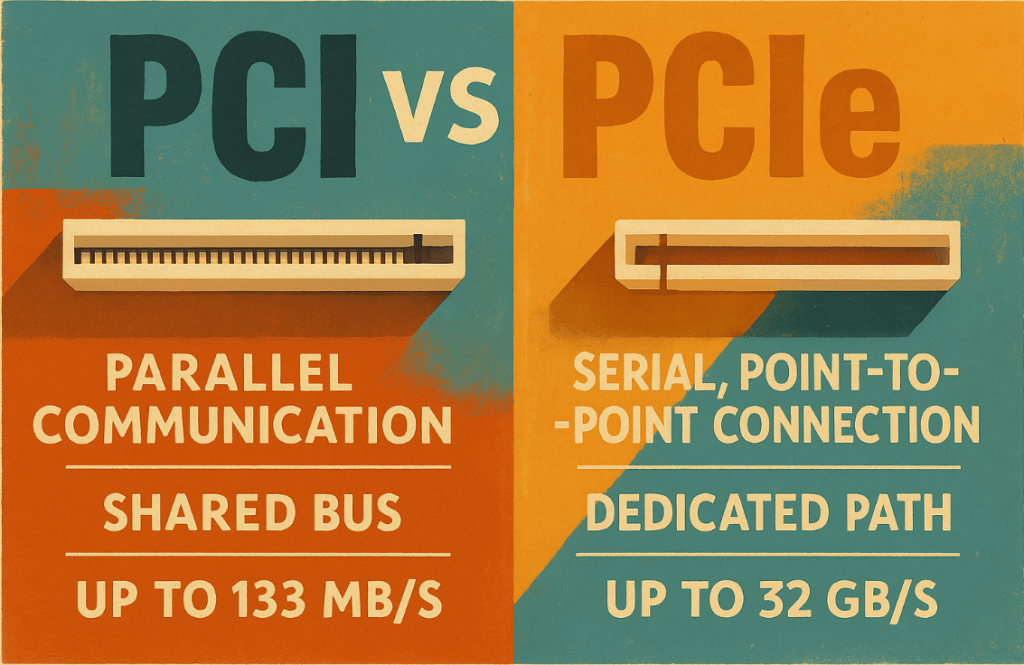
PCI (Peripheral Component Interconnect) and PCIe (PCI Express) are both expansion bus standards used to connect internal hardware components like network cards, sound cards, or GPUs to the motherboard—but their architectures and performance differ greatly.
PCI is a parallel communication interface introduced in the early 1990s, capable of transferring data at speeds up to 133 MB/s using a shared bus. Devices on a PCI bus compete for bandwidth, which can lead to bottlenecks.
PCI slots are physically wider and typically support older or legacy hardware in older desktop systems.
In contrast, PCIe uses a serial, point-to-point connection that eliminates bandwidth sharing and dramatically improves performance.
Each PCIe device has a direct path to the CPU or chipset, using lanes (x1, x4, x8, x16) to scale bandwidth up to 32 GB/s in modern x16 slots.
PCIe slots are common in modern desktops and are essential for high-performance devices like graphics cards, NVMe storage, and high-speed network adapters.
Technicians must know how to identify slot types and understand the backward compatibility of PCIe lanes and versions for successful component installation and upgrade planning.
BitcoinVersus.Tech Editor’s Note:
We volunteer daily to ensure the credibility of the information on this platform is Verifiably True. If you would like to support to help further secure the integrity of our research initiatives, please donate here
BitcoinVersus.tech is not a financial advisor. This media platform reports on financial subjects purely for informational purposes.
 Bitcoin Versus
Leave a comment