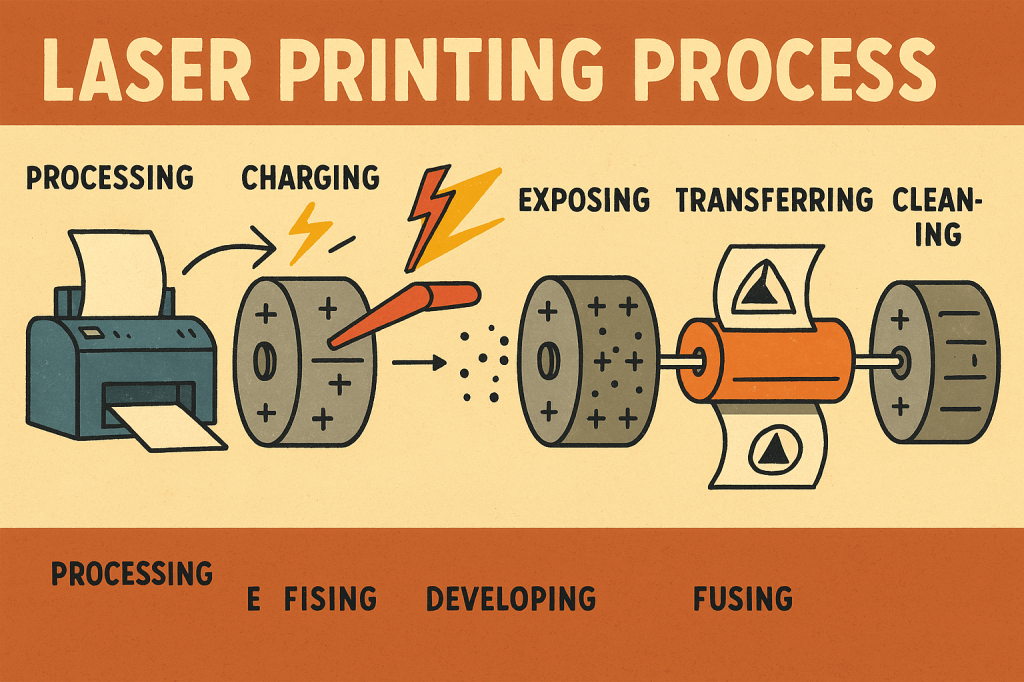
The laser printing process is a precise, multi-step method that relies on electrostatics, heat, and toner to produce high-quality prints quickly and efficiently.
It begins with the processing stage, where the printer receives the data from the computer and organizes it into printable instructions.
In the charging phase, a primary corona wire or roller applies a uniform negative charge across the surface of the photosensitive drum.
The exposing stage follows, where a laser beam selectively discharges areas of the drum to form the latent image by altering the charge in the pattern of the print job.
Next, during the developing stage, toner particles (which carry a negative charge) are attracted to the discharged areas of the drum, adhering only where the laser has written.
The transferring stage involves moving the toner from the drum to the paper, which is positively charged by a transfer corona or roller to attract the negatively charged toner.
In the fusing stage, a heated roller melts and presses the toner into the paper fibers, creating a permanent image.
The final cleaning stage wipes residual toner off the drum and resets its charge, preparing it for the next page. Technicians studying for the CompTIA A+ Core 1 exam must understand these stages not only to troubleshoot print issues, but also to maintain drum units, fusers, and toner cartridges effectively.
BitcoinVersus.Tech Editor’s Note:
We volunteer daily to ensure the credibility of the information on this platform is Verifiably True. If you would like to support to help further secure the integrity of our research initiatives, please donate here
BitcoinVersus.tech is not a financial advisor. This media platform reports on financial subjects purely for informational purposes.
 Bitcoin Versus
Leave a comment