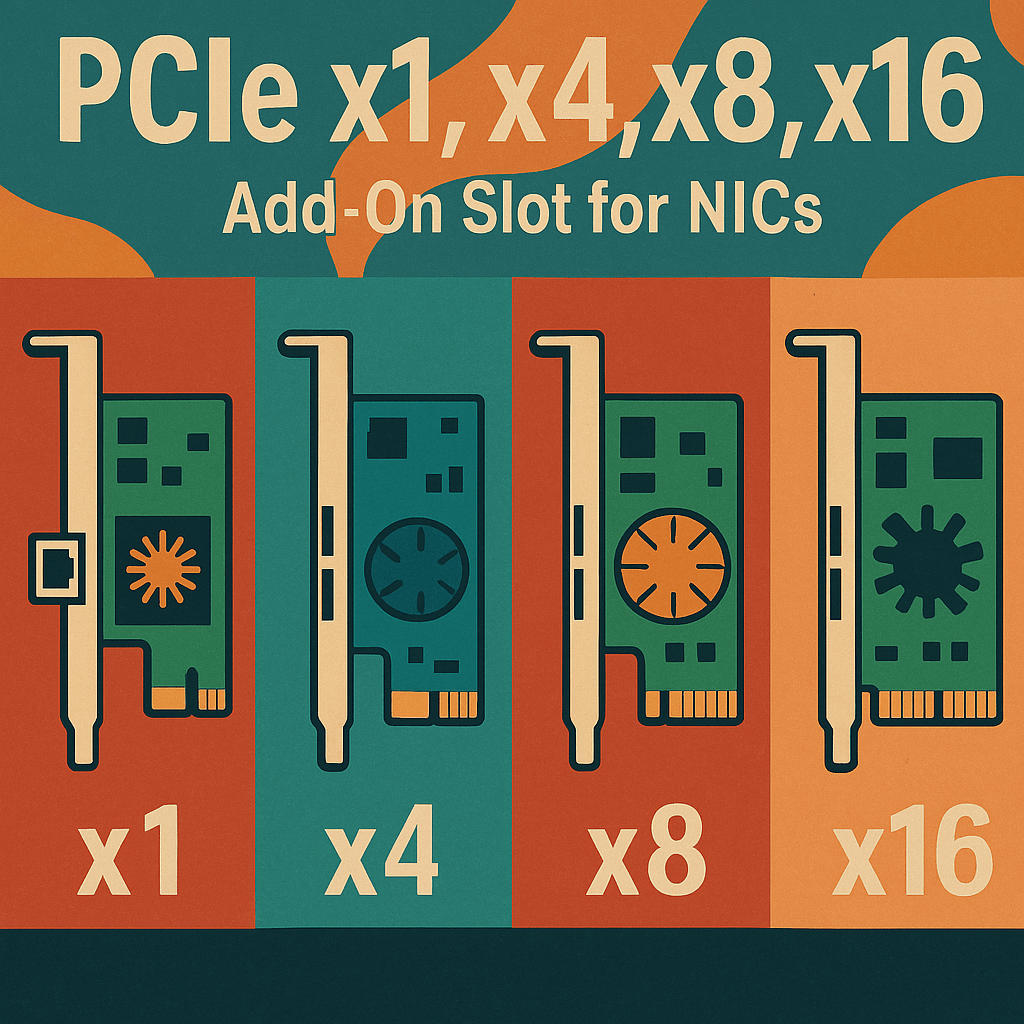
PCI Express (PCIe) is the industry-standard high-speed interface used to connect add-on components—like network interface cards (NICs)—to a computer’s motherboard.
For NICs, PCIe offers dedicated data lanes to the CPU or chipset, ensuring low-latency, high-throughput, and scalable bandwidth. PCIe slots are designated by their lane count: x1, x4, x8, and x16.
Each lane consists of two differential signal pairs (one for sending, one for receiving), allowing data to flow bidirectionally and simultaneously.
A PCIe x1 NIC uses just one lane, making it ideal for standard Ethernet or wireless NICs with lower bandwidth needs. These cards are small, energy-efficient, and often seen in basic desktops.
Larger slots like x4 and x8 offer more lanes and are used for multi-port NICs or fiber-based 10GbE cards that demand higher data throughput. PCIe x16 slots, while typically used for GPUs, are sometimes repurposed for enterprise-grade NICs that need extreme bandwidth—such as dual 25GbE adapters or multi-channel fiber cards in servers or virtualization environments.
All PCIe slots are backward and forward compatible, meaning a x1 card will fit into a x4, x8, or x16 slot and work correctly (at x1 speed).
BitcoinVersus.Tech Editor’s Note:
We volunteer daily to ensure the credibility of the information on this platform is Verifiably True. If you would like to support to help further secure the integrity of our research initiatives, please donate here
BitcoinVersus.tech is not a financial advisor. This media platform reports on financial subjects purely for informational purposes.
 Bitcoin Versus
Leave a comment