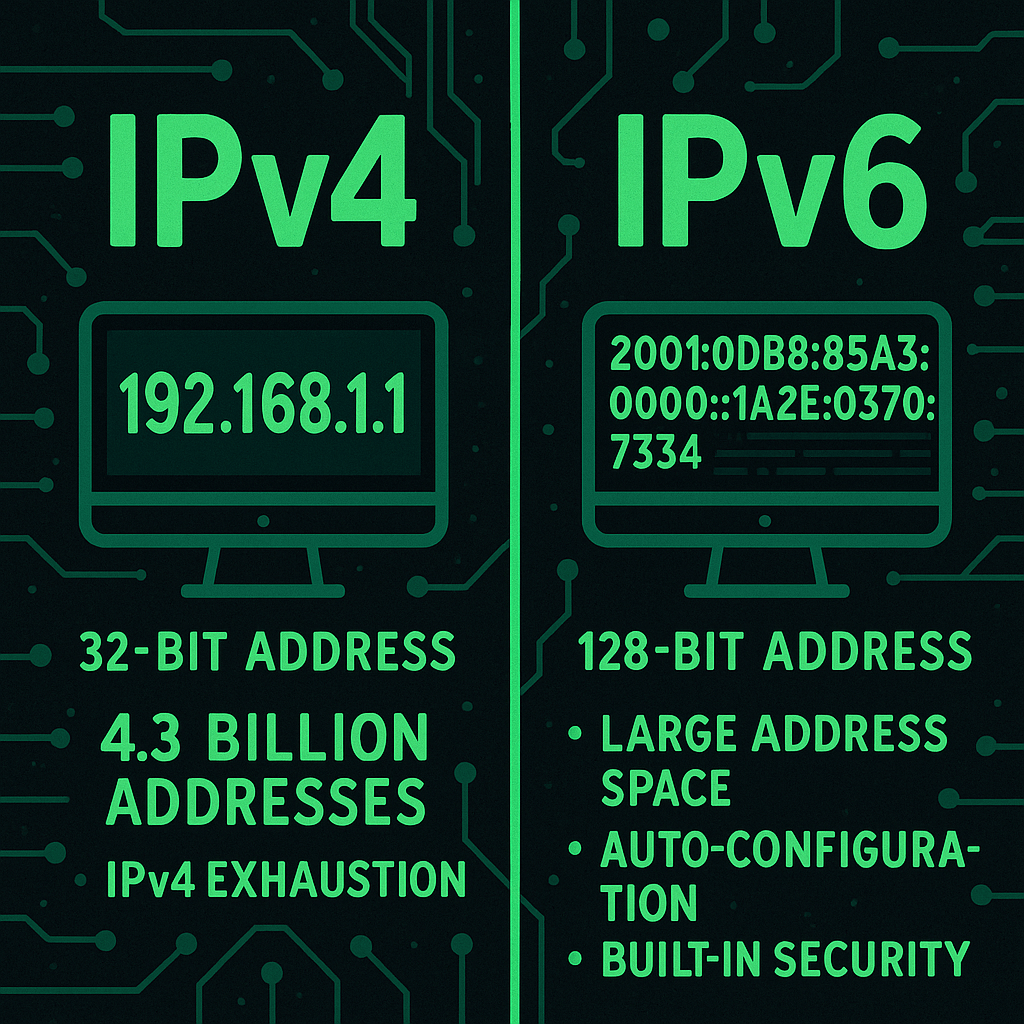
IPv4 (Internet Protocol version 4) is the fourth version of the IP protocol and remains the most widely used standard for assigning IP addresses on the internet and private networks. It uses a 32-bit addressing scheme, represented in dotted decimal format (e.g., 192.168.1.1), which provides approximately 4.3 billion unique addresses.
Due to the limited pool of IPv4 addresses, techniques like NAT (Network Address Translation) and CIDR (Classless Inter-Domain Routing) were implemented to conserve space and optimize routing. IPv4 is easy to implement and widely supported, but it faces ongoing limitations due to address exhaustion and growing device connectivity.
IPv6 (Internet Protocol version 6) was developed to address IPv4’s limitations by introducing a 128-bit address format, allowing for 340 undecillion unique addresses—more than enough to support the future of IoT and global networking.
IPv6 addresses are written in hexadecimal notation and separated by colons (e.g., 2001:0db8:85a3::8a2e:0370:7334). Unlike IPv4, IPv6 natively supports auto-configuration, multicast, and improved security with IPsec. It eliminates the need for NAT, streamlining end-to-end connectivity. Transition technologies such as dual stack and tunneling help bridge IPv4 and IPv6 environments during the global transition to IPv6 infrastructure.
BitcoinVersus.Tech Editor’s Note:
We volunteer daily to ensure the credibility of the information on this platform is Verifiably True. If you would like to support to help further secure the integrity of our research initiatives, please donate here
BitcoinVersus.tech is not a financial advisor. This media platform reports on financial subjects purely for informational purposes.
 Bitcoin Versus
Leave a comment