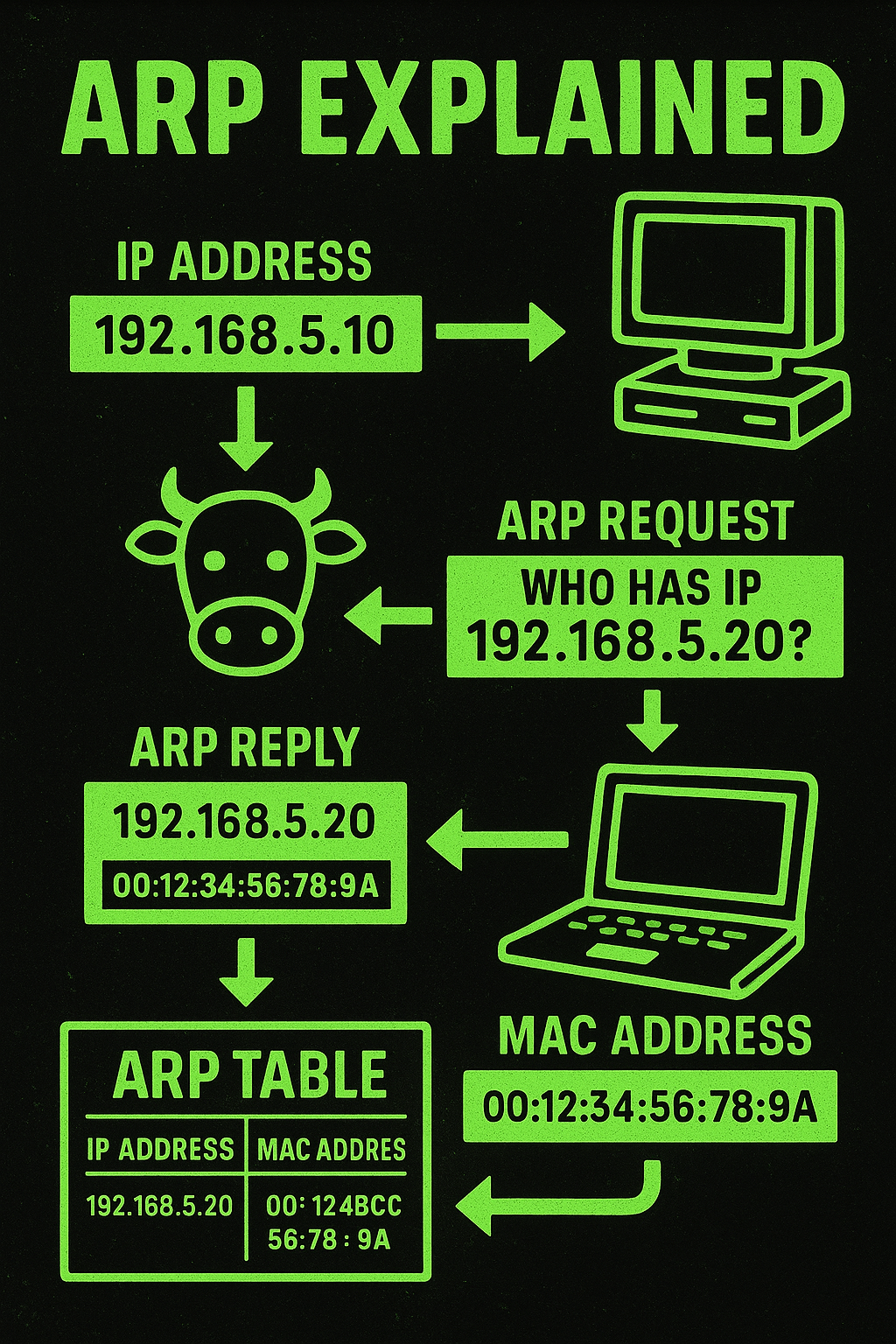
ARP (Address Resolution Protocol) is a Layer 2 protocol used to map a known IPv4 address to its corresponding MAC address on a local network segment.
When a device wants to communicate with another IP on the same subnet, it broadcasts an ARP Request to ask, “Who has this IP?” The device with the matching IP responds with an ARP Reply, revealing its MAC address.
The requesting device then stores this mapping in its ARP table (cache), allowing direct communication at the data link layer without repeated broadcasts. ARP is essential for enabling IP-based devices to communicate over Ethernet and other MAC-addressed networks.
Although critical, ARP is inherently insecure and unverified, making it a potential target for spoofing attacks such as man-in-the-middle (MITM) tactics, where an attacker sends false ARP responses to redirect traffic.
Tools like arp -a (Windows) or ip neighbor (Linux) allow technicians to view or clear the ARP cache when troubleshooting network issues.
ARP does not operate in IPv6 networks; instead, Neighbor Discovery Protocol (NDP) performs a similar function. Understanding ARP’s role in resolving IP to MAC, especially in local segments, helps diagnose issues like unreachable devices, duplicate IPs, or unexpected network slowdowns.
BitcoinVersus.Tech Editor’s Note:
We volunteer daily to ensure the credibility of the information on this platform is Verifiably True. If you would like to support to help further secure the integrity of our research initiatives, please donate here
BitcoinVersus.tech is not a financial advisor. This media platform reports on financial subjects purely for informational purposes.
 Bitcoin Versus
Leave a comment