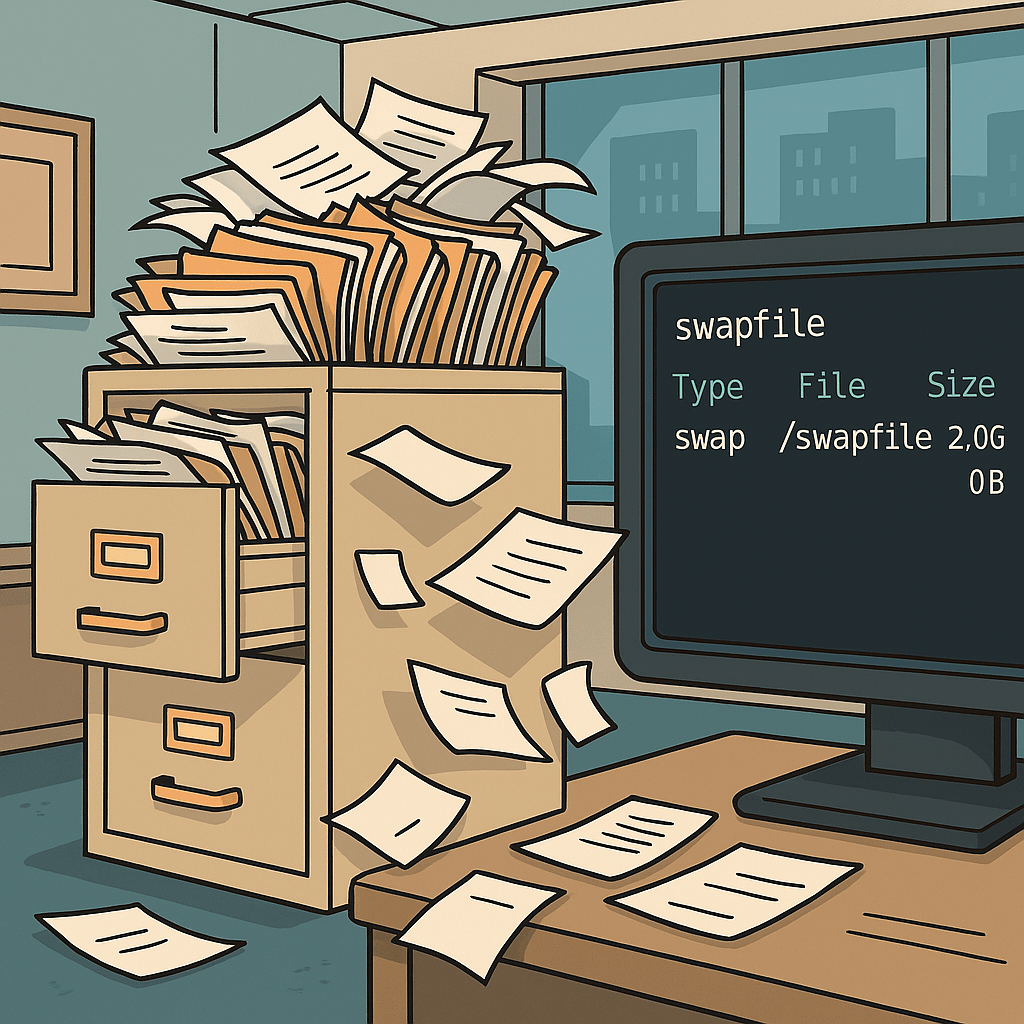
A swap file in Linux is a special file on the disk that acts as virtual memory when the system’s physical RAM becomes full.
Instead of immediately failing or killing processes when memory runs low, the kernel moves less-used data from RAM into the swap file to free up space for active applications.
This ensures system stability and performance under heavy workloads, particularly on systems with limited RAM.
The swap file functions similarly to a swap partition, but it exists as a regular file within the file system and is often easier to resize or relocate.
While a swap file provides extended memory, it operates significantly slower than RAM due to disk latency.
It’s generally recommended as a backup resource, not a substitute for physical memory.
The kernel’s swappiness setting determines how aggressively the system uses the swap space, balancing performance and responsiveness.
Swap files are created using commands like fallocate or dd, and activated with mkswap and swapon, integrating seamlessly with the system’s memory management tools.
BitcoinVersus.Tech Editor’s Note:
We volunteer daily to ensure the credibility of the information on this platform is Verifiably True. If you would like to support to help further secure the integrity of our research initiatives, please donate here
BitcoinVersus.tech is not a financial advisor. This media platform reports on financial subjects purely for informational purposes.
 Bitcoin Versus
Leave a comment