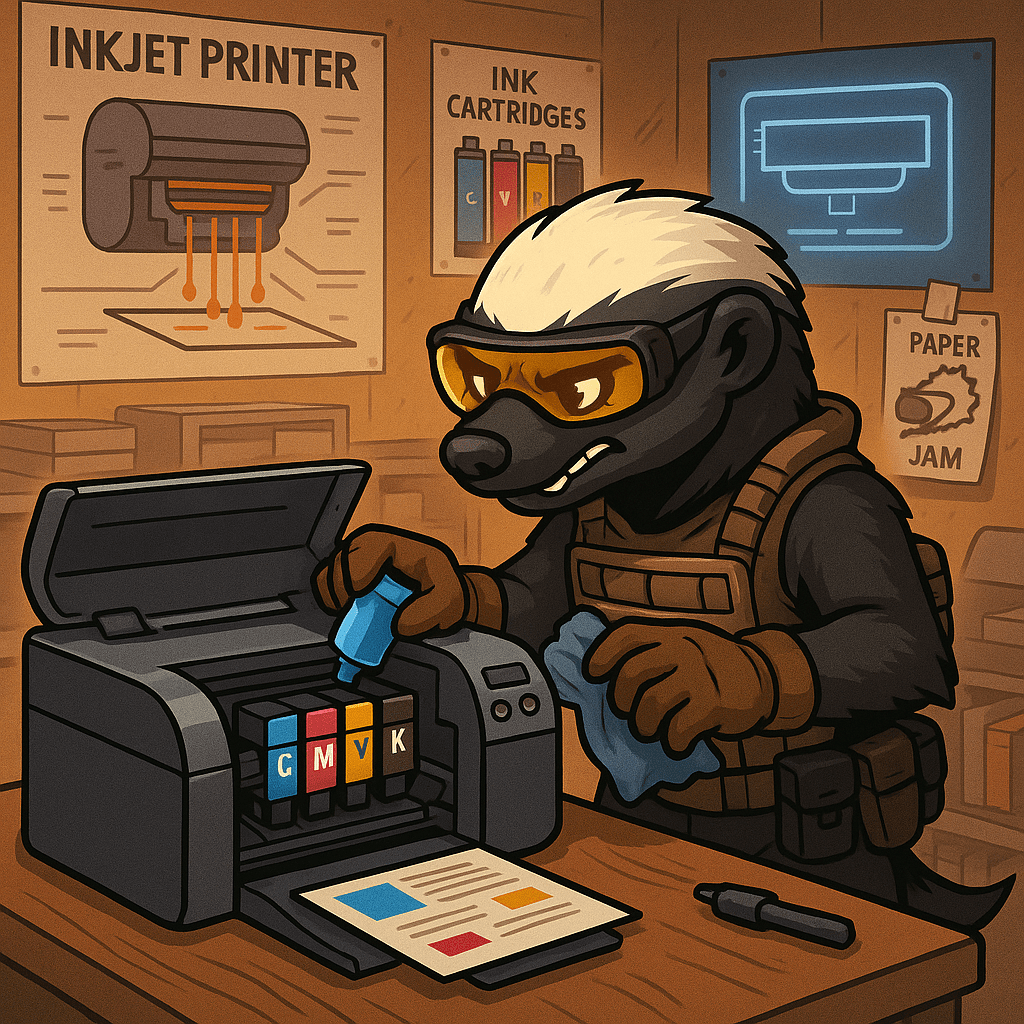
Inkjet printers are among the most common types of consumer and small office printers, known for their ability to produce detailed color images and sharp text on a variety of media.
They function by spraying tiny droplets of ink directly onto paper through nozzles in the printhead. These droplets are controlled with extreme precision, often measured in picoliters, allowing inkjets to handle complex photo printing as well as everyday document output.
Inkjet printers use either thermal bubble technology—where heat causes ink to expand and form a bubble that pushes through the nozzle—or piezoelectric crystals, which change shape to release ink without heat.
The two primary consumables are ink cartridges and printheads, which may be built into the cartridges or as part of the printer itself.
Users must replace these components periodically, especially when quality declines or prints appear streaky or incomplete.
From a configuration standpoint, inkjet printers are often plug-and-play but may require driver installation, Wi-Fi setup, and optional mobile print services such as AirPrint or Google Cloud Print.
Technicians should be familiar with aligning printheads, cleaning cycles (software-controlled), and resolving common issues like clogged nozzles, misfeeds, or paper jams.
BitcoinVersus.Tech Editor’s Note:
We volunteer daily to ensure the credibility of the information on this platform is Verifiably True. If you would like to support to help further secure the integrity of our research initiatives, please donate here
BitcoinVersus.tech is not a financial advisor. This media platform reports on financial subjects purely for informational purposes.
 Bitcoin Versus
Leave a comment