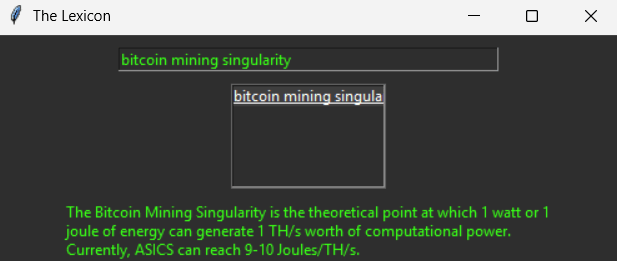
This study proposes a new theoretical framework: the Bitcoin Mining Singularity, defined as the point at which one joule of energy yields one terahash per second (1 J/TH) of cryptographic computation.
This convergence of energy efficiency and computational output in Bitcoin mining represents a potential milestone in the global evolution of post-industrial labor, energy monetization, and distributed digital infrastructure.
Anchored in historical ASIC efficiency improvements, the concept is evaluated within the philosophical and empirical predictions of Bill Gates and Ray Kurzweil.
I argue that the Bitcoin Mining Singularity, projected to occur by 2036, is not speculative futurism but a measurable trajectory embedded in hardware engineering.
Introduction
Bitcoin mining transforms energy into value via the SHA-256 hashing algorithm, producing mathematically verifiable proof-of-work (PoW). The central unit of mining output is the terahash per second (TH/s), while the resource cost is energy, measured in joules.
As machines increase in efficiency, fewer joules are required to generate each unit of hashpower.
The Bitcoin Mining Singularity is the conceptual inflection point where 1 joule = 1 TH/s, collapsing the energy-to-output ratio into a near-symmetrical relationship.
This scenario reflects a world in which computational work is no longer constrained by bottlenecks in energy loss but optimized to a thermodynamic limit. The implications are profound: power becomes currency.
Empirical Efficiency Trends in ASIC Development
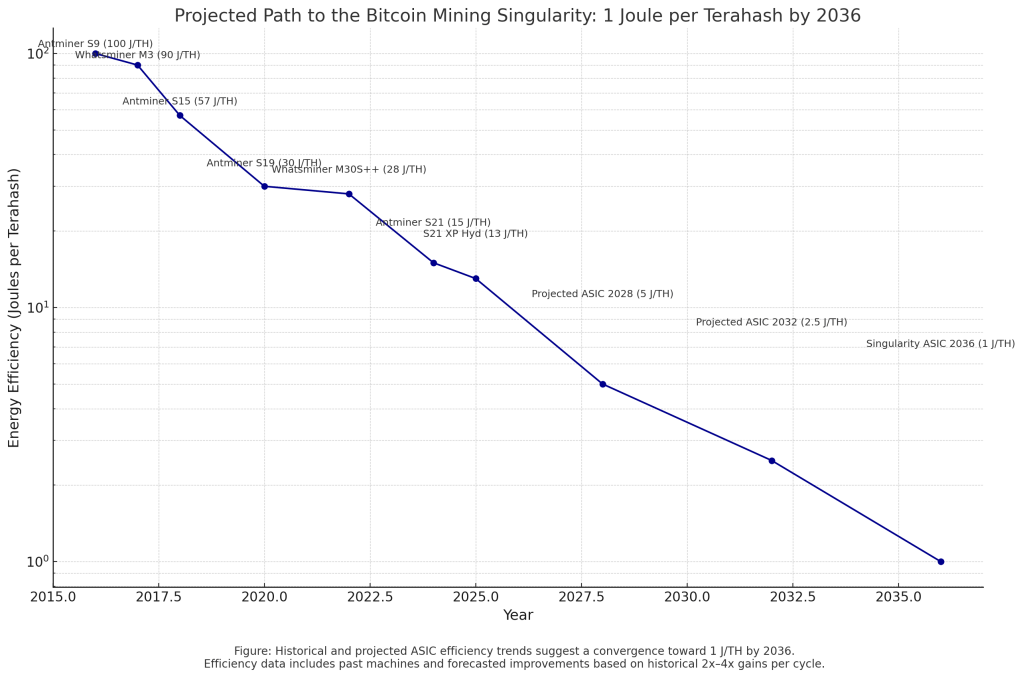
From 2016 to 2025, Bitcoin mining hardware has followed an exponential decline in joules per terahash, consistent with nonlinear engineering returns. The figure below illustrates key machine generations and their respective efficiencies:
| Year | ASIC Model | Energy Efficiency (J/TH) |
|---|---|---|
| 2016 | Antminer S9 | 100 |
| 2017 | Whatsminer M3 | 90 |
| 2018 | Antminer S15 | 57 |
| 2020 | Antminer S19 | 30 |
| 2022 | Whatsminer M30S++ | 28 |
| 2024 | Antminer S21 | 15 |
| 2025 | S21 XP Hyd | 13 |
| 2025 | SealMiner A3 | 9.7 |
| 2028 | Projected ASIC | 5 |
| 2032 | Projected ASIC | 2 |
| 2036 | Singularity Projection | 1 |
Predicting the Bitcoin Mining Singularity
The Bitcoin Mining Singularity—the theoretical point where one joule of energy produces one terahash per second (1 J/TH) — could arrive sooner than estimated.
My initial projections were based on 10–15% annual efficiency gains placed the Singularity between 2036 and 2039.
However, with the introduction of the Seal 03 miner in 2025, which is reported to reach 9.7 J/TH, the pace has accelerated dramatically. This marks a 28% improvement over the S21 XP (13.5 J/TH in 2024), achieved in less than a year.
Using this sharper trend, and assuming continued annual gains in the 25–30% range, the 1 J/TH milestone is expected by 2033.
This prediction is grounded in over a decade of real hardware data, where each generation of ASIC miners consistently reduces energy use while increasing hash output.
From the Antminer S9 in 2016 to the S21 Pro and S21 XP in 2024, the pattern has been measurable and compounding. The leap made by the Sealminer A3 confirms that this trend is accelerating.

Figure 3: This chart tracks the evolution of ASIC efficiency from 2000 W/TH in 2013 to just 13.5 W/TH in 2024. Early models saw dramatic year-over-year efficiency improvements exceeding 60%, while recent gains have narrowed to under 15%. The tapering trend supports the theory of Thermoeconomic Capitulation, as exponential improvements begin to encounter physical and economic limits. Image Source: Blockware
Theoretical Basis: Kurzweil and Gates as Structural Validators
Ray Kurzweil, in his Law of Accelerating Returns, asserts that computational efficiency improves on an exponential scale, guided by iterative design, feedback loops, and material innovation.
This model supports the Bitcoin Mining Singularity by projecting nonlinear scaling in performance-per-watt, particularly under conditions of global demand and hardware competition.
Bill Gates, in public commentary, has predicted a shift to a two-day workweek within decades due to hyperautomation. Central to this vision is the decoupling of income from labor and the rise of universal basic income (UBI) frameworks.
In this light, Bitcoin mining represents a form of sovereign UBI—where energy owners monetize computation directly, without institutional redistribution.
Material and Architectural Projections
The leap to 1 J/TH requires material and design shifts beyond traditional silicon:
- Graphene, Gallium Nitride (GaN), or carbon nanotube architectures to reduce resistance and heat.
- Photonic logic circuits to increase cycle efficiency through light-based gates.
- 3D stacked die arrays to minimize interconnect loss and spatial energy waste.
- Embedded AI on-chip regulation for dynamic workload optimization.
- Thermal recapture integration, allowing waste heat to power auxiliary systems.
These advancements, while experimental today, mirror historical transitions in semiconductor development.
Theory or Law?
You can imagine The Bitcoin Mining Singularity as a forecast grounded in empirical engineering patterns with subsequent validation from similar futurist frameworks.
As with Moore’s Law or the Carnot efficiency limit, it outlines a boundary condition—one we are approaching not by accident, but by design.
In sum, the singularity forecast is:
- Scientific: Derivable from hardware data and thermodynamic laws
- Economic: Redefines value as energy-directed effort
- Inevitable: If trends continue, it is not a question of if, but when
By 2036, the miner may no longer be a machine. It may be an embedded economic node. And energy itself, properly directed, will be indistinguishable from income.
Additional ASIC Use Cases
At the level of 1 joule per terahash, the Bitcoin mining chip transforms from a single-purpose machine into a modular energy tool. Even at peak efficiency, the chip will still generate heat—a byproduct of computation that doesn’t disappear, only reduces.
But instead of routing that heat toward oversized projects like hot tubs or boiler rooms, future applications may become more precise and personal.
The same chip could be embedded into heated jackets, gloves, or even the seat of an electric vehicle, providing localized warmth while mining Bitcoin in the background.
Because the energy is already accounted for in the mining process, any secondary use of its heat becomes added value with no additional cost. In that world, Bitcoin miners won’t just be earning through hashpower—they’ll be powering adjacent systems, solving two problems at once: energy monetization and micro-scale heat delivery.
Final Thoughts
The Bitcoin Mining Singularity points to a future where mining becomes as efficient as physics allows—one joule of energy producing one terahash of power.
As chips reach this level, they won’t just create Bitcoin more efficiently; they’ll open the door to new uses for their heat output, like warming clothing or powering smart devices.
This shift could turn mining into a broader energy solution, making it both a financial tool and a practical part of everyday life.
BitcoinVersus.Tech Editor’s Note:
We volunteer daily to ensure the credibility of the information on this platform is Verifiably True. If you would like to support to help further secure the integrity of our research initiatives, please donate here
BitcoinVersus.tech is not a financial advisor. This media platform reports on financial subjects purely for informational purposes.
 Bitcoin Versus
Leave a comment