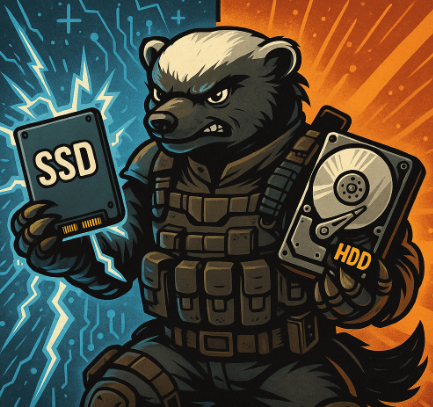
What Is an SSD?
A Solid-State Drive (SSD) uses flash memory chips to store data.
There are no moving parts, making it faster, quieter, and more durable than traditional hard drives.
SSDs have extremely fast read/write speeds, especially in NVMe (PCIe) form, which are ideal for boot drives, gaming systems, and business apps.
SSDs come in different interfaces:
- SATA SSDs – Slower but compatible with older systems.
- NVMe SSDs – Use PCIe lanes, offering speeds above 3000 MB/s.
- M.2 and U.2 – Compact formats for modern systems.
What Is an HDD?
A Hard Disk Drive (HDD) uses spinning magnetic platters and a moving read/write arm. It’s slower, but cost-effective for large storage needs.
Common capacities range from 500GB to 12TB, and they’re still used for backups, surveillance systems, and cold data storage.
HDDs are more prone to mechanical failure due to moving parts and typically have slower boot times and file transfers.
BitcoinVersus.Tech Editor’s Note:
We volunteer daily to ensure the credibility of the information on this platform is Verifiably True. If you would like to support to help further secure the integrity of our research initiatives, please donate here
BitcoinVersus.tech is not a financial advisor. This media platform reports on financial subjects purely for informational purposes.
 Bitcoin Versus
Leave a comment