“I want to know how God created this world. I’m not interested in this or that phenomenon, in the spectrum of this or that element. I want to know His thoughts; the rest are just details.”
– Albert Einstein, Theoretical Physicist
In the complex relationship between faith and science, we often discover that they are not as opposed as they may seem. Science ultimately needs an immaculate source of inspiration.
Conversely, faith is not devoid of reason; it encompasses a deep, methodical exploration of beliefs and the principles that guide them.
Just as the Bible has been subject to countless interpretations throughout history, from being a tool of salvation to a means of control, so too has Bitcoin sparked a wide array of perspectives.
Some see Bitcoin as the future of money – a decentralized currency that challenges the status quo.
Others view Bitcoin as a digital store of value, akin to gold in its ability to preserve wealth. Still, others argue that Bitcoin represents a deeper, biological expression of human power dynamics, evolving with our need for control and influence.
The multiplicity of interpretations, whether of a sacred text or a novel financial asset, underscores a fundamental truth: the ability to ascribe different meanings and uses to a single entity or protocol is a powerful testament to human creativity and adaptability.
This interpretive flexibility not only enriches our understanding but also enhances the intrinsic value of the entity itself.
The relationship between authority, interpretation, and the dissemination of information has been a central theme throughout history, particularly within religious and economic contexts.
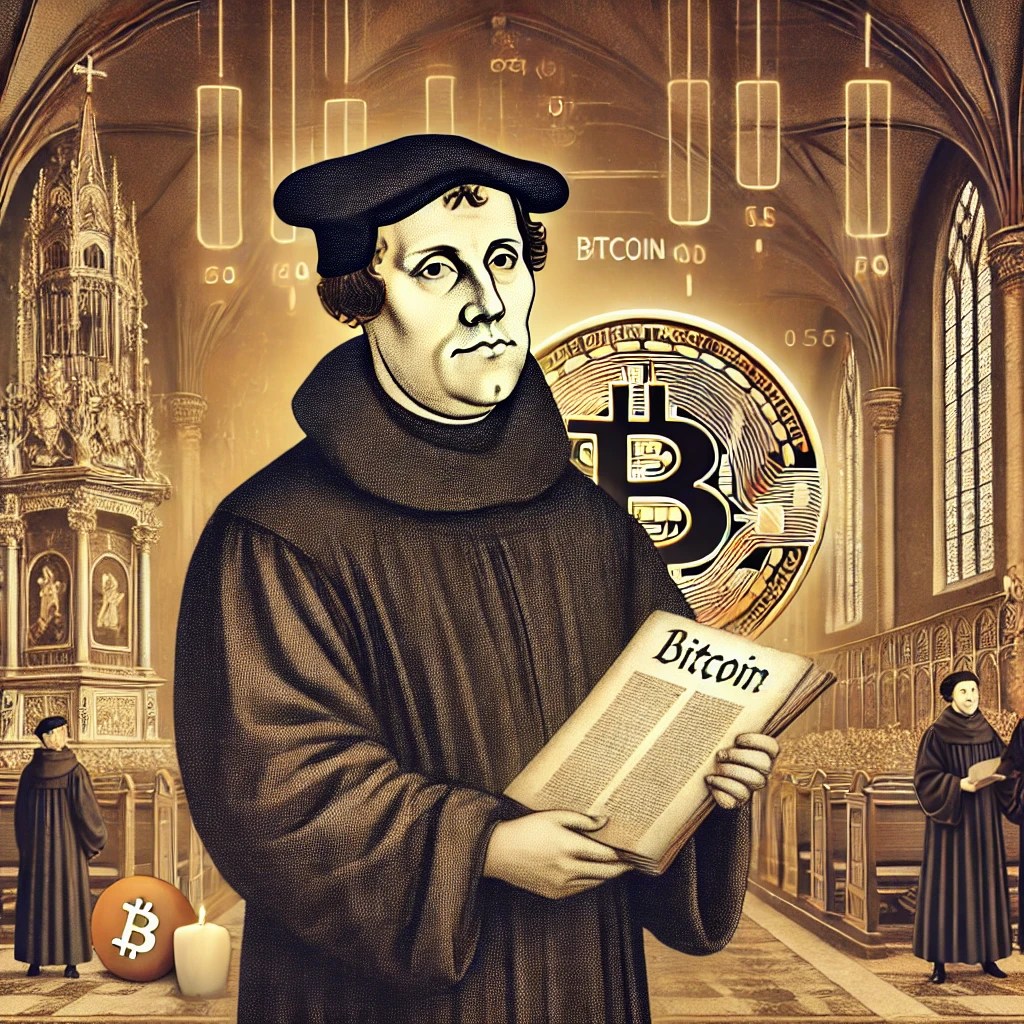
This theme is vividly illustrated through the comparison of the evolution of biblical interpretation in Christianity and the development of financial systems, especially with the recent creation of Bitcoin.
Before the Reformation, the interpretation of Christian scriptures was tightly controlled by the clergy. Members of the church relied on priests and the church hierarchy to interpret the Bible, often without direct access to the scriptures themselves. This system allowed for a certain degree of manipulation and control over religious teachings and practices.
‘Sola Fide‘: A Brief Historicity OF Faith in the Modern Christian Church
Martin Luther’s theology, particularly his doctrine of justification by faith alone, was profoundly influenced by his study of the Bible, especially the writings of the Apostle Paul. It was Paul’s letters that deeply shaped Luther’s views.
“For therein is the righteousness of God revealed from faith to faith: as it is written, The just shall live by faith”
– Romans 1:17 (KJV)
Martin Luther’s transformation began through his intensive study of these Pauline epistles, particularly during his lectures on Romans and Galatians at the University of Wittenberg.
It was through this academic environment that Luther developed his critique of the Catholic Church’s teachings on works and indulgences, ultimately leading to his Reformation efforts.
Luther found solace in the idea that righteousness is a gift from God, received through faith. This realization marked a turning point in his spiritual journey, setting the stage for his later reforms and his famous 95 Theses.
In his 95 Theses, Martin Luther argued that true repentance, as required by Christ, involves a sincere inner change rather than just performing outward rituals like confession. He was critical of indulgences because they led people to believe they could buy forgiveness, which he felt undermined genuine repentance.
Luther also noted that this focus on indulgences made people less likely to do good deeds, like helping the poor, because they thought purchasing indulgences was more spiritually valuable than acts of charity.
This movement emphasized the idea that every believer had the right and responsibility to read and interpret the Bible for themselves, challenging the church’s monopoly over biblical interpretation and heralding a democratization of religious knowledge.
Bitcoin is The Next-gen Reformation
The financial world has also seen its own form of reformation with the emergence of Bitcoin and other cryptocurrencies. Traditionally, the financial sector was dominated by banks and financial experts, who possessed exclusive knowledge and control over the monetary system. This system, much like the pre-Reformation church, was susceptible to manipulation and served the interests of a powerful few.
In my formative years, I can recount the endless lines at the gas pumps during the Financial Crisis of 2008. There was certainly a lot of anger and negative sentiment toward the bank bailout.
A myriad of factors, including predatory lending practices targeting low-income homebuyers through subprime mortgages, excessive risk-taking by global financial institutions, and the accumulation of toxic assets within banks, led to a catastrophic collapse. This “perfect storm” culminated in the bursting of the United States housing bubble, sparking the Great Recession.
One of the most significant contributors to the crisis was the rapid proliferation of predatory financial products that targeted low-income, low-information homebuyers, many of whom were racial minorities. This development in the financial markets went largely unchecked by regulators, catching the U.S. government off guard when the crisis unfolded.
In response to the 2007-2008 financial crisis, Satoshi Nakamoto introduced Bitcoin, with the Genesis Block of Bitcoin’s blockchain containing a hidden message: “The Times 03/Jan/2009 Chancellor on brink of second bailout for banks.”
This message underscored Nakamoto’s reaction to the crisis, highlighting Bitcoin’s intention to offer an alternative to the traditional financial system that had shown itself to be vulnerable and prone to corruption.
Financial Corruption is Apart of Our History
Even further, The historical parallel between the traditional financial system and the pre-Reformation Church is illustrated by the story of the Freedman’s Savings and Trust Company, commonly known as the Freedman’s Bank.
The bank was ultimately sabotaged by a powerful few who mismanaged and embezzled the funds entrusted to them.
Unbeknownst to the account holders, the bank’s trustees loaned out the money to speculative ventures that failed, leading to significant losses. This betrayal of trust, along with the Depression of 1873 culminated in the closure of the bank in 1874, wiping out the savings of thousands of African Americans and ruining their hopes for financial security.
The collapse of the Freedman’s Bank was a devastating blow to the African American community, and it prompted a scathing response from Frederick Douglass, who had been appointed as the bank’s president shortly before its demise.
Douglass famously remarked, “The banking system of the United States is a blotch upon the American name,” highlighting the deep injustice and exploitation inherent in a financial system controlled by the elite at the expense of the vulnerable.
The failure of the Freedman’s Bank is further evidence of a corrupt centralized financial system where the interests of a few could override the needs of the many. This resonates in today’s discussions about the potential of Bitcoin to offer a more equitable and transparent alternative.
Bitcoin aims to challenge this traditional hierarchy.
It allows individuals to engage directly with the financial system without the intermediation of traditional banking institutions, paralleling the Reformation’s challenge to the ecclesiastical hierarchy by empowering individual believers.
Information of Biblical Proportion
In a similar vein, the creation of the Gutenberg Bible in the 15th century marked a turning point, as it democratized access to the scriptures by making them available to a broader audience.
This shift in access of the bible allowed for a more diverse range of interpretations, challenging the Church’s monopoly on biblical authority and paving the way for the Reformation. In essence, the Gutenberg Bible not only transformed the way individuals engaged with religious texts but also decentralized the power of religious institutions, laying the groundwork for a more pluralistic approach to faith.

The Christian Reformation Lead To the First Africans in the Protestant Church
The Christian Reformation also set the stage for the formation of the African Methodist Episcopal (AME) Church in the United States. As Protestant denominations proliferated and the idea of religious freedom took root, African Americans, who faced discrimination and exclusion in predominantly white churches, sought to establish their own places of worship.
The AME Church, founded in 1816 by Richard Allen in response to the racism and segregation within the Methodist Episcopal Church, became the first independent Protestant denomination established by Black people.
The AME Church’s foundation was deeply influenced by the Reformation’s principles of religious self-determination and the emphasis on direct access to spiritual authority. Over time, the AME Church grew to embrace members of all ethnicities while maintaining its historical significance as a symbol of African American religious independence and resilience.
And so, the struggle for access to and control over knowledge—whether sacred texts during the Reformation or financial systems in the era of Bitcoin—has profound implications for societal development.
Just as Martin Luther’s challenge to the Catholic Church democratized religious knowledge by translating the Bible and questioning centralized authority, Bitcoin challenges the traditional financial system by decentralizing control over money. Both movements represent a shift towards individual empowerment, where access to critical information or resources is no longer mediated by a central authority, but made available to all who seek it.
In this context, The Reformation and the rise of Bitcoin share a common thread: A desire to reclaim autonomy and transparency in systems that have long been controlled by a select few.
Bitcoin Versus is not a financial advisor. This media platform reports on financial subjects purely for educational and entertainment purposes only. You should not rely on this information as a substitute for individual advice from a licensed professional. Do your own due diligence and contact a professional financial advisor for any advice on how to invest your money.
 Bitcoin Versus
Leave a comment