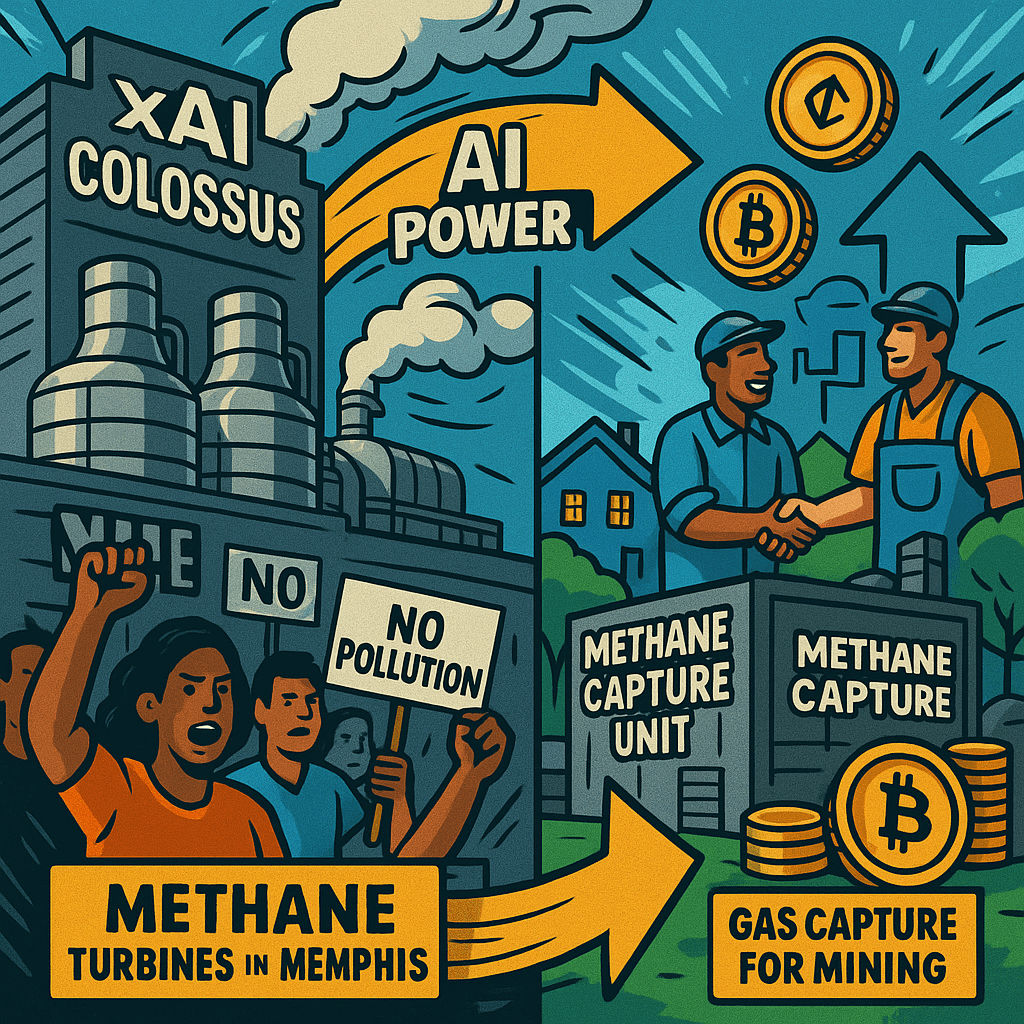
Shelby County Health Department issued an air permit on July 2, 2025, allowing xAI to operate up to 15 methane gas combustion turbines at its Memphis data center powering the Colossus supercomputer.
Community activists and environmental groups dispute the legality of the permit, citing months of unpermitted operations that allegedly violated the Clean Air Act.
xAI began deploying mobile turbines in fall 2024 to power Colossus—built in just 122 days using 100,000 Nvidia H100 GPUs. Satellite imagery from April 2025 suggests as many as 35 units on-site, exceeding permitted capacity.
Permit approval allows up to 15 turbines until January 2027 with required emission controls.
Local residents, many from Boxtown—a predominantly Black neighborhood with a history of industrial pollution—voice concern over continued nitrogen oxide and formaldehyde emissions tied to high asthma and cancer rate.
SELC and NAACP plan legal action to challenge both past unpermitted operations and the permit.
xAI issued a statement saying turbines would feature state-of-the-art emissions controls, making it “the lowest emitting” data center of its kind. The company emphasized its commitment to community partnership.
Memphis Chamber of Commerce praised the permit approval as balancing economic development with environmental stewardshi.
There is one immediate solution for the community in Memphis. Bitcoin mining could capture this methane gas and create more jobs for the community. Around the world, companies are using stranded or flared methane to mine Bitcoin, transforming waste into economic value.
Flare gas is a byproduct of oil extraction, typically burned off as waste due to the lack of nearby infrastructure to transport or use it efficiently.
Bitcoin mining transforms this environmental liability into a financial asset by deploying mobile data centers directly at oil sites. These miners convert methane-rich flare gas into electricity on-site, using it to power ASIC machines that secure the Bitcoin network.
By doing so, operators not only reduce harmful emissions like carbon dioxide and methane but also generate revenue from energy that would otherwise be lost.
Companies like Crusoe Energy, Giga Energy, and Upstream Data have deployed such systems globally, proving that flare gas Bitcoin mining can reduce pollution while supporting local economies and decentralized finance.
From NRG Bloom’s flare-gas capture programs to Gryphon Digital’s operations, and numerous West Texas flare-mitigation sites, Bitcoin mining has increasingly been used as a scalable, mobile tool to neutralize harmful emissions while generating digital revenue and tech employment in overlooked areas.
BitcoinVersus.Tech Editor’s Note:
We volunteer daily to ensure the credibility of the information on this platform is Verifiably True. If you would like to support to help further secure the integrity of our research initiatives, please donate here
BitcoinVersus.tech is not a financial advisor. This media platform reports on financial subjects purely for informational purposes.
 Bitcoin Versus
Leave a comment