
Landauer’s Principle is a fundamental law of physics that establishes the minimum possible amount of energy required to irreversibly change or erase one bit of information in a computational process.
This principle is rooted in the second law of thermodynamics, which states that any logically irreversible operation, such as resetting a bit from one state to another, must dissipate a certain amount of heat to the environment. The minimum energy required for this operation is given by the equation:
Emin bit = kT ln(2)
In the context of Bitcoin mining hardware, Landauer’s Principle sets the theoretical lower bound for the energy required to perform the massive number of bit operations involved in each SHA-256 hash.
When scaled to the level of one terahash, this limit defines the absolute physical minimum energy consumption that any hardware device, no matter how advanced, could ever achieve.
Landauer’s Principle therefore provides the foundation for the absolute energy limit thesis in The Bitcoin mining Singularity, making it essential for any rigorous analysis of long-term efficiency trends and absolute physical constraints.
The absolute limit of Bitcoin mining hardware is fundamentally determined by the laws of physics, particularly Landauer’s Principle, which sets the minimum energy required to change a single bit of information. At typical room temperature, this minimum energy is about 2.8 × 10⁻²¹ joules per bit operation.
For Bitcoin mining, where one SHA-256 hash involves approximately ten thousand bit operations and one terahash equals one trillion hashes, the theoretical minimum energy required per terahash is 0.000028 joules. This value represents an absolute boundary that cannot be surpassed by any hardware, regardless of technological innovation.
The Thermoeconomic Capitulation equation is used to model how quickly hardware efficiency improves over time, starting from a current benchmark of 9.5 joules per terahash.
This equation projects efficiency improvements based on annual rates of 15, 21, and 25 percent. According to these projections, hardware efficiency may approach but will never exceed the Landauer limit.
With an annual improvement rate of 25 percent, the theoretical minimum energy use per terahash would be reached in the year 2068. At an annual rate of 21 percent, the limit would be met in 2078, and at 15 percent per year, not until 2102.
The accompanying chart, shown in Figure 8, illustrates these scenarios by plotting each efficiency pathway—corresponding to 15, 21, and 25 percent improvement rates—alongside the Landauer limit as a horizontal reference line. All projected efficiency trends approach this physical boundary but do not cross it.
This analysis makes clear that although significant advances in mining efficiency are possible, every further improvement will become increasingly difficult as the physical limits imposed by thermodynamics are approached.
Understanding these limits through Landauer’s Principle and the Thermoeconomic Capitulation equation provides a practical and science-based framework for setting realistic expectations regarding the future of Bitcoin mining hardware.
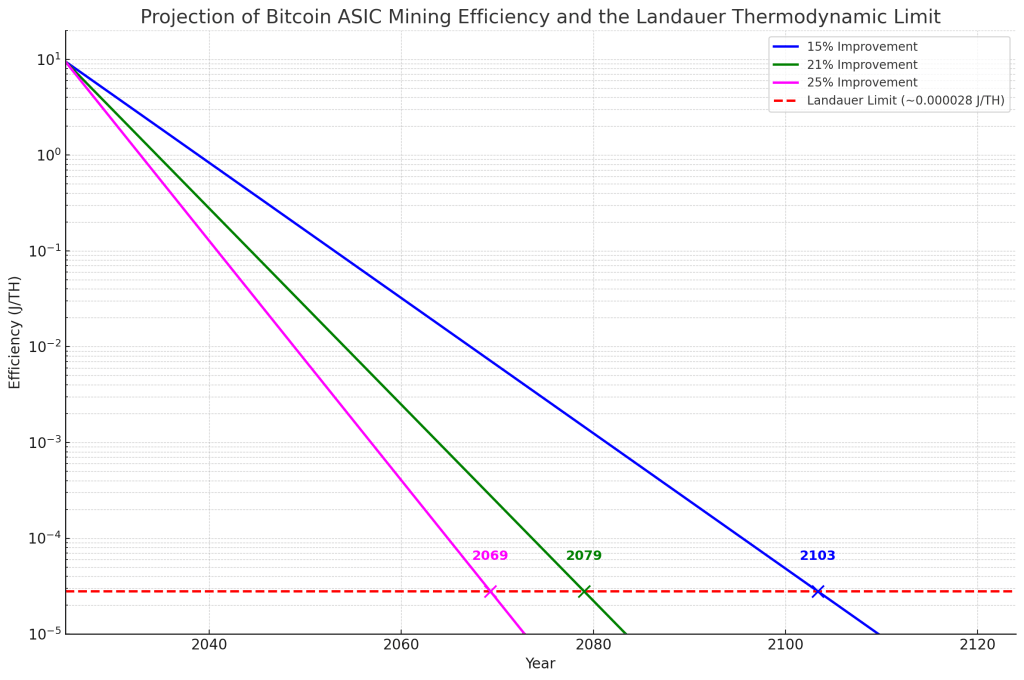
Figure 8: Landauer’s Principle sets a theoretical lower bound on the energy needed to erase one bit of #information, meaning there is a minimum amount of energy that must be used to perform any computational task. In regards to bitcoin mining ASIC Efficiency, this translates to an absolute thermodynamic limit on how efficient a machine can be per terahash. This chart projects the anticipated improvement in bitcoin mining hardware efficiency utilizing this principle under three different annual rates of progress: 15 percent (blue), 21 percent (green), and 25 percent (magenta). Each trajectory is calculated using the Thermoeconomic Capitulation equation, starting from a baseline efficiency of 9.5 joules per terahash (J/TH) in 2025. The horizontal red dashed line marks the Landauer thermodynamic limit, representing the absolute minimum energy required per terahash as dictated by Landauer’s Principle. For a 25 percent annual efficiency gain, the limit is projected to be reached in 2069; at 21 percent, in 2079; and at 15 percent, in 2103. Regardless of technological progress, all efficiency trajectories can theoretically approach but never surpass this fundamental physical boundary. Thermodynamic laws ultimately define the long-term limits of Bitcoin mining efficiency.
BitcoinVersus.Tech Editor’s Note:
We volunteer daily to ensure the credibility of the information on this platform is Verifiably True. If you would like to support to help further secure the integrity of our research initiatives, please donate here
BitcoinVersus.tech is not a financial advisor. This media platform reports on financial subjects purely for informational purposes.
 Bitcoin Versus
Leave a comment