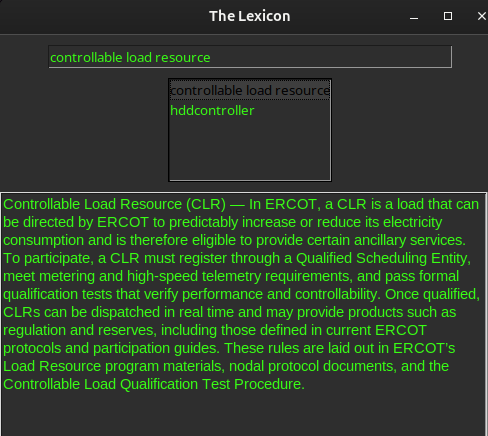
Controllable Load Resources are loads that ERCOT can dispatch to predictably reduce or increase electricity use, allowing qualified facilities to act like fast, flexible grid assets inside the wholesale market.
The designation and core rules appear in ERCOT’s nodal protocols and guidance for load participation.
Participation begins with registration through a Qualified Scheduling Entity, installation of required metering and high-speed telemetry, and completion of a formal Controllable Load Qualification Test that verifies performance for real-time operations and ancillary services.
ERCOT’s load-participation page and the current qualification procedure outline the steps and testing criteria.
Once qualified, a Controllable Load Resource can be dispatched in real time and can earn capacity revenues for providing reliability services such as Regulation, Responsive Reserve variants including Fast Frequency Response, Non-Spin, and the newer ERCOT Contingency Reserve Service introduced in 2023 to strengthen reliability.
ERCOT’s market materials and ECRS launch notice describe the service set and operational purpose.
ERCOT’s guidance also permits qualified Controllable Load Resources to submit offers into and be dispatched by the Real-Time Energy Market, which lets large loads monetize flexibility through economic dispatch in addition to ancillary services.
The nodal market explainer details that structure for participating loads.
Controllable Load Resources differ from Non-Controllable Load Resources, which respond automatically to frequency or under-frequency relays and qualify under a separate procedure rather than following ERCOT dispatch signals.
ERCOT’s NCLR qualification document explains the non-dispatchable path for load participation.
In April 2025 ERCOT executed a no-cost patent license with Lancium that covers technology relevant to controllable loads, which ERCOT states should remove intellectual-property barriers and encourage broader CLR participation.
The market notice and ERCOT Monthly report describe the agreement and its intended impact on market access for controllable loads.
Flexible compute campuses such as bitcoin mines are prominent candidates for CLR enrollment because large, interruptible demand can be ramped down quickly to provide reserves or respond to price signals.
Public research and industry commentary analyze miners’ use of controllable-load designations in ERCOT and the resulting grid and market effects.
BitcoinVersus.Tech Editor’s Note:
We volunteer daily to ensure the credibility of the information on this platform is Verifiably True. If you would like to support to help further secure the integrity of our research initiatives, please donate here
BitcoinVersus.tech is not a financial advisor. This media platform reports on financial subjects purely for informational purposes.
 Bitcoin Versus
Leave a comment