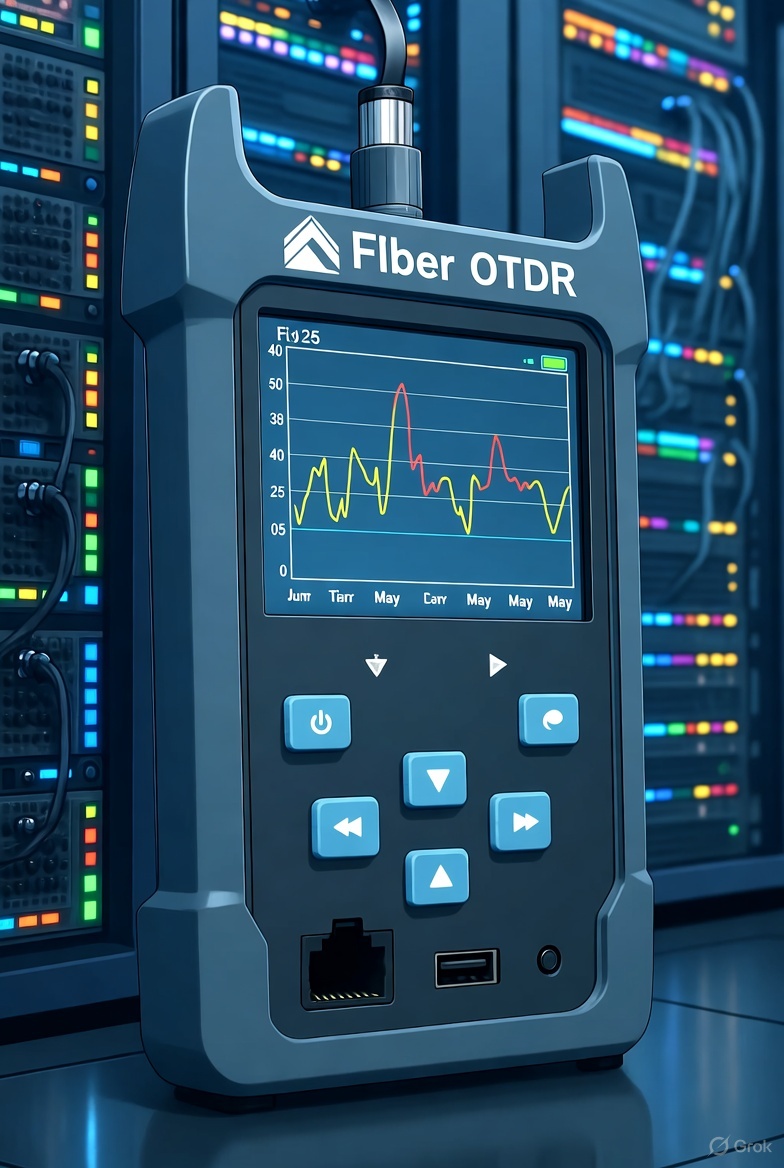
OTDR, or Optical Time Domain Reflectometer, operates by injecting a series of short laser pulses into one end of an optical fiber and measuring the light that is scattered or reflected back from points along the fiber.
This backscattered light—primarily due to Rayleigh scattering and Fresnel reflections—is captured by a photodetector within the OTDR, and the time delay between pulse emission and return is used to calculate the distance to each event.
The result is a trace or graph that plots signal loss versus distance, revealing the location and severity of splices, connectors, bends, breaks, and other anomalies.
The OTDR functions similarly to radar, using time-domain analysis to map the fiber’s internal structure.
It includes a laser source, a timing circuit, and a receiver, often with a circulator to direct light efficiently.
The trace shows characteristic drops or spikes at splice points, connectors, or faults, and technicians interpret these features to assess link quality.
OTDRs are essential for commissioning, troubleshooting, and documenting fiber optic networks, especially in long-haul and access deployments where pinpointing faults without physical inspection is critical
BitcoinVersus.Tech Editor’s Note:
We volunteer daily to ensure the credibility of the information on this platform is Verifiably True. If you would like to support to help further secure the integrity of our research initiatives, please donate here
BitcoinVersus.tech is not a financial advisor. This media platform reports on financial subjects purely for informational purposes.
 Bitcoin Versus
Leave a comment