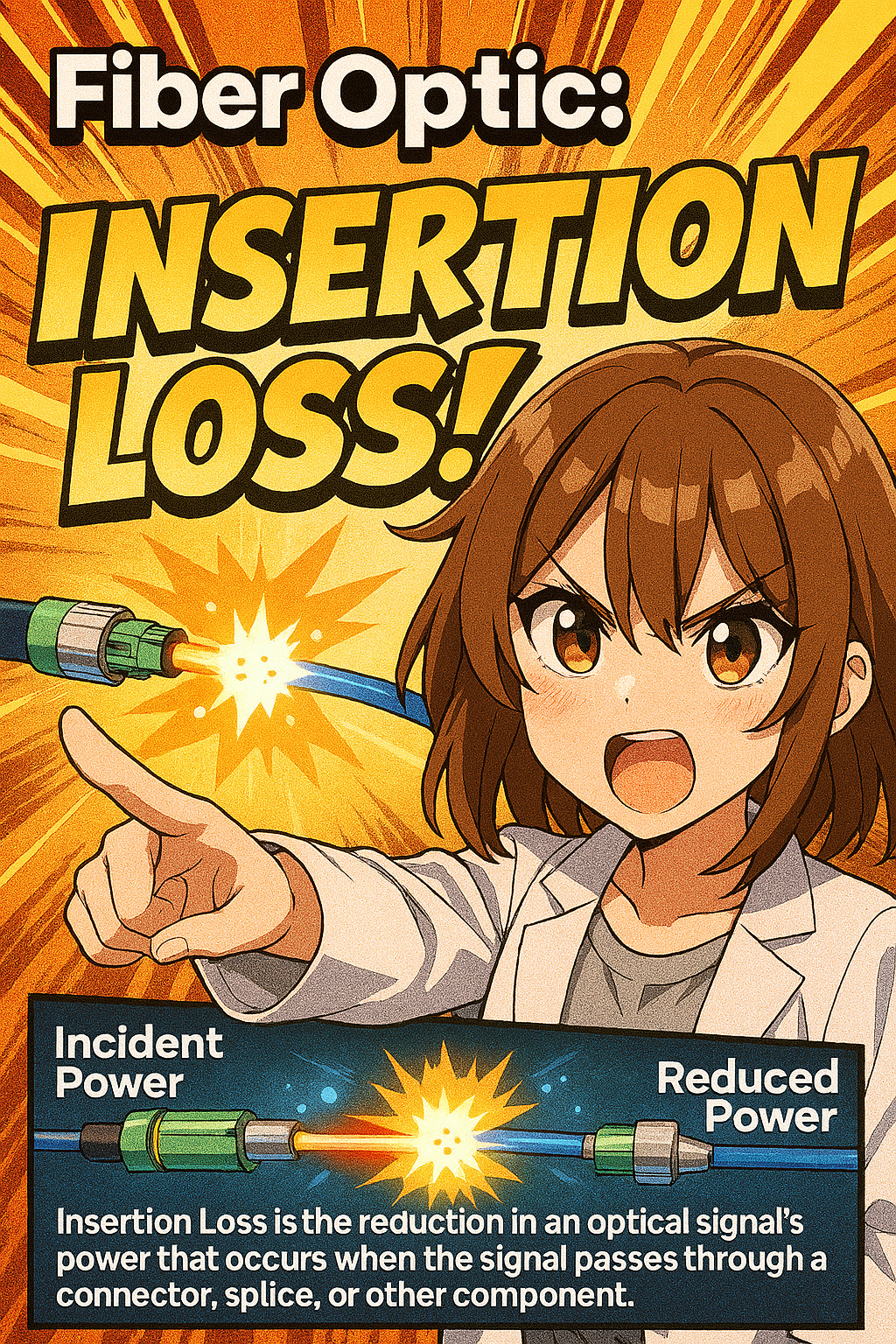
Insertion Loss in fiber optics refers to the amount of signal power lost when a component—such as a connector, splice, or device—is inserted into the optical path.
It’s measured in decibels (dB), and lower values indicate better performance.
When light travels through a fiber, any interruption or interface can cause some of the signal to be absorbed, scattered, or misaligned.
Insertion Loss quantifies that drop in power between the input and output of the component.
For example, a good connector might have an insertion loss of less than 0.3 dB, while a poor splice or dirty interface could exceed 1 dB.
Minimizing insertion loss is essential for maintaining signal strength, especially in long-distance or high-bandwidth systems.
BitcoinVersus.Tech Editor’s Note:
We volunteer daily to ensure the credibility of the information on this platform is Verifiably True. If you would like to support to help further secure the integrity of our research initiatives, please donate here
BitcoinVersus.tech is not a financial advisor. This media platform reports on financial subjects purely for informational purposes.
 Bitcoin Versus
Leave a comment