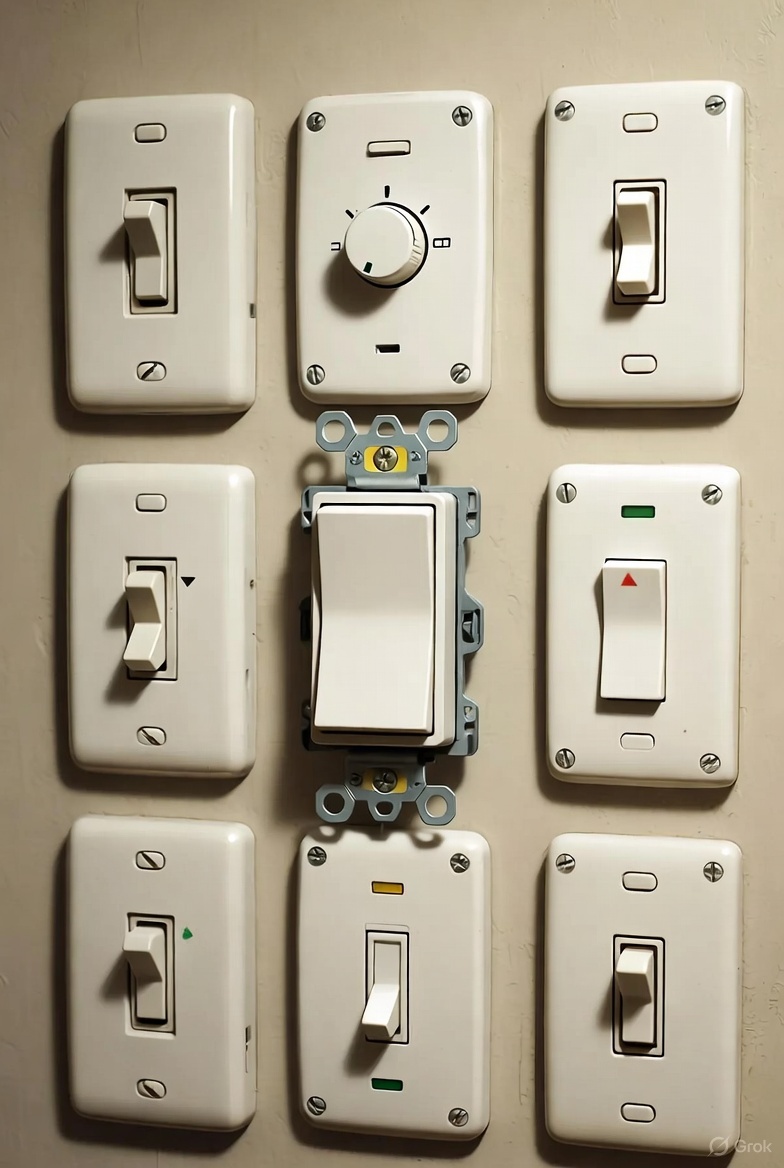
Electrical switches are categorized in various ways, often based on their construction, actuation method, and function within a circuit. A common classification uses the Pole and Throw configuration: the Single Pole, Single Throw (SPST) is the simplest ON/OFF switch, controlling one circuit from one location, like a standard light switch.
The Single Pole, Double Throw (SPDT), often called a three-way switch in residential wiring, has one input that connects to one of two different outputs, enabling control of one circuit from two locations (e.g., controlling a hallway light from both ends).
The Double Pole, Single Throw (DPST) controls two separate circuits simultaneously with one actuator, typically for high-amperage appliances or industrial equipment.
Lastly, the Double Pole, Double Throw (DPDT) is essentially two SPDT switches operated by a single mechanism, allowing two separate circuits to be switched between two different states.
Beyond these common wall switches, a vast array of specialized types exists to suit diverse applications.
A disconnect switch is a crucial component in electrical systems, designed to isolate a portion of the circuit for maintenance or safety purposes. This device allows operators to safely disconnect electrical equipment from the power source, ensuring that no current flows through the system during repairs or inspections.
Typically, disconnect switches are installed in various applications, including industrial settings, commercial buildings, and residential installations, where they serve as a safeguard against electrical hazards.
They come in various configurations, such as knife switches, rotary switches, and pull-out switches, each suited for specific operational requirements. The proper installation and maintenance of disconnect switches are essential to ensure compliance with safety regulations and to protect both personnel and equipment from potential electrical faults. By providing a reliable means of cutting off power, these switches play a vital role in enhancing the overall safety and efficiency of electrical systems.
A grounding switch is a specialized electrical safety device engineered to deliberately and securely connect a de-energized circuit conductor, such as a power line or a piece of electrical equipment, directly to the earth (ground) after it has been isolated from its voltage source.
Its primary purpose is not to control the operation of a circuit like a standard switch, but to provide a crucial layer of protection for maintenance personnel and equipment by ensuring that a disconnected conductor cannot become accidentally re-energized by an external source, such as back-feeding, induced voltage from adjacent live lines, or the residual charge stored in capacitive components.
Unlike a load-break switch, a grounding switch is not designed to interrupt current flow; instead, it is applied only when the circuit is confirmed to be de-energized.
These switches are commonly found in high-voltage applications, such as in electrical substations, where they are often integrated into a single unit with a disconnect switch, forming a “disconnect-isolate-ground” combination.
When maintenance is required, the sequence is to first open the circuit breaker, then open the disconnect switch to provide a visible air gap for isolation, and finally close the grounding switch to bond the now-isolated section to the earth potential, creating a safe, grounded work environment.
In this critical role, the grounding switch acts as a final and vital safety measure, effectively creating a short-circuit to ground that would instantly trip upstream protective devices if the line were to become accidentally energized, thereby preventing electrocution and ensuring compliance with stringent electrical safety protocols.
Pushbutton switches make or break connection only while pressed, rotary switches select one of many circuits by turning a knob, and selector switches function as manual multi-position controllers.
Furthermore, many switches are activated by physical stimuli other than a human hand: limit switches are triggered by the motion of a machine part, pressure switches respond to fluid or air pressure levels, float switches activate based on liquid level, and temperature switches (thermostats) open or close at a set temperature. In the realm of electronics, mercury tilt switches use conductive liquid to sense orientation, while DIP switches and rockers provide configuration settings on circuit boards.
Finally, the relay is a critical type of switch where a low-power electrical signal energizes an electromagnet to mechanically open or close a separate, high-power circuit, effectively acting as a remotely operated or electrically amplified switch.
In regard to configuration, switches are also distinguished by their physical operation: Toggle switches use a lever that flips between positions; Pushbutton switches are pressed to activate or deactivate, often with a momentary (only active while pressed) or latched (stays in position until pressed again) action; Rocker switches pivot or “rock” to change state; and Rotary switches use a turning knob to select one of multiple positions.
Specialized types include Dimmer switches for adjusting light brightness, Limit switches actuated by machine motion, and Smart switches integrated with Wi-Fi for remote and automated control.
BitcoinVersus.Tech Editor’s Note:
We volunteer daily to ensure the credibility of the information on this platform is Verifiably True.
If you would like to support to help further secure the integrity of our research initiatives, please donate here: bc1qrved9tfquym6u3age7xhmnkjs2lq8j9aulperagkuhtuk5w5c35ssfpge8
BitcoinVersus.tech is not a financial advisor. This media platform reports on financial subjects purely for informational purposes.
 Bitcoin Versus
Leave a comment