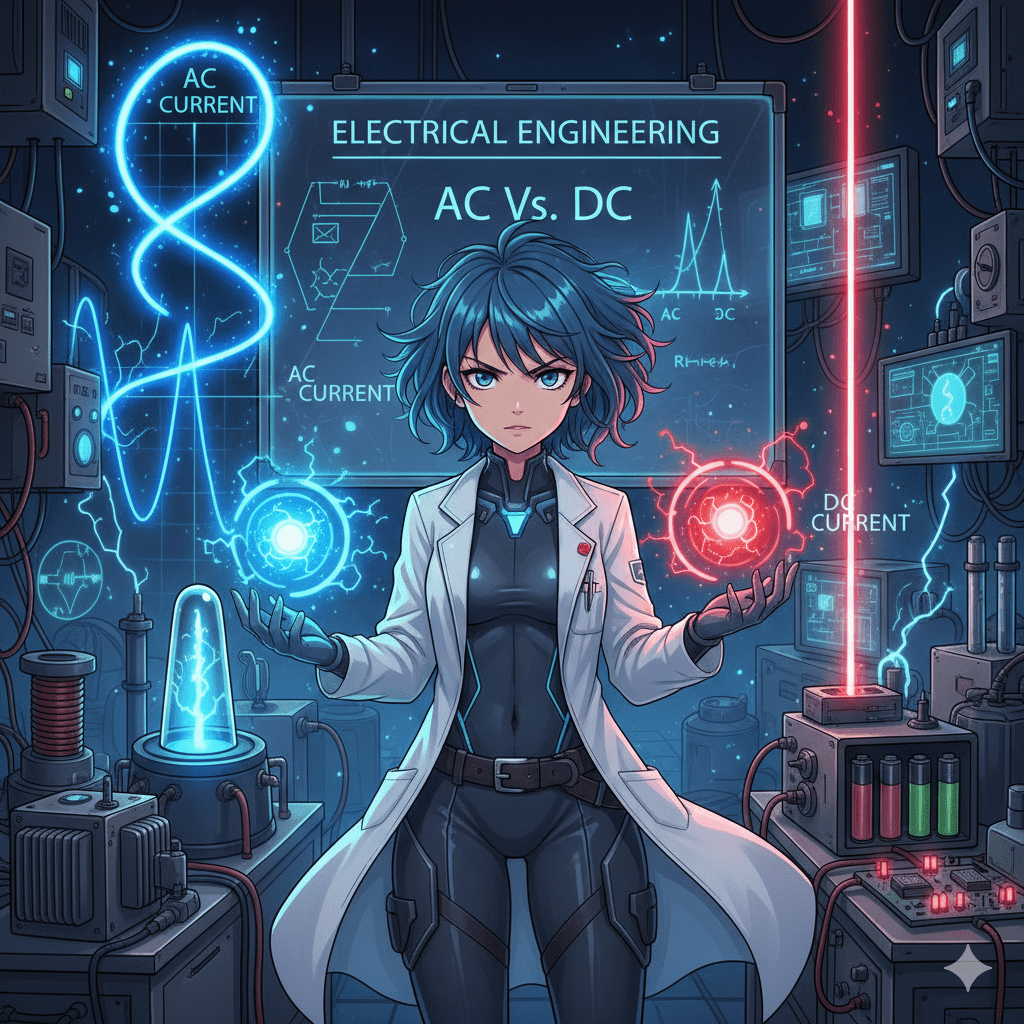
Alternating Current (AC) is a type of electric current characterized by a continuous and periodic reversal in the direction of charge flow, which results in a sinusoidal (or other periodic waveform) variation in voltage and current magnitude over time.
Unlike Direct Current (DC), which maintains a constant polarity and direction, AC systematically oscillates between a positive and a negative maximum value.
This fundamental oscillation is defined by its frequency, measured in Hertz (Hz), which indicates the number of complete cycles (from zero to positive maximum, back through zero to negative maximum, and back to zero) the current completes per second; a standard utility frequency, for instance, is 50 Hz or 60 Hz depending on the geographical region.
The primary mechanism for generating AC is electromagnetic induction, typically achieved by rotating a coil of wire within a magnetic field, a process central to the operation of electrical generators.
The most common waveform for AC is the sine wave due to its efficient power transmission characteristics and natural occurrence in rotating machinery, though other waveforms like square, triangle, and sawtooth waves are also used in various electronic applications.
The principal advantage of AC, which led to its universal adoption for power grids by winning the “War of the Currents,” is the ease with which its voltage can be increased or decreased with high efficiency using a transformer; this allows for the transmission of electricity at extremely high voltages over long distances with minimal power loss, before being “stepped down” to safer, lower voltages for industrial, commercial, and residential use.
Consequently, AC is the form of electrical power that powers homes, businesses, and the vast majority of the world’s electrical infrastructure, driving everything from lights and appliances to industrial machinery, while also being fundamental to the operation of devices like radios and certain types of motors, specifically induction and synchronous motors, which are simpler and more robust than their DC counterparts.
So what’s the difference essentially? Direct current (DC) flows steadily in one direction, providing a constant voltage, which is common in batteries and small electronic devices.
Alternating current (AC), on the other hand, periodically reverses direction and varies its voltage (oscillation), making it easier and more efficient to transmit over long distances, which is why it powers homes and industries.
This difference in flow direction and voltage behavior distinguishes their typical uses and transmission methods.
BitcoinVersus.Tech Editor’s Note:
We volunteer daily to ensure the credibility of the information on this platform is Verifiably True.
If you would like to support to help further secure the integrity of our research initiatives, please donate here: bc1qrved9tfquym6u3age7xhmnkjs2lq8j9aulperagkuhtuk5w5c35ssfpge8
BitcoinVersus.tech is not a financial advisor. This media platform reports on financial subjects purely for informational purposes.
 Bitcoin Versus
Leave a comment