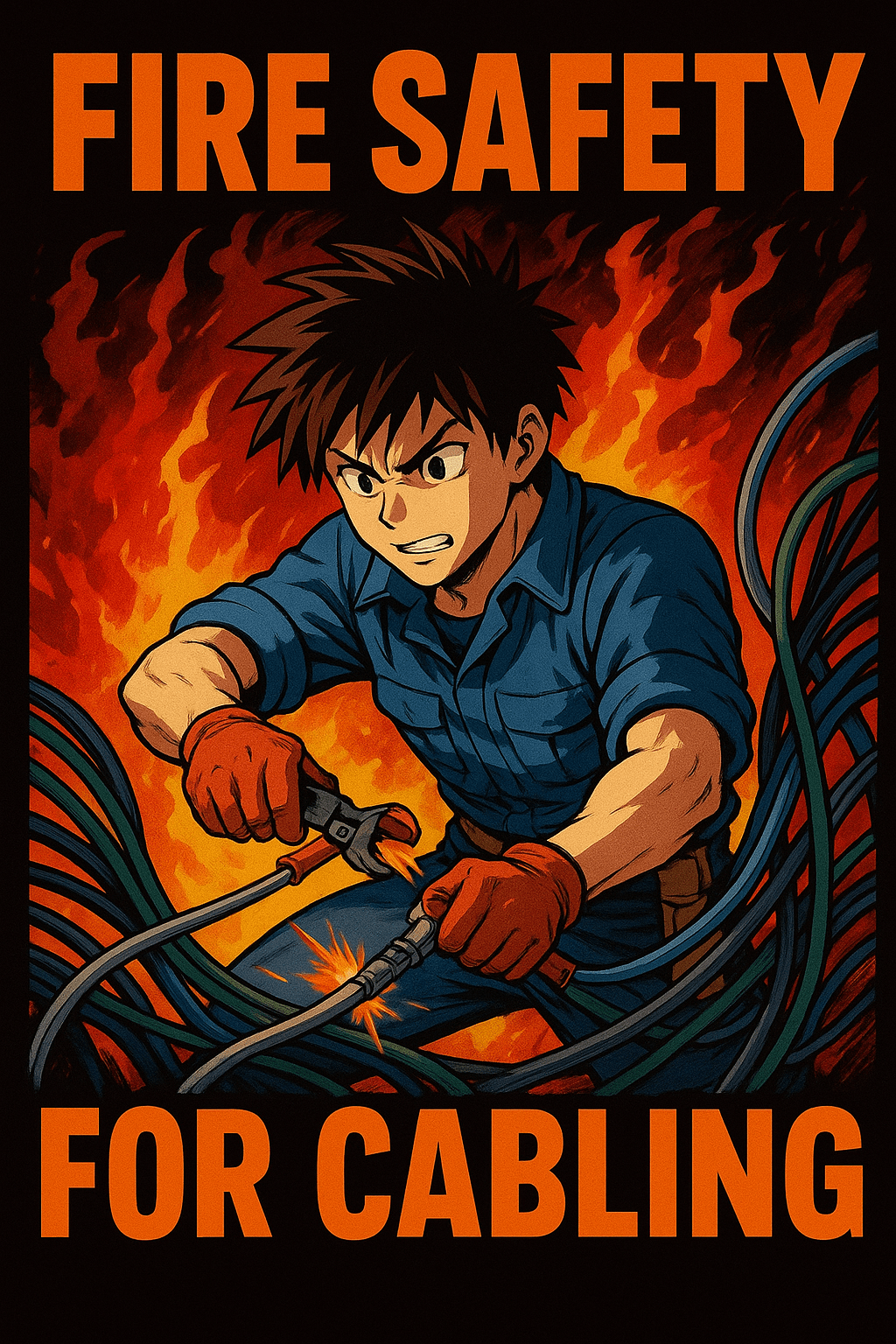
Fire safety in cable installations is a critical aspect of both data center and field operations, ensuring the protection of personnel, equipment, and infrastructure.
The first step toward minimizing fire risk begins with selecting the correct cable type for the environment. Plenum-rated cables, labeled CMP, are designed for air-handling spaces such as ceiling voids or raised floors and feature insulation that produces minimal smoke during combustion.
Riser-rated cables, or CMR, are intended for vertical runs between floors, while general-purpose cables, marked CM or CMG, are only suitable for single-floor open areas. In international or confined installations, low-smoke zero halogen (LSZH) cables are preferred because they emit fewer toxic gases if ignited.
Proper routing and separation of cabling also play a vital role in reducing fire hazards. Cables should be installed away from heat sources, HVAC ducts, and sprinkler heads, and when they must cross fire-rated walls or floors, they should be enclosed in fire-rated conduits or sleeves.
Openings created during cable runs should be sealed with firestop materials such as intumescent foam or putty to preserve the building’s fire barrier.
Bundles must be neatly secured to allow air circulation, as overfilled trays or tightly packed wiring can trap heat and accelerate flame spread. Additionally, power and data cables should be routed separately to prevent electrical interference and reduce the likelihood of arcing.
Accurate labeling and documentation enhance safety by allowing quick identification and isolation during emergencies. Both ends of every cable should be labeled with flame-resistant tags, and diagrams must be kept current to reflect any changes in layout.
Routine inspections are essential to identify early warning signs such as jacket discoloration, cracking, or melting that indicate excessive heat exposure.
Abandoned or unused cables should be removed, especially older PVC-coated types that contribute to the fire’s fuel load, and any compromised fire barriers must be restored immediately after maintenance or upgrades.
For coaxial and Ethernet cables, proper grounding and shielding are equally important.
All metallic sheaths, connectors, and racks should be bonded to a verified ground to minimize the chance of arcing or electrical fires. Surge protection at building entry points adds another layer of defense against lightning strikes or power surges.
Fiber optic cables, while nonconductive and generally safer, also require attention. Installers should use nonconductive riser (OFNR) or plenum (OFNP) rated cables, maintain adequate separation from high-voltage systems to prevent jacket melting, and dispose of fiber shards safely, as they are both flammable and hazardous to health.
Fire prevention in structured cabling is not just about compliance but about foresight and discipline.
Choosing the right fire-rated materials, maintaining separation and airflow, labeling accurately, and inspecting regularly all contribute to creating a safer and more reliable network environment.
Whether in a residential riser, a commercial plenum, or a megawatt-scale mining facility, disciplined fire practices ensure the integrity of infrastructure and the protection of every technician working around it.
BitcoinVersus.Tech Editor’s Note:
We volunteer daily to ensure the credibility of the information on this platform is Verifiably True. If you would like to support to help further secure the integrity of our research initiatives, please donate here
BitcoinVersus.tech is not a financial advisor. This media platform reports on financial subjects purely for informational purposes.
 Bitcoin Versus
Leave a comment