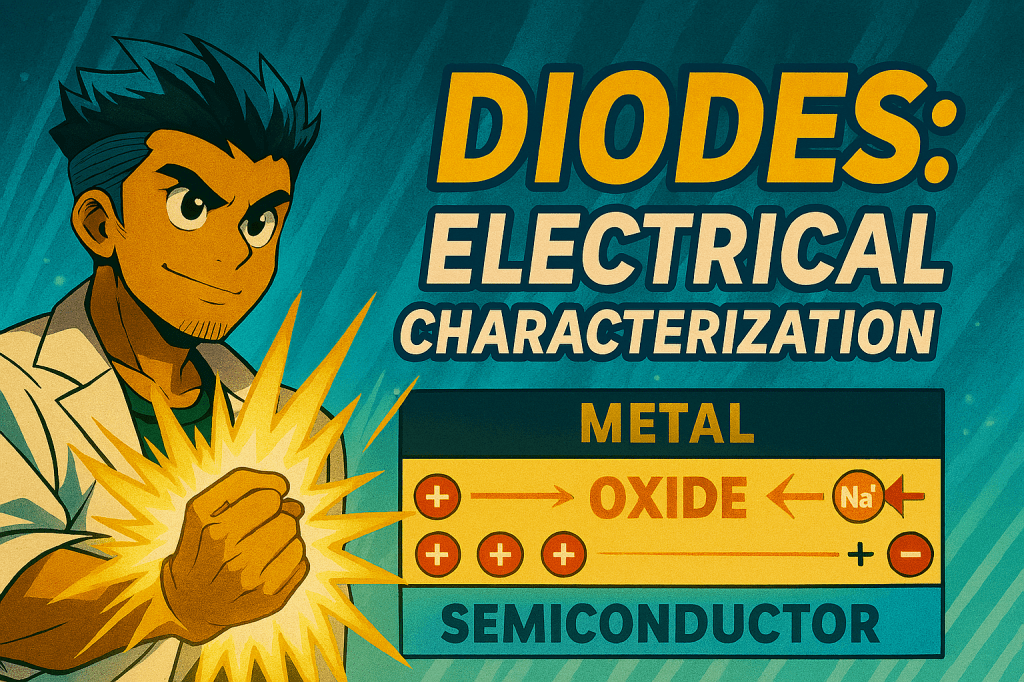
A diode is a two-terminal semiconductor device that permits current to flow primarily in one direction, making it a fundamental component in electronics. Electrical characterization of diodes involves analyzing their current–voltage (I–V) relationship, which reveals distinct operating regions.
In a diode, the anode and cathode are the two terminals that define its directionality and electrical behavior. The anode is the positive side, where conventional current enters the diode, and the cathode is the negative side, where current exits.
When a diode is forward-biased—meaning the anode is connected to a higher potential than the cathode—it allows current to flow freely once the threshold voltage is surpassed (typically around 0.7 V for silicon diodes).
This is the conducting state of the diode. Conversely, when the diode is reverse-biased—with the cathode at a higher potential than the anode—it blocks current flow, except for a minimal leakage current, until breakdown occurs.
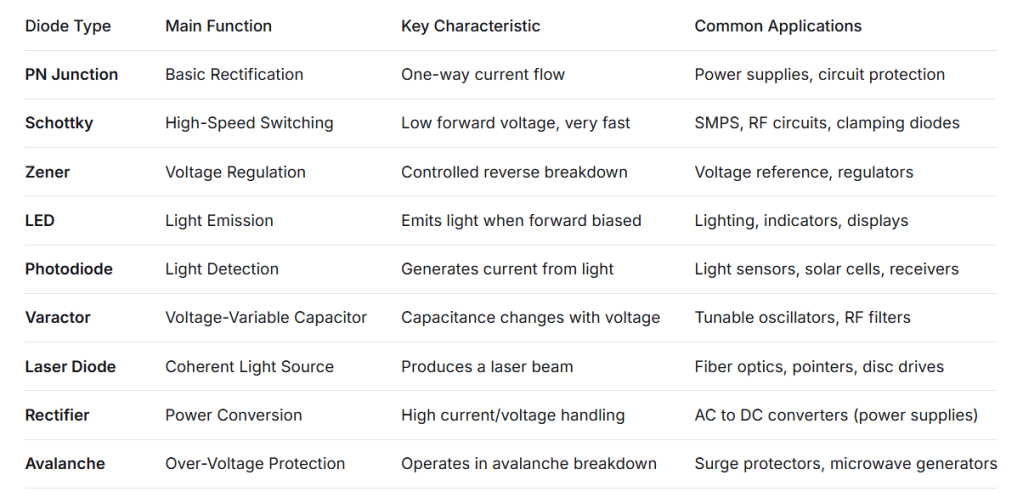
The physical structure of the diode’s p-n junction enforces this behavior: the anode is connected to the p-type material (rich in holes), and the cathode to the n-type material (rich in electrons). This asymmetry is what gives diodes their rectifying property, allowing them to act as one-way valves for electrical current.
In forward bias, when the positive terminal of a voltage source is connected to the diode’s anode and the negative terminal to its cathode, the depletion region narrows, allowing charge carriers to recombine and current to rise exponentially once the threshold voltage (approximately 0.7 V for silicon, 0.3 V for germanium) is exceeded.
In reverse bias, the depletion region widens, majority carriers are pulled away from the junction, and only a small leakage current flows due to minority carriers.
At sufficiently high reverse voltages, breakdown mechanisms occur: avalanche breakdown, where energetic carriers ionize atoms and create large currents, and the Zener effect, where strong electric fields break covalent bonds at lower voltages.
Additional electrical characteristics include static and dynamic resistance, transition and diffusion capacitance, reverse recovery time, and temperature dependence. Together, these parameters define the diode’s performance in circuits, making electrical characterization essential for applications in rectification, signal processing, voltage regulation, and high-frequency electronics.
BitcoinVersus.Tech Editor’s Note:
We volunteer daily to ensure the credibility of the information on this platform is Verifiably True.
If you would like to support to help further secure the integrity of our research initiatives, please donate here: bc1qrved9tfquym6u3age7xhmnkjs2lq8j9aulperagkuhtuk5w5c35ssfpge8
BitcoinVersus.tech is not a financial advisor. This media platform reports on financial subjects purely for informational purposes.
 Bitcoin Versus
Leave a comment