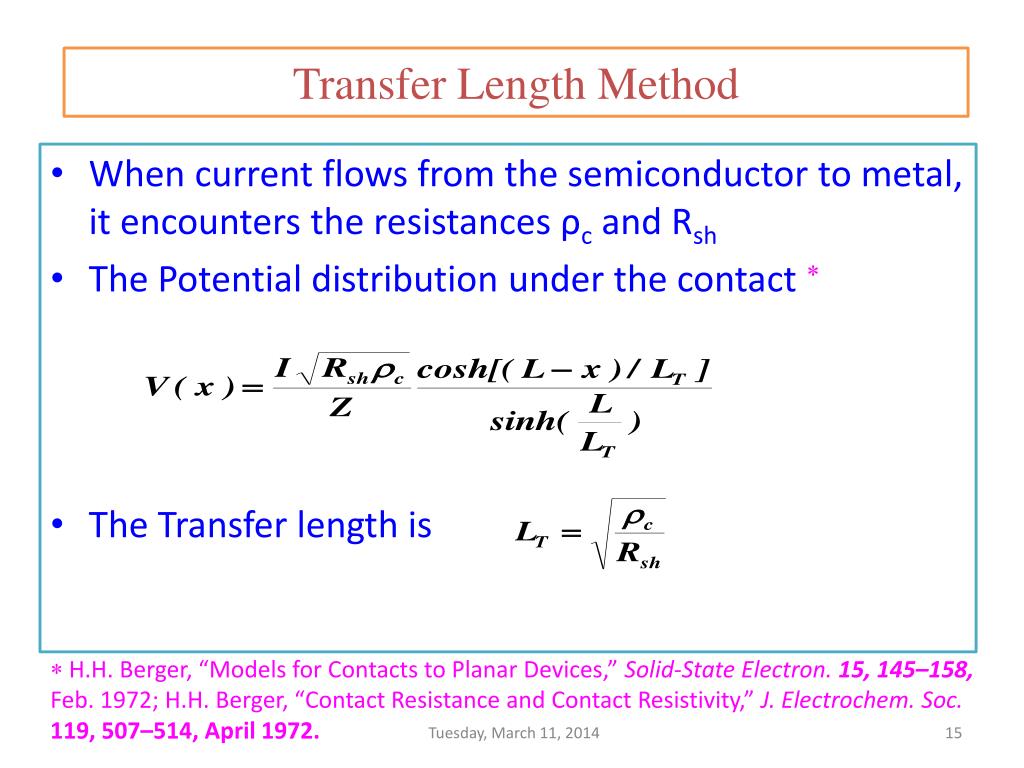
The Transfer Length Method (TLM) is a widely used technique in semiconductor physics and engineering for determining the specific contact resistivity between a metal and a semiconductor.
It was developed as a response to the increasing significance of contact resistance in microelectronic devices due to device miniaturization.
In practice, TLM involves depositing a series of metal contacts with varying spacing on the semiconductor surface using fabrication techniques such as photolithography and metal deposition.
The method assumes ohmic behavior of the contacts, meaning the contacts have linear current-voltage characteristics.
The core concept of TLM is based on measuring the total resistance between pairs of metal contacts spaced at different distances. The current flow under the metal contact does not spread evenly but is concentrated within a certain characteristic length below the contact, called the transfer length.
The current transitions from the semiconductor into the metal mainly through this transfer length multiplied by the contact width. By analyzing how the measured resistance changes with the spacing between contacts, the method extracts both the contact resistance and the sheet resistance of the semiconductor layer.
Overall, TLM provides a practical and reliable way to experimentally determine the specific contact resistivity, which is a critical parameter reflecting the quality and performance of metal-semiconductor interfaces in devices. It helps engineers optimize contact design to minimize resistive losses and enhance device efficiency.
Cover Image Credit: ACS Publications
BitcoinVersus.Tech Editor’s Note:
We volunteer daily to ensure the credibility of the information on this platform is Verifiably True.
If you would like to support to help further secure the integrity of our research initiatives, please donate here: bc1qrved9tfquym6u3age7xhmnkjs2lq8j9aulperagkuhtuk5w5c35ssfpge8
BitcoinVersus.tech is not a financial advisor. This media platform reports on financial subjects purely for informational purposes.
 Bitcoin Versus
Leave a comment