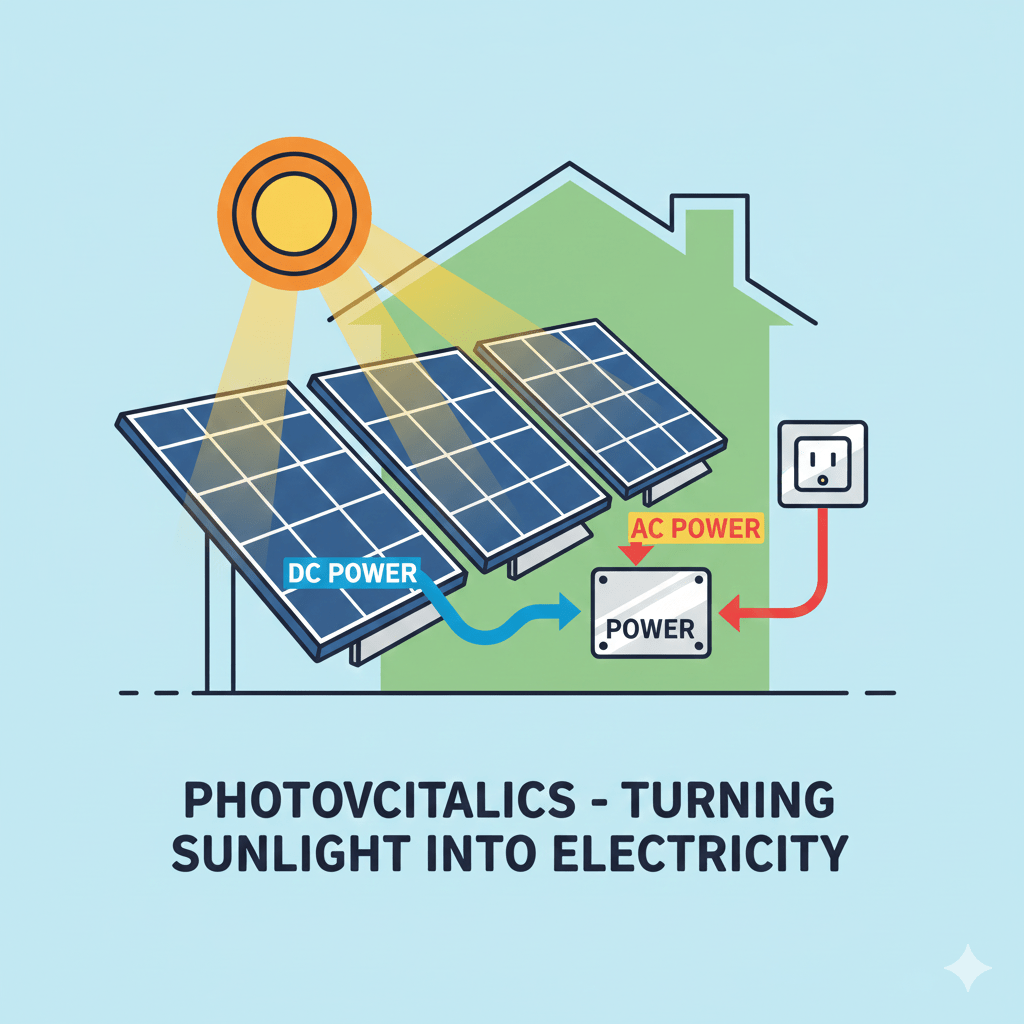
Photovoltaics is the technological principle and scientific field concerned with the direct conversion of light energy, specifically photons from sunlight, into electrical energy through the photovoltaic effect, a physical and chemical process that occurs within a class of materials known as semiconductors, most commonly crystalline silicon.
The fundamental unit of this conversion is the photovoltaic cell, or solar cell, which is essentially a specialized, large-area semiconductor diode structured as a p-n junction; this junction is created by adjoining a p-type semiconductor, rich in positively-charged holes, with an n-type semiconductor, rich in negatively-charged electrons, forming an internal electric field across a depletion region.
When photons possessing energy greater than the semiconductor’s bandgap strike the cell, they transfer their energy to electrons, exciting them from the valence band into the conduction band and thereby creating mobile electron-hole pairs; the internal electric field then acts to forcefully separate these charge carriers, driving the electrons towards the n-side and the holes towards the p-side, which generates a voltage potential, or electromotive force, between the two conductive contacts on either side of the cell.
This behavior and the resulting electrical output are perfectly described and graphically represented by the current-voltage (IV) curve, which is a fundamental characteristic of all semiconductor diodes, plotting the current (I) that flows through the device against the voltage (V) applied across its terminals.
A standard diode IV curve demonstrates exponential current increase under forward bias (positive voltage) and minimal, saturation-level current under reverse bias (negative voltage), effectively acting as a one-way valve for electricity. However, a photovoltaic cell operates in the active fourth quadrant of this IV curve, where the current is negative and the voltage is positive, meaning it generates power instead of consuming it.
The key parameters extracted from this solar cell IV curve are the short-circuit current (Isc), which is the maximum current when the voltage is zero, directly proportional to the incident light intensity; the open-circuit voltage (Voc), which is the maximum voltage when the current is zero, dependent on the semiconductor’s material properties; the fill factor (FF), a measure of the curve’s “squareness” representing the quality of the cell; and, most critically, the maximum power point (Pmax), the product of current and voltage at the knee of the curve where the cell delivers its highest possible electrical power output.
Therefore, the diode IV curve is not merely an analogous model but is the definitive electrical blueprint that captures the essence of a solar cell’s function, illustrating its transition from a passive diode in the dark to an active power generator under illumination.
BitcoinVersus.Tech Editor’s Note:
We volunteer daily to ensure the credibility of the information on this platform is Verifiably True.
If you would like to support to help further secure the integrity of our research initiatives, please donate here: bc1qrved9tfquym6u3age7xhmnkjs2lq8j9aulperagkuhtuk5w5c35ssfpge8
BitcoinVersus.tech is not a financial advisor. This media platform reports on financial subjects purely for informational purposes.
 Bitcoin Versus
Leave a comment