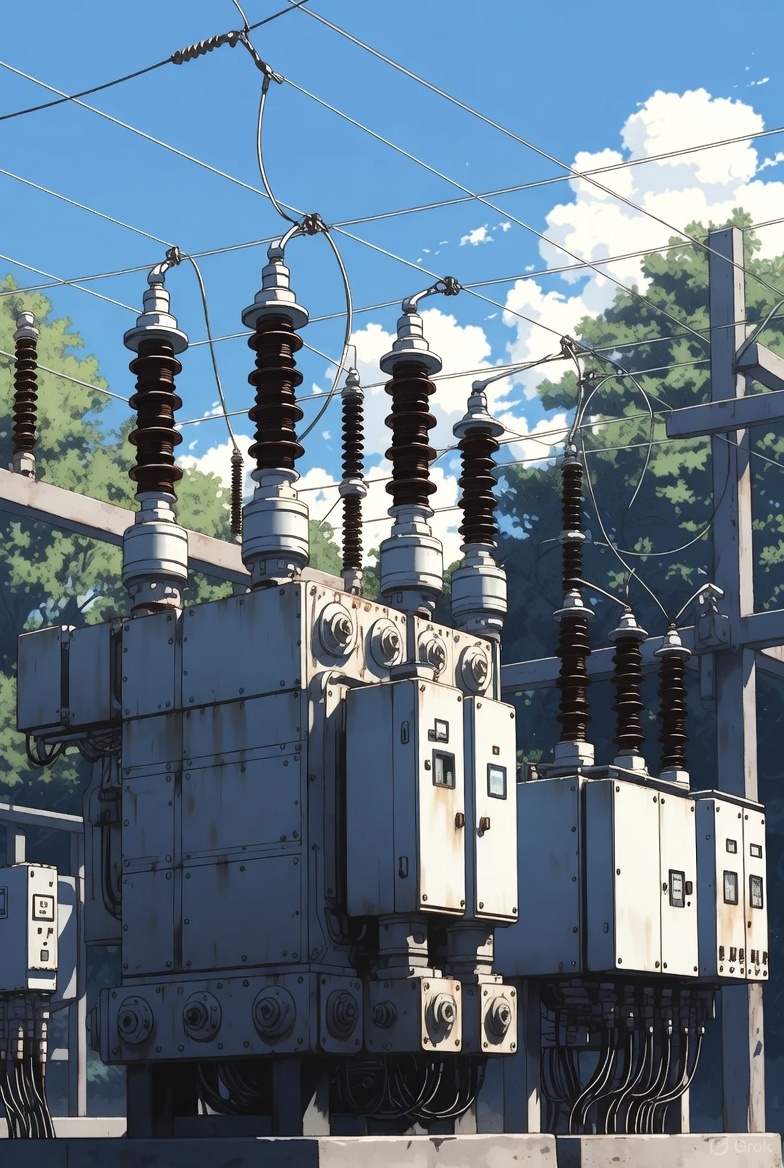
Unlike a simple switch, a circuit breaker is capable of safely interrupting the extremely large short-circuit currents that occur during a fault (such as a line-to-line or line-to-ground fault) at high voltages, which typically refers to voltages of 72KV and above.
When a fault is detected by protective relays, the breaker’s contacts open, creating an electric arc between them.
The primary challenge in circuit breaker design is the efficient and rapid quenching of this arc to prevent damage to the equipment and restore the insulating strength of the medium between the contacts.
Common arc-quenching mediums include SF6 (Sulfur Hexafluoride) gas, vacuum, or compressed air, each giving rise to different types of circuit breakers, such as SF6 circuit breakers, vacuum circuit breakers, and air-blast circuit breakers.3 Their reliable operation is essential for maintaining the stability and integrity of the entire power grid.
For instance, air-insulated breakers utilize the surrounding atmosphere to quench the arc, while oil-insulated breakers rely on the dielectric properties of oil to facilitate the interruption process.
Gas-insulated breakers, on the other hand, utilize sulfur hexafluoride (SF6) gas, which is known for its excellent insulating and arc-extinguishing properties, making it suitable for compact installations. The choice of medium not only affects the efficiency of the arc extinction but also impacts maintenance requirements, environmental considerations, and overall system design.
For example, while vacuum circuit breakers are known for their minimal maintenance needs and compact size, they may not be suitable for all applications due to their specific operational constraints.
Similarly, gas-insulated breakers, while highly effective in urban settings where space is limited, raise concerns regarding the environmental impact of SF6 gas. Understanding these classifications and their implications is crucial for engineers and designers when selecting the appropriate high voltage breaker for a given application, ensuring optimal performance and safety in electrical systems.
BitcoinVersus.Tech Editor’s Note:
We volunteer daily to ensure the credibility of the information on this platform is Verifiably True.
If you would like to support to help further secure the integrity of our research initiatives, please donate here: bc1qrved9tfquym6u3age7xhmnkjs2lq8j9aulperagkuhtuk5w5c35ssfpge8
BitcoinVersus.tech is not a financial advisor. This media platform reports on financial subjects purely for informational purposes.
 Bitcoin Versus
Leave a comment