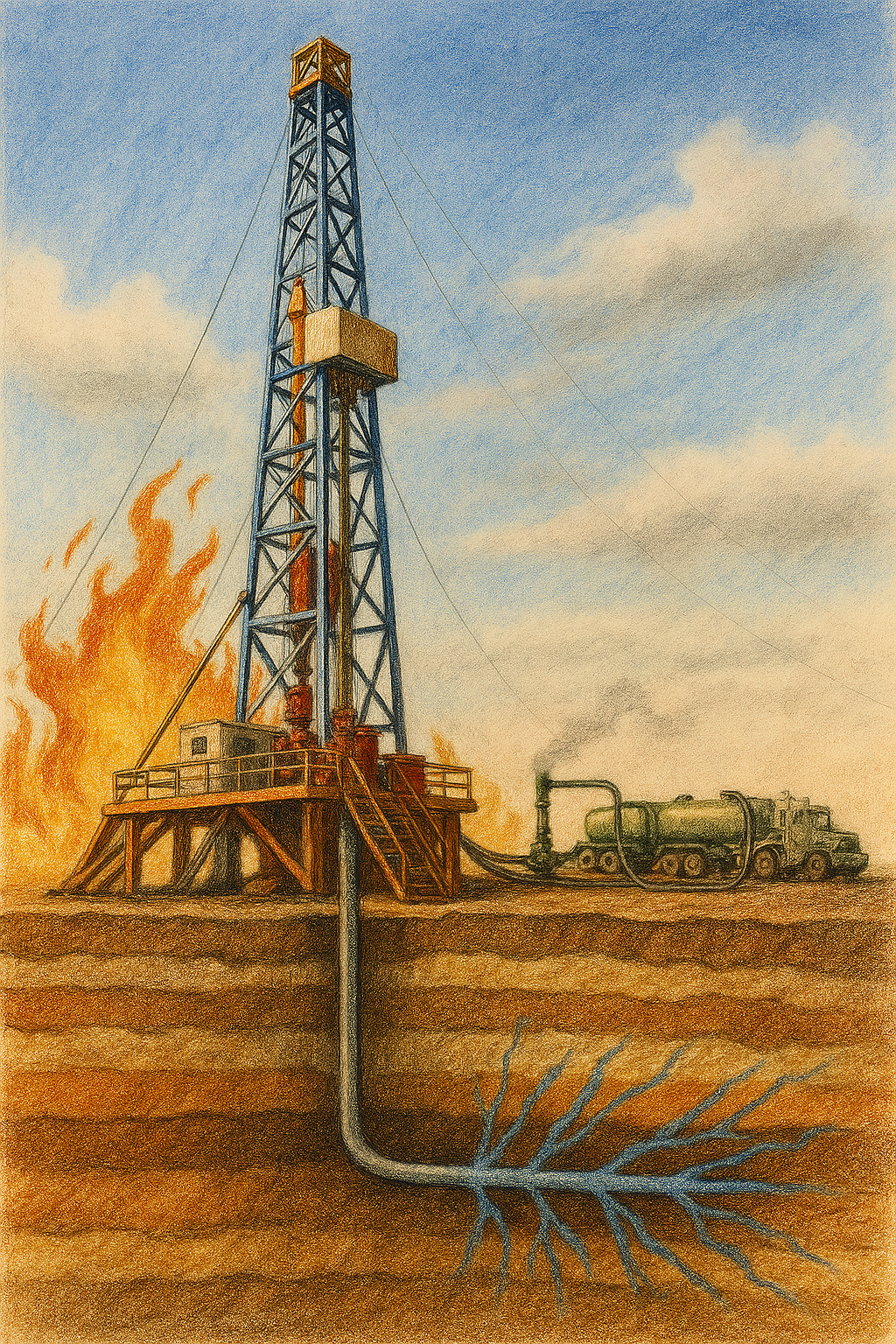
Drilling in the oil and gas industry refers to the complex, multi-stage operation of penetrating the Earth’s surface to reach underground reservoirs of hydrocarbons. It begins with site selection and permitting, followed by the deployment of a drilling rig—a towering structure equipped with rotary systems, drill bits, and support equipment.
The process involves rotating a drill bit attached to a drill string to cut through layers of rock, while drilling mud is circulated to cool the bit, stabilize the borehole, and transport rock cuttings to the surface.
As the well deepens, casing (steel pipe) is inserted and cemented in place to prevent collapse and isolate different geological zones. Engineers use bottomhole assemblies (BHAs) and directional drilling techniques to steer the well toward target formations, maximizing exposure to productive zones.
The entire operation is guided by formation evaluation data, real-time sensors, and geophysical models. Drilling culminates in reaching the reservoir, after which the well may be completed for production or plugged if unviable.
Fracking, short for hydraulic fracturing, is a well stimulation technique used after drilling to unlock hydrocarbons trapped in low-permeability rock formations such as shale. The process involves injecting a high-pressure mixture of water, sand (proppants), and chemical additives into the wellbore.
This fluid travels through perforations in the casing and creates fractures in the surrounding rock. The sand particles remain lodged in these fractures, keeping them open and allowing oil or gas to flow more freely to the surface.
Fracking is not a drilling method but a post-drilling enhancement that dramatically increases production rates in unconventional reservoirs.
It has been widely adopted since the 1940s and is responsible for unlocking vast energy reserves across North America.
Despite its effectiveness, fracking raises environmental concerns, including water usage, chemical management, induced seismicity, and surface impacts, prompting regulatory oversight and technological innovation to improve safety and transparency.
BitcoinVersus.Tech Editor’s Note:
We volunteer daily to ensure the credibility of the information on this platform is Verifiably True.
If you would like to support to help further secure the integrity of our research initiatives, please donate here: bc1qrved9tfquym6u3age7xhmnkjs2lq8j9aulperagkuhtuk5w5c35ssfpge8
BitcoinVersus.tech is not a financial advisor. This media platform reports on financial subjects purely for informational purposes.
 Bitcoin Versus
Leave a comment