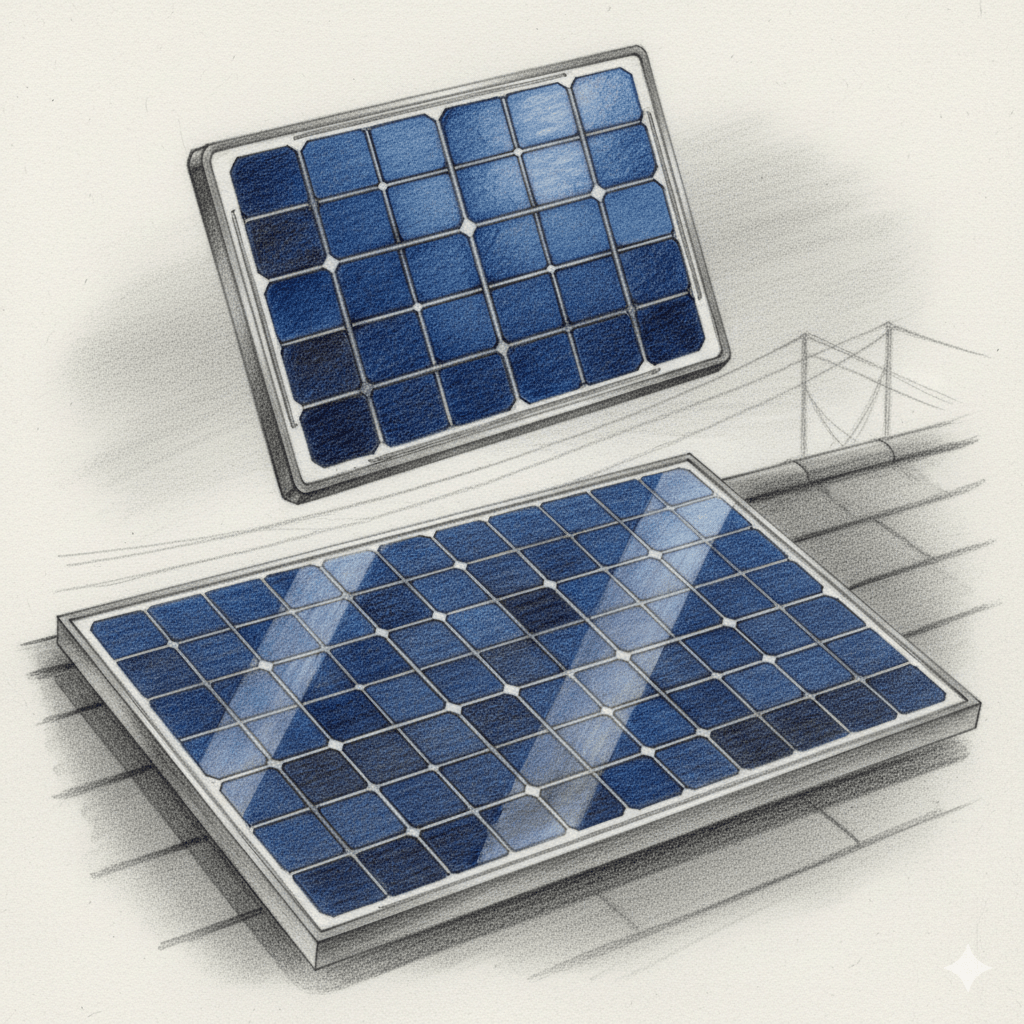
Solar cells, often called photovoltaic cells, are semiconductor devices that convert light from the sun directly into electrical energy.
They form the basic building block of solar panels and many other solar power systems.
Basic idea
A solar cell takes incoming light, absorbs part of that light inside a semiconductor, and turns the absorbed energy into the motion of electric charges.
When those charges are guided through metal contacts and an external circuit, they form a usable electric current that can power loads such as electronics, buildings, or parts of the electric grid.
Structure and materials
Most commercial solar cells are made from silicon, which is a semiconductor. A typical silicon solar cell contains several key parts:
- A transparent protective front layer, often glass, that lets light in and protects the device.
- An anti reflection coating that reduces the amount of light that bounces off the surface.
- A thin top region that has been doped to be n type, meaning it has extra electrons available as charge carriers.
- A thicker underlying region that has been doped to be p type, meaning it has extra holes, or missing electrons, that behave as positive charge carriers.
- Metal contacts on the front and back that collect charge and connect the cell to external wiring.
- Encapsulant and backing material that provide mechanical strength and environmental protection.
The boundary where the p type and n type regions meet is called a p n junction. The junction creates an internal electric field that is central to how a solar cell operates.
Although crystalline silicon dominates the market, many other materials can be used, such as amorphous silicon, cadmium telluride, copper indium gallium selenide, and newer materials such as perovskites and organic semiconductors.
How a solar cell works
When sunlight reaches the solar cell, photons enter the semiconductor and may be absorbed. If a photon has enough energy, absorption promotes an electron from a bound state in the valence band to a higher energy state in the conduction band. After that promotion there is an electron in the conduction band and a hole left behind in the valence band.
Near the p n junction, there is a built in electric field that pushes electrons toward the n type side and holes toward the p type side. In other words, the junction separates the electron hole pair before they recombine. Once separated, electrons travel through the n type region into the front metal contact, then through the external circuit, where they can do useful work, and finally return through the back contact to the p type region.
The cell develops a voltage between its front and back contacts because of the separation of charge and the internal electric field. When the cell is connected to a load, current flows. The product of voltage and current gives the output electrical power.
Electrical behavior
The current and voltage of a solar cell depend on light level and on the electrical load connected to it. Under illumination, a solar cell behaves somewhat like a current source in parallel with a diode. At one extreme, with the terminals open, the cell delivers an open circuit voltage. At the other extreme, with the terminals shorted, the cell delivers a short circuit current.
For any given level of sunlight, there is a particular combination of current and voltage called the maximum power point where the product of current and voltage is highest. Power electronics in solar systems, such as maximum power point trackers, are designed to operate cells and modules close to that point.
Efficiency and performance measures
The efficiency of a solar cell is the ratio of electrical power output to the solar power incident on the cell surface. For example, if sunlight delivers a certain number of watts per square meter and the cell produces a smaller number of watts per square meter of electrical power, the ratio gives the efficiency.
Several factors affect efficiency:
- Band gap of the semiconductor, which sets what fraction of the solar spectrum can be usefully absorbed.
- Quality of the crystal and purity of the material, which influence how often carriers recombine before reaching the junction.
- Optical effects, such as reflection losses and how deeply light penetrates into the device.
- Electrical losses, such as resistive losses in the semiconductor and in the metal contacts.
- Temperature, since higher temperature usually reduces voltage and lowers efficiency.
Engineers also use practical measures like fill factor, which compares the maximum obtainable power to the ideal product of open circuit voltage and short circuit current, and they test performance under standard test conditions for fair comparison.
Types of solar cells
Several main categories of solar cells are used or studied.
Crystalline silicon solar cells use wafers of silicon with well controlled doping and crystal structure. Monocrystalline cells use a single crystal and generally achieve higher efficiency, while multicrystalline cells use many crystal grains and can be less expensive.
Thin film solar cells deposit very thin layers of semiconductor on glass, metal, or flexible substrates. Examples include cadmium telluride and copper indium gallium selenide. These cells can reduce material usage and sometimes allow lightweight or flexible modules.
Emerging solar cells include perovskite cells, organic cells, quantum dot cells, and tandem structures that stack materials with different band gaps in order to capture more of the solar spectrum. Research focuses on achieving higher efficiency, lower cost, and longer lifetime.
From cells to modules and systems
A single solar cell produces only a limited voltage and current. Manufacturers connect many cells in series and parallel inside a protective frame to create a module, often called a solar panel. Modules are then connected together into strings and arrays in order to reach the power level required for a home, business, or utility scale plant.
In a complete photovoltaic system, the solar array connects to power electronics such as inverters, which convert the direct current output of the modules into alternating current suitable for the grid or for local loads. Systems may also incorporate charge controllers and batteries for energy storage, as well as monitoring and safety equipment.
Advantages and limitations
Solar cells provide electrical energy from sunlight, which is a renewable resource. They operate silently, have no moving parts in normal use, and can be deployed at many scales, from milliwatt devices that power calculators to gigawatt scale solar farms.
At the same time, solar power output depends on weather and time of day and therefore does not match demand on its own. Large areas are often needed to generate high power levels, and energy storage or complementary generation sources can be required to balance supply and demand. Manufacturing also involves energy and materials that must be managed responsibly.
Even with those challenges, solar cells remain one of the most important technologies for converting sunlight into electricity, and ongoing advances in materials, device design, and manufacturing continue to improve their performance and lower their cost.Extended thinking
BitcoinVersus.Tech Editor’s Note:
We volunteer daily to ensure the credibility of the information on this platform is Verifiably True.
If you would like to support to help further secure the integrity of our research initiatives, please donate here: bc1qrved9tfquym6u3age7xhmnkjs2lq8j9aulperagkuhtuk5w5c35ssfpge8
BitcoinVersus.tech is not a financial advisor. This media platform reports on financial subjects purely for informational purposes.
 Bitcoin Versus
Leave a comment