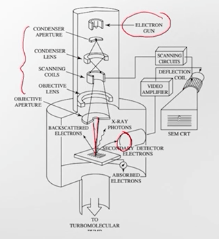
Scanning Electron Microscopy, or SEM, is a way to take very close‑up pictures of tiny things by shooting a thin beam of electrons onto a sample and moving the beam back and forth like a scanner.
When the electrons hit the surface, they knock out other electrons and sometimes cause the material to emit X‑rays; special detectors collect these signals and turn them into bright or dark spots on a screen, forming an image that shows the shape and texture of the surface with detail down to a few nanometers—far finer than ordinary light microscopes can see.
The main parts of an SEM are an electron gun that creates the beam, magnetic lenses that focus it, tiny coils that steer it in a raster pattern, and detectors that pick up the secondary electrons (which tell us about surface bumps) and back‑scattered electrons (which give clues about the material’s composition).
By adjusting the beam’s voltage and the detector settings, scientists can also identify what elements are present using the X‑ray signals.
Because it works in a vacuum and can handle a wide range of materials, SEM is widely used in fields like biology, electronics, metallurgy, and forensic science to explore the tiny structures that make up everyday objects.
Cover Image Credit: Arizona State University
BitcoinVersus.Tech Editor’s Note:
We volunteer daily to ensure the credibility of the information on this platform is Verifiably True.
If you would like to support to help further secure the integrity of our research initiatives, please donate here: bc1qrved9tfquym6u3age7xhmnkjs2lq8j9aulperagkuhtuk5w5c35ssfpge8
BitcoinVersus.tech is not a financial advisor. This media platform reports on financial subjects purely for informational purposes.
 Bitcoin Versus
Leave a comment