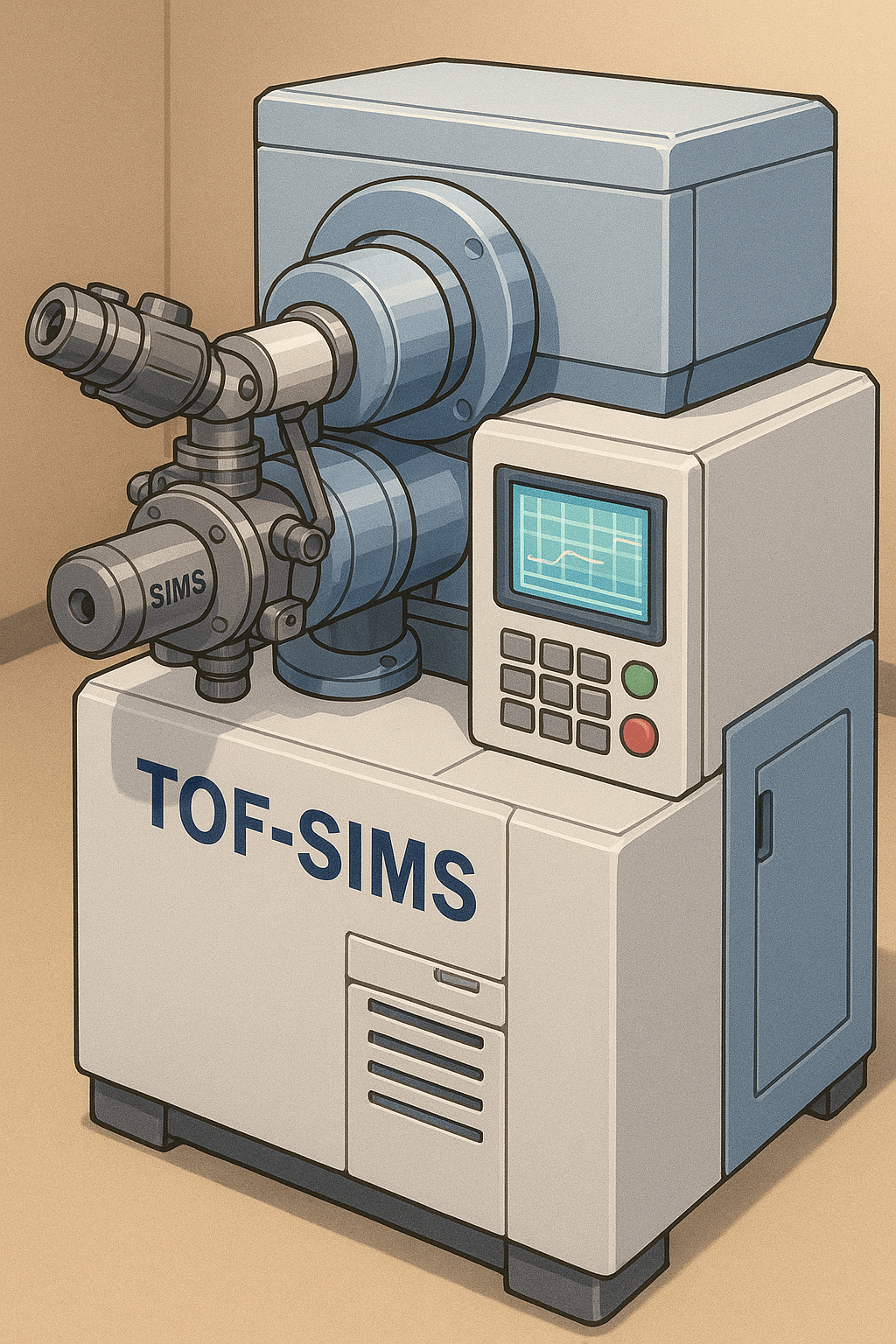
Time-of-Flight Secondary Ion Mass Spectrometry (TOF-SIMS) is a powerful technique used to analyze the surface of materials by detecting the chemical composition of just the outermost layers.
The technique allows for analysis of a chemical structure in 3D with nanoscale resolution.
In this method, a sample is bombarded with a focused beam of primary ions.
These ions hit the surface and knock out particles, including secondary ions, from the very top layer of the material.
The secondary ions are then accelerated into a mass spectrometer, where their “time of flight” is measured—that is, how long it takes them to travel through the instrument.
Because lighter ions travel faster than heavier ones, the instrument can separate them and determine their mass.
This allows scientists to identify what elements and molecules are present on the surface.
TOF-SIMS is especially useful for studying thin films, coatings, semiconductors, and biological samples, since it provides highly sensitive, detailed information about surface chemistry without needing to cut into the material.
BitcoinVersus.Tech Editor’s Note:
We volunteer daily to ensure the credibility of the information on this platform is Verifiably True.
If you would like to support to help further secure the integrity of our research initiatives, please donate here: bc1qrved9tfquym6u3age7xhmnkjs2lq8j9aulperagkuhtuk5w5c35ssfpge8
BitcoinVersus.tech is not a financial advisor. This media platform reports on financial subjects purely for informational purposes.
 Bitcoin Versus
Leave a comment