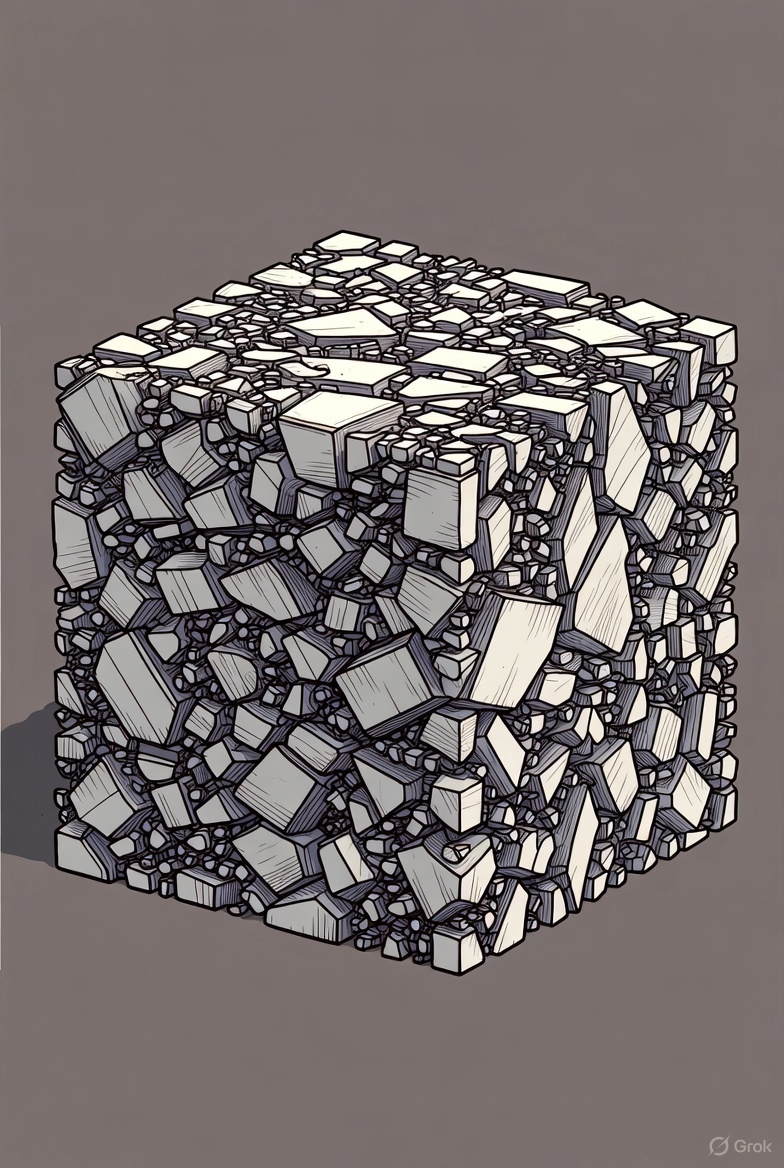
Polycrystalline silicon, often called poly-si, is a special material used to build the tiny pathways inside computer chips.
Its main job is to control the flow of electricity, and a key property it has is called resistance.
Resistance is how much a material slows down or fights against the electric current. Think of it like trying to push a ball through a pipe filled with sand; the sand creates resistance, making it hard for the ball to move quickly.
For a computer chip to work fast and properly, engineers need to carefully control the resistance of the poly-si pathways. If the resistance is too high, the electrical signals become slow and weak, making the chip sluggish. If it’s too low, it can cause other problems, like parts of the chip leaking power when they should be off.
Several key factors determine the resistance of a poly-si pathway.
The first is its grain structure. Poly-si isn’t a single, smooth crystal. Instead, it’s made of countless tiny crystal blocks, called “grains,” all stuck together. The borders where these different grains meet are called grain boundaries.
These boundaries act like speed bumps or walls for electricity. The more grain boundaries there are in the path, the more the electricity has to slow down and bump around, which greatly increases the resistance. Another major factor is doping.
This is the process of adding a very small number of specific impurity atoms, like phosphorus or boron, to the silicon.
These added atoms are like adding special “conducting helpers” that make it much easier for electrons (the particles that carry electricity) to move. If there aren’t enough of these helpers, the resistance will be very high.
A third factor is the surface roughness. This is about how smooth the top of the poly-si pathway is.
A rough, bumpy surface is harder for electricity to travel across than a perfectly smooth one, just like it’s harder to walk across a rocky field than a paved road, and this also increases the resistance.
When engineers need to lower the resistance of poly-si, they work on these exact factors. To fix the problem of too many grain boundaries, they use a process called annealing.
This involves heating the material to a very high temperature for a short time. The heat gives the silicon atoms extra energy, allowing the tiny, mismatched grains to melt together just enough to form larger, smoother grains. With fewer grain boundaries, the electricity flows much more easily.
The annealing process also helps with the doping factor. The heat helps to “activate” the doping atoms, meaning it helps push these “conducting helpers” into the perfect spots within the silicon crystals so they can do their job effectively.
By carefully controlling the grain size, the amount of doping, and the smoothness of the surface, engineers can tune the resistance of poly-si to create fast, efficient, and powerful computer chips.
BitcoinVersus.Tech Editor’s Note:
We volunteer daily to ensure the credibility of the information on this platform is Verifiably True.
If you would like to support to help further secure the integrity of our research initiatives, please donate here: bc1qrved9tfquym6u3age7xhmnkjs2lq8j9aulperagkuhtuk5w5c35ssfpge8
BitcoinVersus.tech is not a financial advisor. This media platform reports on financial subjects purely for informational purposes.
 Bitcoin Versus
Leave a comment