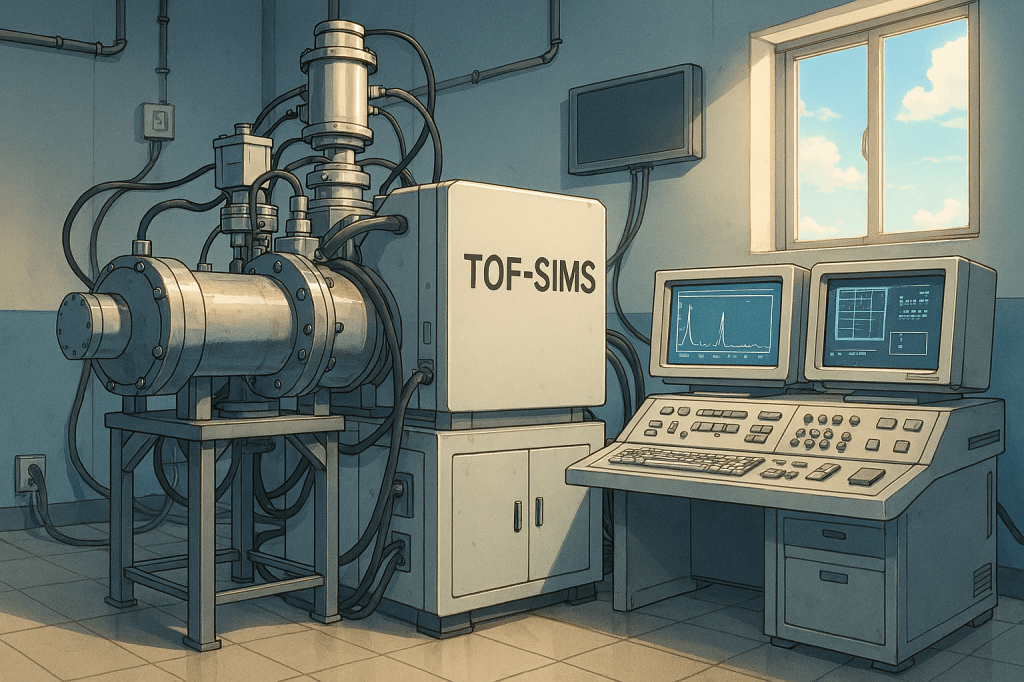
SIMS (Secondary Ion Mass Spectrometry) instrumentation is designed to analyze the surface composition of materials by detecting ions ejected from the surface.
The system includes a primary ion source that fires a focused beam of ions (like gallium or cesium) onto the sample.
This bombardment knocks atoms and molecules off the surface, some of which become ionized—these are called secondary ions.
These ions are then collected and sent through a mass analyzer, often a Time-of-Flight (TOF) tube, which measures how long each ion takes to reach the detector.
Because lighter ions travel faster than heavier ones, the instrument can identify their mass and determine what elements or molecules are present on the surface.
The entire setup operates under high vacuum to prevent interference from air molecules.
SIMS spectra are graphs that show the number of detected ions versus their mass-to-charge ratio (m/z). Each peak in the spectrum represents a specific ion, and its height indicates how much of that ion was found.
These spectra can reveal the presence of elements, isotopes, and even complex organic molecules.
In TOF-SIMS, the spectra are especially rich because the technique is sensitive to a wide range of masses and can detect even trace amounts of material.
Scientists use these spectra to create chemical maps of surfaces, study contamination, analyze thin films, and investigate semiconductor layers with nanometer-scale precision.
BitcoinVersus.Tech Editor’s Note:
We volunteer daily to ensure the credibility of the information on this platform is Verifiably True.
If you would like to support to help further secure the integrity of our research initiatives, please donate here: bc1qrved9tfquym6u3age7xhmnkjs2lq8j9aulperagkuhtuk5w5c35ssfpge8
BitcoinVersus.tech is not a financial advisor. This media platform reports on financial subjects purely for informational purposes.
 Bitcoin Versus
Leave a comment