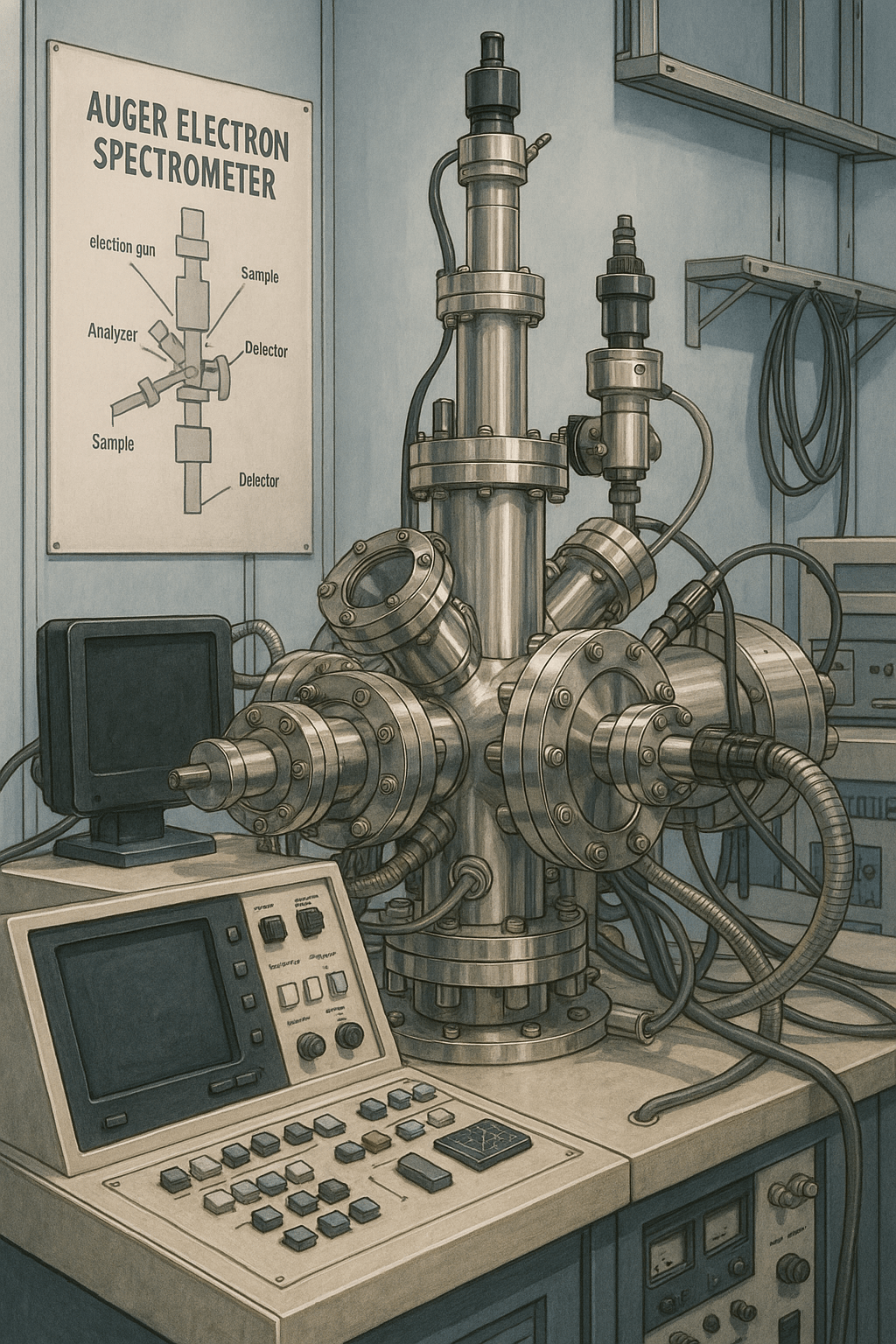
Auger Electron Spectroscopy (AES) is a powerful surface-sensitive analytical technique widely used in materials science to investigate the elemental composition of the outermost atomic layers of a sample.
Unlike bulk characterization methods, AES focuses specifically on the top few nanometers of a material, making it invaluable for studying thin films, coatings, and surface modifications.
The principle behind AES lies in the Auger effect, a relaxation process that occurs when an atom’s inner-shell electron is removed—typically by bombardment with a high-energy electron beam.
This vacancy is then filled by a higher-energy electron from an outer shell, and the excess energy released in the process is transferred to another electron, which is subsequently ejected from the atom.
This emitted particle, known as the Auger electron, carries an energy signature that is characteristic of the element from which it originated. By measuring and analyzing the energies of these Auger electrons, researchers can identify the elements present at the surface and even gain insights into their chemical states.
Because AES is highly surface-specific, it has become a critical tool in fields such as semiconductor fabrication, corrosion studies, catalysis, and nanotechnology, where understanding the composition and behavior of surfaces is essential to advancing both fundamental science and practical applications.
BitcoinVersus.Tech Editor’s Note:
We volunteer daily to ensure the credibility of the information on this platform is Verifiably True.
If you would like to support to help further secure the integrity of our research initiatives, please donate here: bc1qrved9tfquym6u3age7xhmnkjs2lq8j9aulperagkuhtuk5w5c35ssfpge8
BitcoinVersus.tech is not a financial advisor. This media platform reports on financial subjects purely for informational purposes.
 Bitcoin Versus
Leave a comment