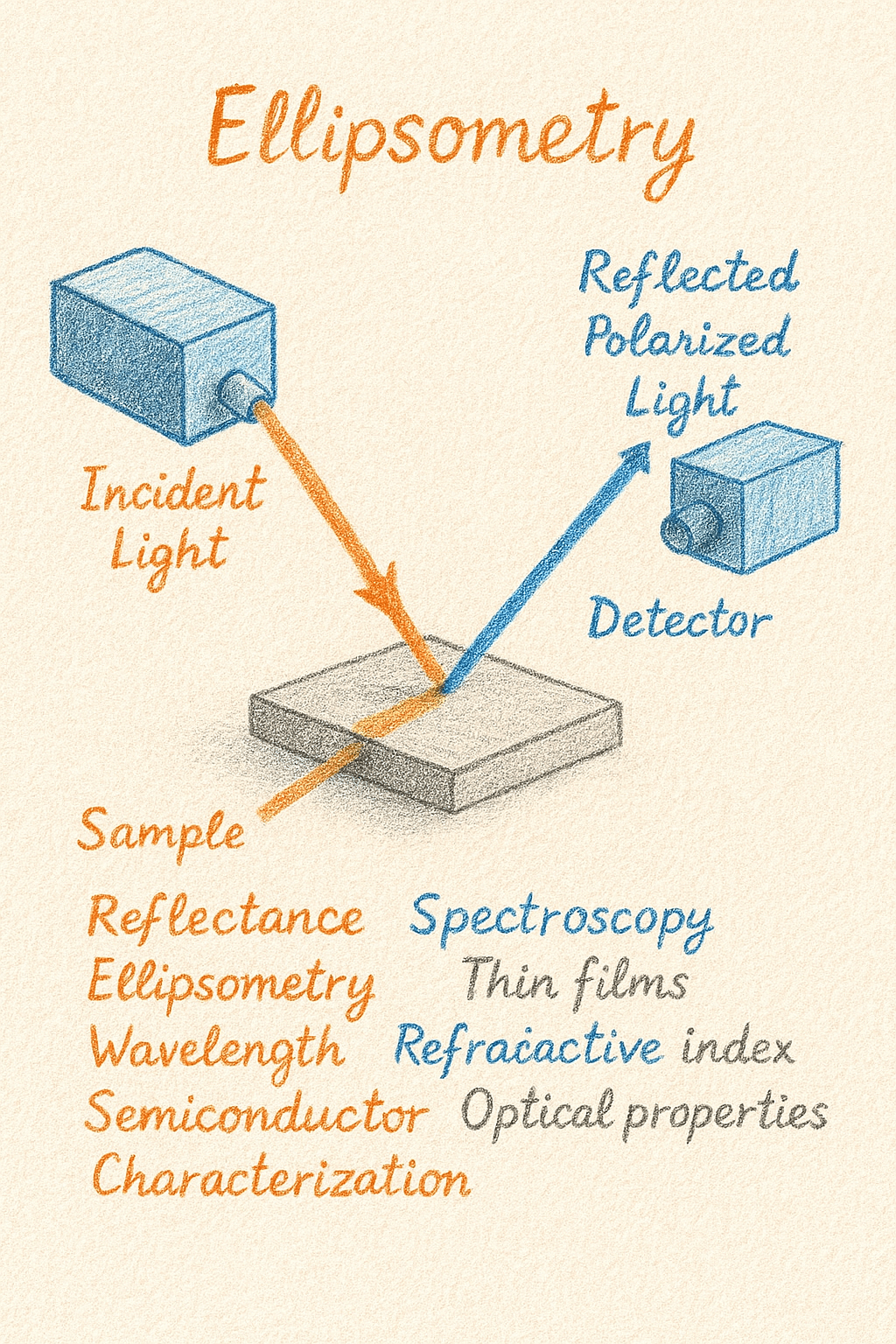
Ellipsometry is an advanced optical technique used to characterize thin films and surfaces by analyzing changes in the polarization of light upon reflection or transmission.
In practice, a beam of polarized light is directed at a material, and the reflected or transmitted light undergoes a change in polarization that is measured as two parameters: the amplitude ratio (Ψ) and the phase difference (Δ).
These values are highly sensitive to the material’s optical properties and structural features, allowing ellipsometry to determine film thickness, refractive index, dielectric function, and even composition, crystallinity, roughness, and doping concentration.
Because it is non-destructive and extremely precise, ellipsometry is widely used in semiconductor manufacturing, materials science, and nanotechnology, where accurate control of thin films is critical.
Modern spectroscopic ellipsometers extend the technique across a broad wavelength range, enabling detailed analysis of complex multilayer structures. Beyond physics and engineering, ellipsometry has also found applications in biology and medicine, where it helps study biomolecular films and liquid interfaces.
BitcoinVersus.Tech Editor’s Note:
We volunteer daily to ensure the credibility of the information on this platform is Verifiably True.
If you would like to support to help further secure the integrity of our research initiatives, please donate here: bc1q5qgtq8szqa6yy38tqpsyuk3hynq8zy3xvqhsvzecj8lnryrnzhmqsfmwhh
 Bitcoin Versus
Leave a comment