It will take some time to figure out if tracking the energy efficiency and computational power progression of the bitcoin ASIC Mining Machine has anything to do with the anticipated value of bitcoin.
Under the current parameters of the model, Power Efficiency Theory suggests that Bitcoin could approach roughly $2-$3 million per coin by 2045, implying a network valuation near $55-$60 trillion if the technological progression of ASIC hardware continues along its current trajectory.
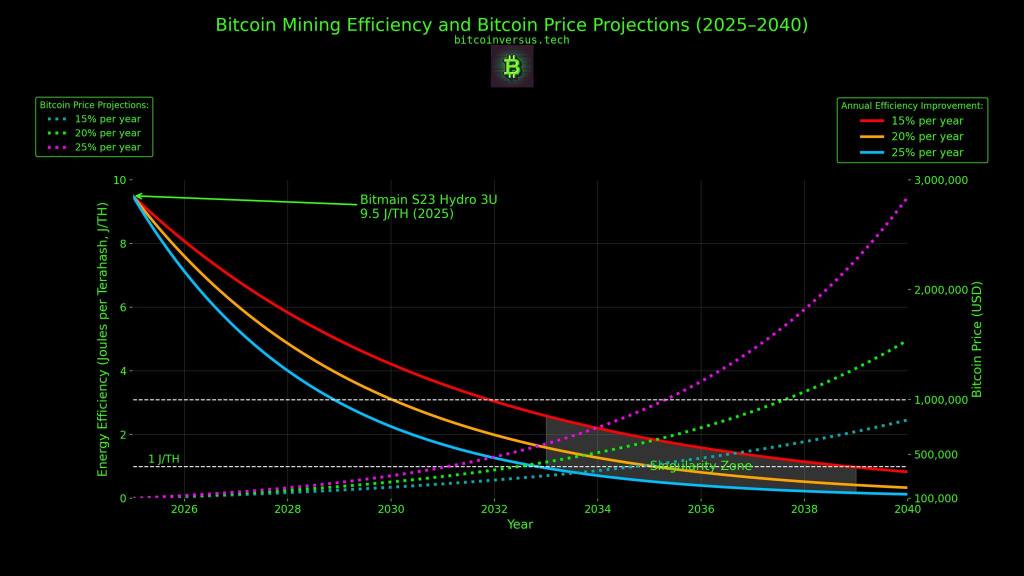
New insight in humanity rarely begins with an answer. It usually begins with a problem or a question.
Whether a solution can be found determines whether a fundamental breakthrough occurs.
That process is how mathematics develops and how cultural progress unfolds.
If a problem in society can be solved through reasoning and measurement, then that is the most meaningful kind of math.
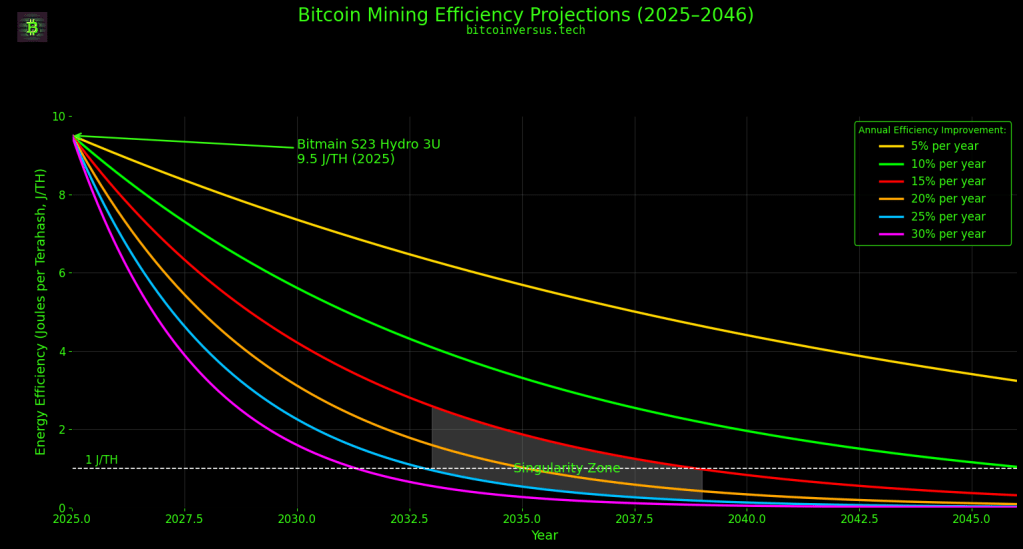
Bitcoin allows systems to be measured in a different way because the protocol operates within the laws of physics.
The metrics behind compute power and efficiency are the most accurate way to measure the value of bitcoin. if the compute power (hashrate) of a machine or if the ASIC Chip efficiency (J/TH/s) of machine improves, then not only is that hardware more valuable, but that hardware online at scale makes the entire mechanism (the bitcoin protocol) more valuable as time goes on.
Bitcoin can therefore be viewed as secure, powerful, or valuable in relation to its individual systemic energy capacity rather than being assigned an arbitrary price through a weakening inflationary unit such as the United States dollar.
I contend that there may be a way to measure the long term progression of Bitcoin’s value.
Interestingly, estimating price was almost accidental. My original focus was to answer questions such as:
“When will the first 1 PH/s or 10 PH/s machine arrive at scale in production?”
Or,
“When will the first 1 J/TH ASIC machine arrive?”
Because those questions involve measurable performance metrics, the answers ultimately had to be expressed mathematically.
And the answer to those questions isn’t really spoken in English. You have to speak it in math. The original language looks like this:
Where:
• represents the starting value
• represents computational power growth
• represents energy efficiency improvement
• represents initial market lag
• represents lag decay
• represents time
Within the context of Bitcoin mining, value becomes proportional to a power efficiency progression combined with a contraction variable that anticipates diminishing volatility as the asset matures.
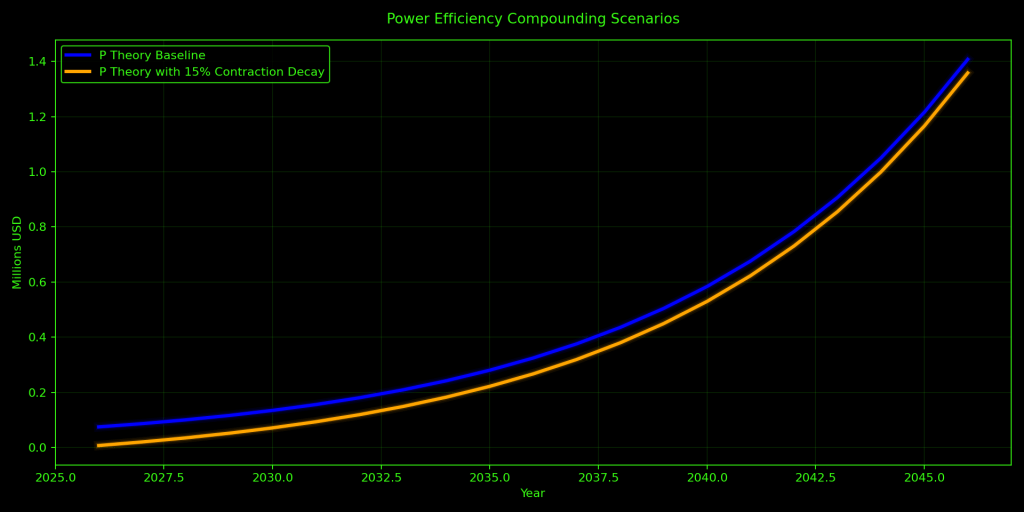
In practical terms, downturns still occur. However, as the system matures, the severity of those downturns may decline.
Instead of the fifty percent corrections historically seen in Bitcoin markets, future cycles might trend closer to ten or twenty or thirty percent corrections as the asset becomes more established.
Bitcoin Mining Power Efficiency Theory ultimately proposes that the long term value of the Bitcoin protocol can be interpreted through measurable technological progress rather than purely monetary speculation.
By observing the rate at which computational power increases and energy efficiency improves within ASIC mining hardware, it becomes possible to approximate the expanding productive energy capacity securing the network.
Individual machines act as measurable units of that larger system, and as their performance improves and scales across the global mining infrastructure, the collective strength and economic significance of the protocol grows alongside it.
Whether the model proves perfectly accurate remains a question that only time can answer, but over the coming decades the progression of ASIC hardware will reveal whether Bitcoin’s value is best understood not simply through market sentiment, but through the physics, engineering, and energy efficiency that ultimately sustain the network itself.
BitcoinVersus.Tech Editor’s Note:
We volunteer daily to ensure the credibility of the information on this platform is Verifiably True. I
If you would like to support to help further secure the integrity of our research initiatives, please donate here: 3C9o19EH5HSiwEPyCTmEKzxhNCbo2X6TTb
BitcoinVersus.tech is not a financial advisor. This media platform reports on financial subjects purely for informational purposes.
 Bitcoin Versus
Leave a comment