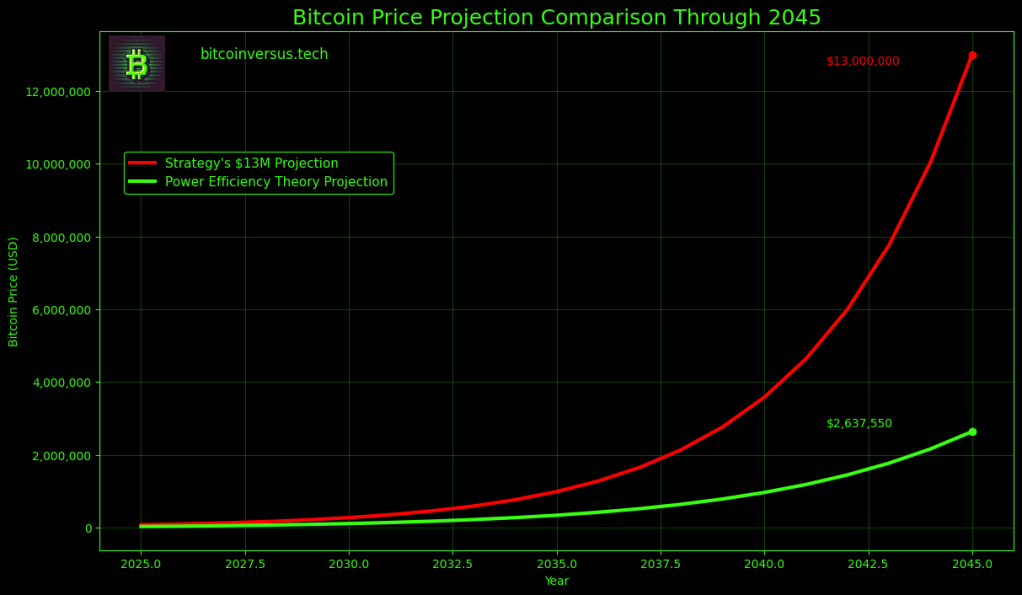
Michael Saylor, executive chairman of Strategy, has forecast that Bitcoin could reach $13 million per coin by 2045, implying a network value approaching $280 trillion. In interviews with CNBC, Saylor argued that Bitcoin could capture roughly 7 percent of global capital markets, far above its current share of global wealth.
His projection assumes large scale capital migration from traditional financial assets into Bitcoin over the next two decades.
Saylor’s company has positioned itself at the center of the Bitcoin treasury movement. Strategy has accumulated hundreds of thousands of BTC since 2020 and remains the largest publicly traded corporate holder of the asset.
The firm has repeatedly raised capital through equity and debt to expand its Bitcoin position, arguing that Bitcoin represents a superior long term reserve asset compared with traditional treasury strategies.
While Saylor’s thesis relies primarily on capital inflows and monetary adoption, Power Efficiency Theory evaluates Bitcoin from a different perspective.
Michael Saylor’s widely cited Bitcoin projection model assumes price growth driven by capital migration into Bitcoin from global asset classes such as gold, real estate, and sovereign bonds.
In mathematical form, the model resembles a traditional compound growth equation where Bitcoin price grows at a fixed annual rate as adoption expands. Power Efficiency Theory proposes a different mechanism. Instead of modeling capital inflows, the theory measures Bitcoin’s underlying computational productivity, defined by the growth of network hashrate and improvements in ASIC energy efficiency.
Instead of modeling price purely through macroeconomic demand, the Power Efficiency Theory analyzes the technological progression of the machines securing the network, particularly improvements in ASIC computational output and energy efficiency.
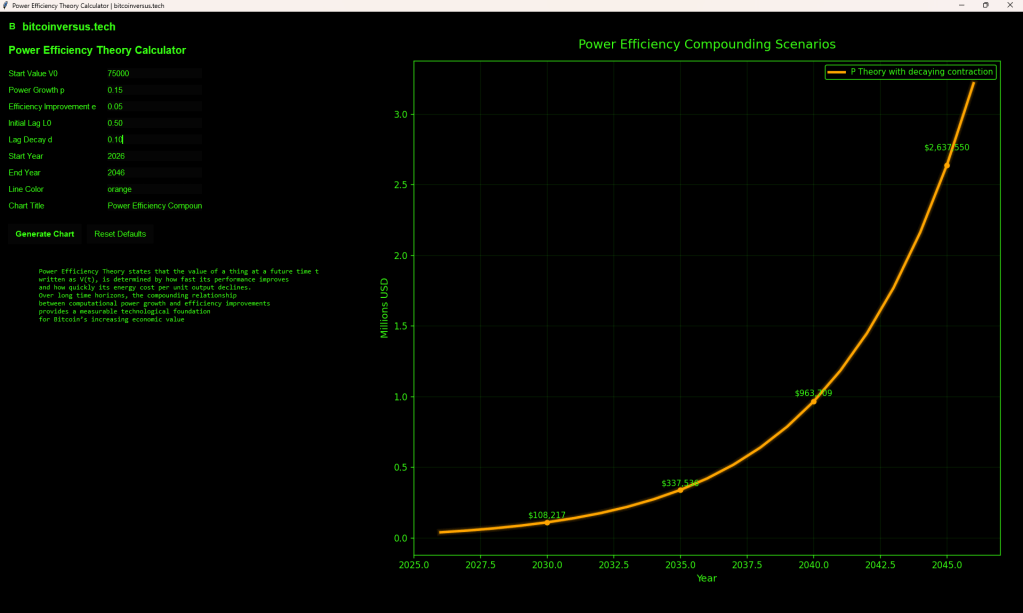
The core premise suggests that Bitcoin’s value rises as the productive computational energy or joule per terahash efficiency of the ASIC machine increases.
In other words, the machine becomes the measurement instrument. Improvements in ASIC performance reveal the expanding computational energy securing the Bitcoin network, allowing Bitcoin’s value to be interpreted through measurable technological progress.
Computational Energy as the Foundation of Value
Power Efficiency Theory proposes that Bitcoin’s value is closely tied to the amount of cryptographic work the network can produce per unit of energy. Mining hardware evolves along two measurable axes:
1.Computational power growth measured through network hashrate (TH/s or PH/s).
2. Energy efficiency improvements measured through joules per terahash (J/TH/s).
When both variables improve simultaneously, the computational energy productivity of the Bitcoin network compounds over time, increasing the system’s security and economic value.
The relationship can be represented mathematically.
Where
V(t) represents projected value over time
V₀ represents starting value
p represents computational power growth
e represents efficiency improvements
L represents technological lag
d represents lag decay
x represents time measured in years
The equation models how improvements in computational output and energy efficiency compound together while accounting for the gradual removal of early technological limitations.
Mining Hardware Efficiency Is Measurable
Bitcoin mining efficiency improvements provide real world data supporting the model.
Early ASIC miners consumed extremely large amounts of energy per unit of computation, while modern systems have dramatically improved efficiency.
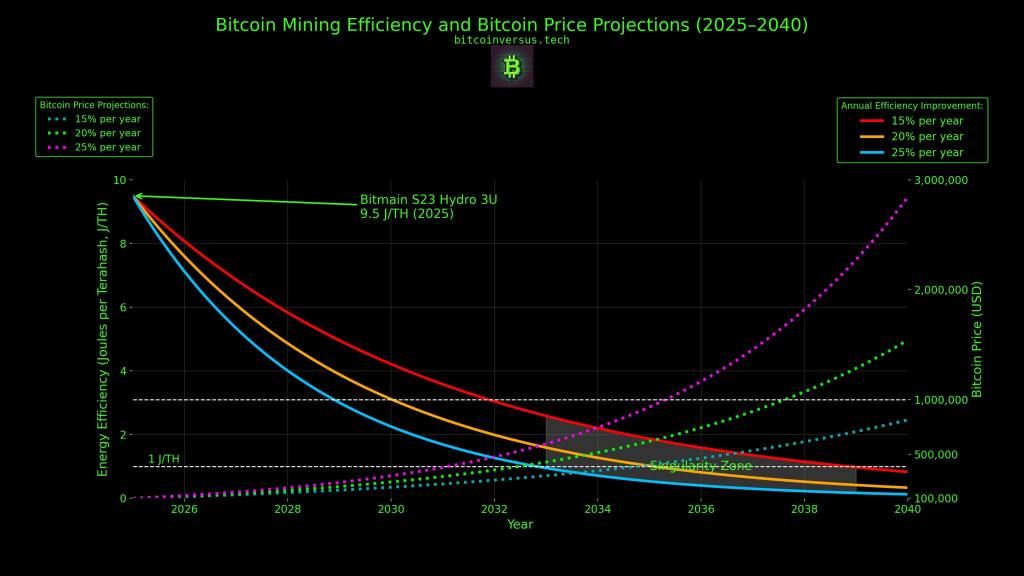
Recent mining hardware such as Bitmain’s hydro cooled ASIC machines operates near 9.5 joules per terahash, a massive improvement compared with early ASIC generations that required orders of magnitude more energy for the same computational output.
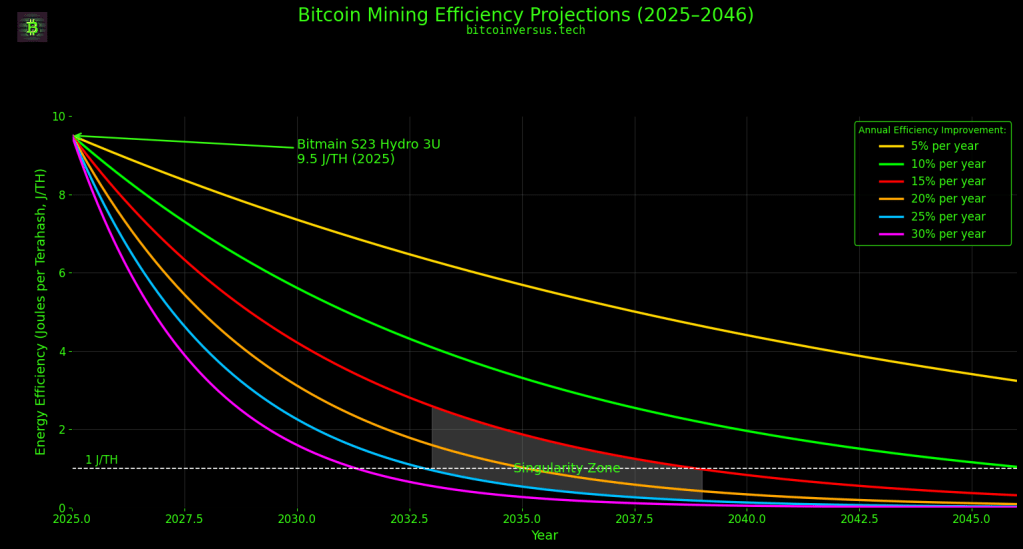
Projected improvements in Bitcoin mining hardware efficiency measured in joules per terahash (J/TH) beginning from a 9.5 J/TH baseline in 2025. Each curve represents a different annual efficiency improvement rate ranging from 5% to 30%.Higher improvement rates reach the 1 J/TH threshold earlier, with aggressive trajectories approaching the milestone around 2032–2034, while moderate rates reach the level closer to 2036–2039. Slower improvement rates delay the milestone well into the 2040s. The shaded Singularity Zone around 2033–2036 highlights the period where multiple efficiency trajectories converge toward sub-1 J/TH performance, indicating a potential technological inflection point for ASIC mining hardware.
Projected efficiency curves suggest that continued annual improvements between 15 percent and 25 percent could gradually push mining hardware toward the 1 J/TH range, although such gains become progressively harder as semiconductor physics approaches thermodynamic limits.
Power Efficiency Compounding and Price Projection
Using realistic assumptions, Power Efficiency Theory produces long term projections based on the compounding relationship between computational growth and energy efficiency.
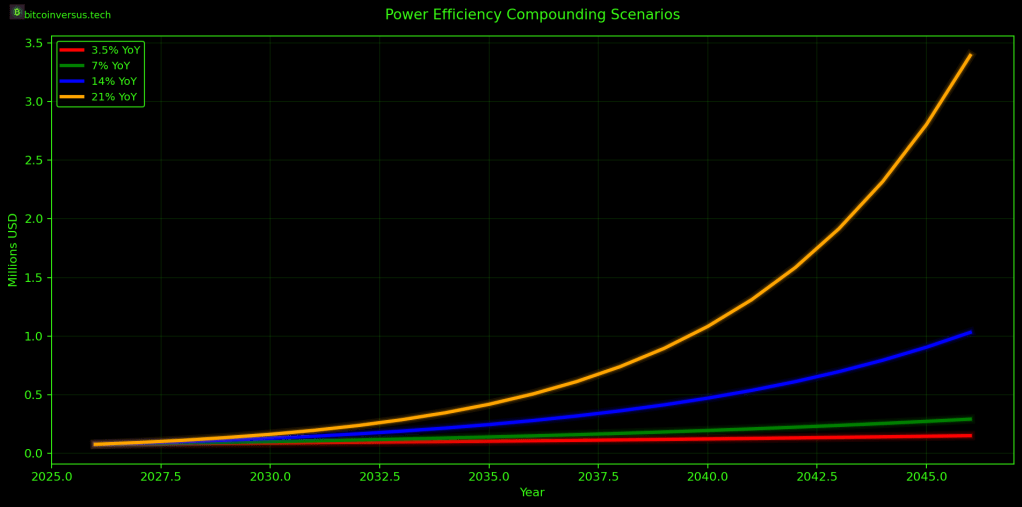
A recent calculation using the Power Efficiency Theory model assumes.
Starting Bitcoin value: $75,000
Computational power growth: 10 percent annually
Energy efficiency improvement: 5 percent annually
Under those assumptions the model produces an estimated trajectory approaching.
Approximately $517,000 per Bitcoin around 2040
Approximately $1.13 million per Bitcoin around 2045
Under slightly stronger technological improvement scenarios, projections approach $1.5 million per coin by the mid 2040s.
Market Capitalization Implications
If Bitcoin reached roughly $1.3 million per coin, the network would achieve a market capitalization near $28 trillion assuming the full supply of 21 million coins.
Within the Power Efficiency framework, such a valuation would already represent one of the most successful financial technologies ever created. The Bitcoin network would rival the historical market capitalization of gold and become one of the largest monetary assets in modern history.
By comparison, Saylor’s projection of $13 million per Bitcoin implies a market capitalization near $280 trillion, nearly an order of magnitude larger than the estimate produced by Power Efficiency modeling.
Technological Limits Matter
Another factor influencing the difference between projections involves physical constraints within semiconductor engineering.
As ASIC efficiency approaches the lower thermodynamic limits of computation, each improvement becomes more difficult to achieve. Semiconductor scaling, heat dissipation, and energy transfer limitations impose real constraints on hardware progression.
Because Power Efficiency Theory incorporates those technological realities, the model assumes continued exponential improvement in mining productivity but recognizes the diminishing returns encountered near physical limits of computation.
Bitcoin Value as Systemic Energy Capacity
The central conclusion of Power Efficiency Theory is simple.
Bitcoin can be viewed as secure, powerful, and economically valuable relative to the systemic computational energy capacity protecting its ledger.
As mining hardware becomes more efficient and global hashrate continues to expand, the network’s productive energy capacity grows. That expanding computational energy base becomes a measurable foundation for Bitcoin’s long term value.
Under that framework, projections between $1 million and $3 million per coin by 2045 remain extraordinarily bullish while remaining grounded in the technological trajectory of the mining industry.
A bitcoin network valued near $28 trillion would represent a historic economic milestone.
BitcoinVersus.Tech Editor’s Note:
We volunteer daily to ensure the credibility of the information on this platform is Verifiably True. I
If you would like to support to help further secure the integrity of our research initiatives, please donate here: 3C9o19EH5HSiwEPyCTmEKzxhNCbo2X6TTb
BitcoinVersus.tech is not a financial advisor. This media platform reports on financial subjects purely for informational purposes.
 Bitcoin Versus
Leave a comment