This DIY electronic solar tracker is a clever and simple project that helps a small solar panel automatically follow the sun to capture the maximum amount of sunlight throughout the day.
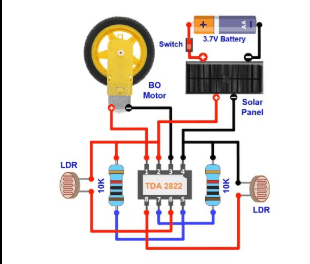
The schematic illustrates a simple automatic solar tracker that uses two light-dependent resistors (LDRs) to sense the direction of the brightest sunlight and drive a small DC gear motor (labeled “BO Motor”) to rotate a solar panel accordingly. The circuit is powered by a small solar panel supplemented by a 3.7V battery connected through a switch, providing continuous power even in low light.
The two LDRs, placed on opposite sides of the panel, form voltage dividers with 10kΩ resistors, feeding differential signals into a TDA2822 stereo audio amplifier IC repurposed as a motor driver.
When both LDRs receive equal light, their resistances balance the inputs and the motor stays still; when one side gets more light, its LDR lowers resistance, creating an imbalance that the TDA2822 amplifies to turn the motor in the correct direction until the panel faces the sun evenly again. This clever analog feedback system requires no microcontroller, making it an accessible single-axis tracker ideal for boosting the efficiency of small solar setups.
It works by using light-dependent resistors (LDRs), also known as photoresistors, which change their electrical resistance depending on how much light hits them—brighter light lowers the resistance, while dimmer light increases it. These LDRs are typically placed in pairs (or four for better accuracy) around the panel, so when the sun shines more strongly on one side, it creates an imbalance in the circuit.
This imbalance triggers small DC motors or a servo connected to a rotating swivel base, gently turning the panel until both sides receive equal light again, keeping the panel facing directly at the sun.Compared to a fixed solar panel, which can lose 30–40% of its potential energy as the sun moves across the sky, a tracker like this can boost energy output by 20–50%, depending on the location and design.
Many versions are low-cost and don’t even need a microcontroller—just basic electronic components—though some people add an Arduino for more precise control.
The rotating swivel mechanism allows for single-axis tracking (following the sun from east to west daily) or dual-axis (adding up-and-down movement for seasonal changes). It’s a popular hobby project that’s great for charging batteries or powering small gadgets more efficiently.
Overall, it’s an accessible way to get noticeably better performance from solar panels without complicated equipment.
BitcoinVersus.Tech Editor’s Note:
We volunteer daily to ensure the credibility of the information on this platform is Verifiably True.
If you would like to support to help further secure the integrity of our research initiatives, please donate here: bc1q5qgtq8szqa6yy38tqpsyuk3hynq8zy3xvqhsvzecj8lnryrnzhmqsfmwhh
 Bitcoin Versus
Leave a comment