
Solar inverters are essential devices in photovoltaic (PV) systems that convert the direct current (DC) electricity generated by solar panels into alternating current (AC) electricity, which is compatible with household appliances and the utility grid.
They serve as the “brain” of a solar energy system, not only enabling energy conversion but also managing system performance, safety, and grid interaction.
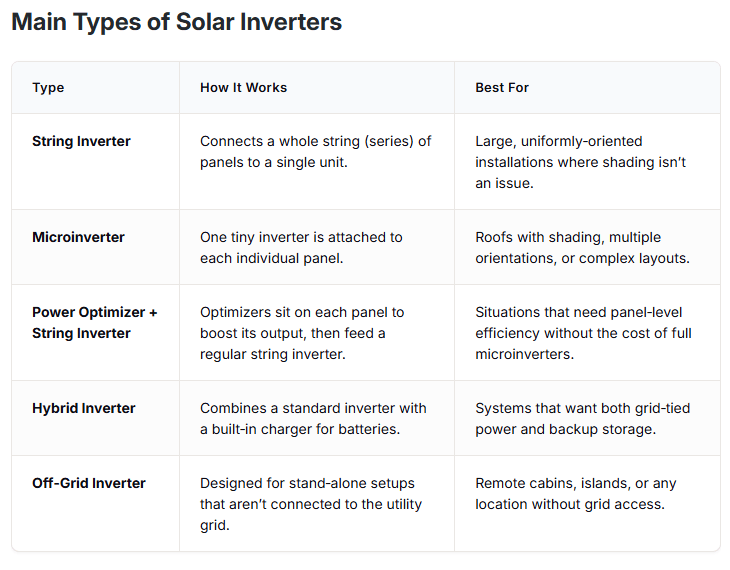
There are several main types of solar inverters, each suited to different applications: string inverters connect multiple panels in series and are cost-effective for uniform installations; microinverters are installed on individual panels, offering better performance in shaded or complex layouts; power optimizers work with string inverters to improve panel-level efficiency; hybrid inverters integrate battery storage for backup and load shifting; and off-grid inverters are designed for standalone systems in remote areas without grid access.
Advanced models often include features like Maximum Power Point Tracking (MPPT), anti-islanding protection, and smart monitoring capabilities to optimize energy yield and ensure safe operationVerde Solutions+1.
Quick Review
- String inverters are the most cost‑effective for simple, uniform roofs.
- Microinverters shine when panels face different directions or experience shading.
- Power optimizers give panel‑level gains while still using a single string inverter.
- Hybrid inverters add battery storage for backup or load‑shifting.
- Off‑grid inverters keep everything running when there’s no grid connection at all.
These options let homeowners and installers choose the right balance of cost, performance, and flexibility for any solar project.
BitcoinVersus.Tech Editor’s Note:
We volunteer daily to ensure the credibility of the information on this platform is Verifiably True.
If you would like to support to help further secure the integrity of our research initiatives, please donate here: bc1q5qgtq8szqa6yy38tqpsyuk3hynq8zy3xvqhsvzecj8lnryrnzhmqsfmwhh
 Bitcoin Versus
Leave a comment