Bitcoin valuation models often reflect the assumptions used to describe the network’s long term growth.
Some frameworks approach the problem from a macroeconomic perspective, estimating price through capital migration from traditional asset classes into Bitcoin.
Other approaches examine Bitcoin through the physical systems that secure the network itself. Mining hardware efficiency, semiconductor design improvements, and computational power provide measurable variables that evolve over time.
Examining those technological metrics introduces a different lens for understanding Bitcoin’s economic value, one grounded not only in financial adoption but also in the observable progression of computational infrastructure.
2 Different Equations: Capital Absorption Versus Computational Energy Productivity
Bitcoin price forecasts depend on the assumptions used to model long term growth.
One widely discussed projection comes from Michael Saylor, who argues Bitcoin could reach roughly $13 million per coin by 2045.
His base case assumes approximately twenty nine percent annual growth.
Under that scenario Bitcoin expands from about $65,000 per coin to a market capitalization approaching $280 trillion while capturing roughly seven percent of global wealth.
Mathematically the projection resembles a compound growth equation where price appreciation occurs at a constant annual rate over time.
In that expression represents the starting Bitcoin price, r represents annual growth rate, and x represents time in years. Using Saylor’s base assumptions the model can be approximated as:
where . Capital migration from traditional assets such as gold, real estate, equities, and sovereign bonds forms the foundation of the projection. Bitcoin functions as a digital store of value that gradually absorbs portions of global wealth over time.
The same concept can also be expressed using global wealth allocation.
In that equation represents total global wealth and represents Bitcoin’s share of that wealth. A seven percent share of global wealth results in a network value approaching $280 trillion. Dividing that value by the fixed supply of twenty one million coins produces the widely cited $13 million price projection.
Measuring Bitcoin As A Computational System
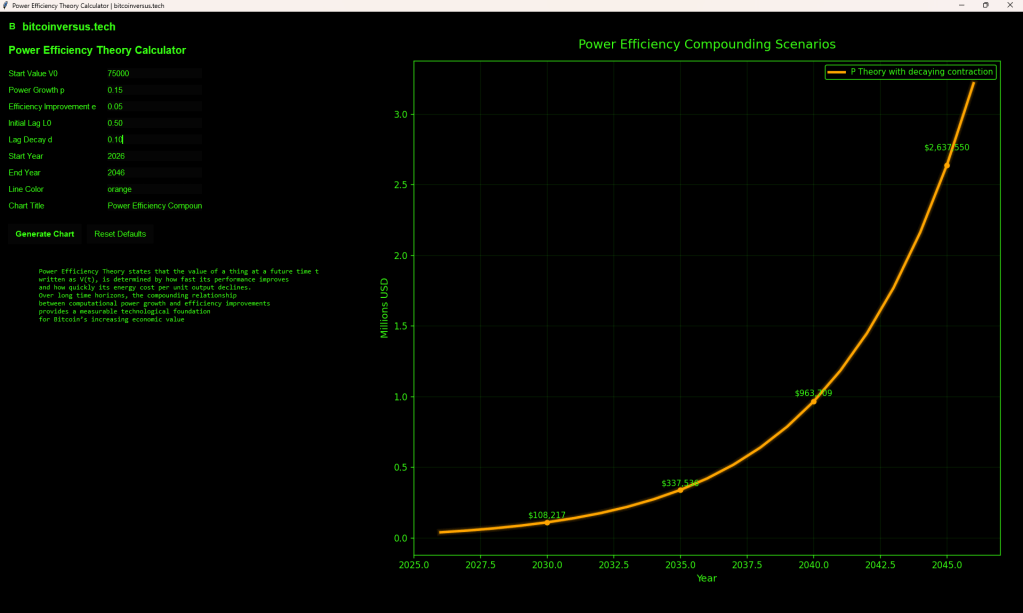
Power Efficiency Theory approaches Bitcoin valuation from a different perspective.
Instead of modeling price through capital migration, the theory examines Bitcoin as a global computational energy system whose economic capacity expands through improvements in hardware productivity.
The equation describing the system is:
p represents computational power growth.
e represents improvements in energy efficiency.
L represents initial market lag.
d represents decay of that lag over time.
x represents time.
Under that framework Bitcoin’s value grows as the network becomes capable of performing more cryptographic computation while consuming less energy for each unit of work.
Unlike macroeconomic adoption models, Power Efficiency Theory relies on variables that originate directly from the physical infrastructure of the network.
Metrics such as joules per terahash, ASIC chip efficiency, and machine hashrate capacity are measurable engineering quantities. Each generation of mining hardware produces new empirical data points that allow the progression of efficiency to be tracked with precision.
Structural Differences Between The Equations
Saylor’s framework relies primarily on a macroeconomic adoption dynamic. The growth engine consists of a single compounding driver.
Growth occurs as capital continues moving into Bitcoin from other asset classes.
Power Efficiency Theory introduces a different internal structure.
Growth depends on the relationship between two measurable technological variables. Increasing computational capacity expands total network processing power while improvements in energy efficiency reduce the energy required for each unit of computation.
The model also incorporates a lag decay component.
Infrastructure buildout, hardware upgrade cycles, and adoption delays introduce friction between technological advancement and economic recognition. The lag term gradually decays as the network matures.
Measurement Precision And Model Philosophy
The distinction between the two frameworks lies primarily in the type of variables used to estimate growth.
Capital absorption models operate at the macroeconomic level. Global wealth allocation, monetary adoption, and asset migration determine long term valuation.
Such variables remain difficult to measure with precision because they depend on behavioral and geopolitical dynamics.
Power Efficiency Theory focuses on the underlying technological infrastructure that secures the Bitcoin network. Mining hardware efficiency, chip design improvements, and machine level computational output produce quantifiable metrics.
Engineers can measure the exact number of joules required to compute one terahash of hashing power.
Because those variables originate from physical systems, the model evaluates Bitcoin through measurable technological progression rather than speculative capital allocation.
Hardware level metrics provide a deterministic foundation that can be observed directly in mining equipment.
What The Chart Demonstrates
The comparison chart illustrates how the two models diverge over time.
The compound growth curve derived from Saylor’s model produces a smooth exponential trajectory reaching roughly $13 million by 2045 under a constant twenty nine percent annual growth assumption.
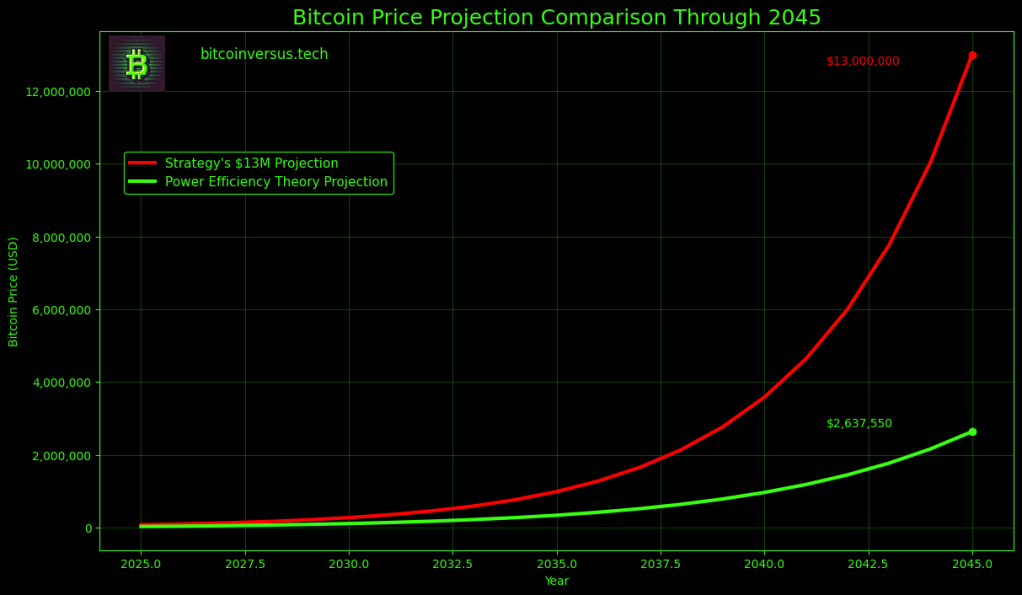
Power Efficiency Theory generates a different path because valuation depends on measurable improvements in computational productivity and energy efficiency. The trajectory reflects the pace at which mining hardware becomes capable of performing larger amounts of computation using less energy.
Both models attempt to describe the long term economic trajectory of Bitcoin. One framework views Bitcoin primarily as a monetary asset competing with traditional stores of value.
The other views Bitcoin as a global computational system whose economic capacity expands through measurable technological progress.
In simplified form, the difference between the two frameworks can be expressed mathematically.
The model proposed by Michael Saylor assumes Bitcoin price grows as capital flows into the network from other asset classes. Under that framework, valuation increases as adoption expands and a larger portion of global wealth migrates into Bitcoin.
The relationship can be expressed as:
Bitcoin price ∝ capital adoption
Power Efficiency Theory describes Bitcoin from a different perspective. The model evaluates the network as a computational system whose economic capacity increases as mining hardware becomes more powerful and more energy efficient. Improvements in ASIC chip design, machine level hashrate, and energy efficiency determine the productive capability of the network.
That relationship can be expressed as:
Bitcoin value ∝ computational energy productivity
Both frameworks attempt to explain the same phenomenon, yet each focuses on a different driver of growth. One examines capital flows into the asset, while the other measures the technological systems that allow the network itself to operate and expand.
Each framework highlights a different mechanism driving Bitcoin’s evolution. Capital absorption describes adoption dynamics at the macroeconomic level. Computational productivity describes the technological infrastructure that enables the network to operate securely and efficiently.
Understanding both perspectives provides a broader view of how Bitcoin may evolve as both a monetary system and a global computation network.
BitcoinVersus.Tech Editor’s Note:
We volunteer daily to ensure the credibility of the information on this platform is Verifiably True. I
If you would like to support to help further secure the integrity of our research initiatives, please donate here: 3C9o19EH5HSiwEPyCTmEKzxhNCbo2X6TTb
BitcoinVersus.tech is not a financial advisor. This media platform reports on financial subjects purely for informational purposes.
 Bitcoin Versus
Leave a comment