Information Technology
-

BIOS stands for Basic Input/Output System. It is firmware stored on a chip on the motherboard that initializes hardware components and loads the operating system. BIOS interfaces are text-based, and users access them by pressing keys like DEL, F2, or ESC during system startup. BIOS uses Legacy Boot, has limited drive support (up to 2.2…
-

When installing a CPU, it’s not just about matching sockets—proper thermal contact between the CPU and its cooler is critical for stability and longevity. This is where TIM (Thermal Interface Material), commonly referred to as thermal paste, plays a vital role. It fills microscopic gaps between the metal surfaces of the CPU heat spreader and…
-

Border Gateway Protocol (BGP) is the core routing protocol of the global Internet, responsible for exchanging reachability information between large, independently operated networks known as Autonomous Systems (ASes). It is classified as an Exterior Gateway Protocol (EGP) and operates as a path‑vector protocol, meaning it selects routes based on entire AS‑paths rather than simple metrics…
-

Information‑sharing partnership (often shortened in practice to “information partnership”) refers to a structured relationship in which two or more organizations agree to exchange security‑relevant information—such as threats, vulnerabilities, incidents, indicators of compromise, or best practices—in order to strengthen each participant’s overall security posture. It is built on the idea that no single organization has complete…
-
ICMP (Internet Control Message Protocol) is a network‑layer protocol used to send error messages, status information, and diagnostic signals between devices. It reports problems such as unreachable destinations or expired packet lifetimes and supports tools like ping and traceroute that test connectivity and measure network paths.” BitcoinVersus.Tech Editor’s Note: We volunteer daily to ensure the…
-

Installing Wireshark on Ubuntu is far easier through the terminal because Ubuntu already includes the correct Wireshark package in its official repositories. Instead of hunting through confusing alphabetical package indexes, mismatched versions, or multiple repository categories on the web, the terminal lets Ubuntu automatically detect your system version, architecture, and dependencies. A simple command like:…
-

Authentication is the process of verifying that a user, device, or system is truly who or what it claims to be. It answers the question, “Who are you?” and relies on credentials such as passwords, PINs, biometrics (like fingerprints or facial recognition), security tokens, or digital certificates. In essence, authentication establishes identity by checking provided…
-

Cache is a high‑speed data storage layer designed to keep frequently accessed information close to the processor, dramatically reducing the time it takes to retrieve that data. Instead of reaching all the way out to main memory or even slower storage, the CPU first checks the cache. When the requested data is already there, known…
-
A stream cipher is a form of symmetric encryption that protects data by processing it in a continuous flow, usually one bit or one byte at a time. Instead of working with large, fixed‑size blocks of data, a stream cipher generates a keystream—a long sequence of pseudorandom bits—derived from a secret key and sometimes an…
-

Nonrepudiation in computer security refers to the set of mechanisms, assurances, and cryptographic guarantees that prevent an individual or system from denying that a specific action, communication, or transaction took place. It ensures that when a message is sent, a file is signed, or a transaction is executed, there is irrefutable evidence linking that action…
-

Virtualization relies on three foundational requirements: equivalence, resource control, and efficiency. Equivalence means that a program running inside a virtual machine should behave exactly as it would on real hardware, with no modifications required. Resource control ensures that the virtual machine monitor (VMM) or hypervisor has full authority over hardware resources, preventing virtual machines from…
-
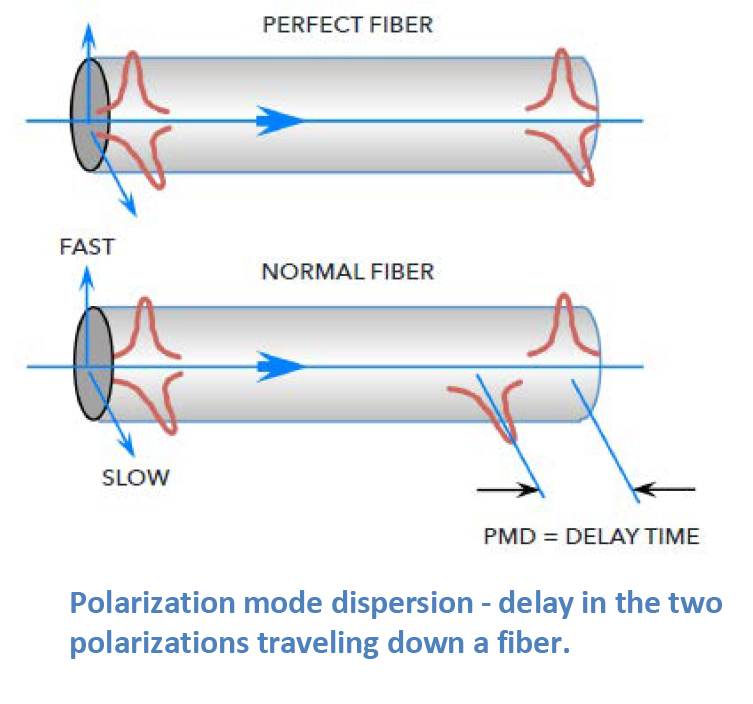
Polarization Mode Dispersion (PMD) refers to the distortion of optical signals caused by slight differences in the propagation speed of light’s polarization modes as they travel through fiber. In an ideal optical fiber, light of all polarization states should move uniformly. However, imperfections, asymmetries, and environmental stress within the fiber cause birefringence—splitting the light into…

