technology
-

Photoelectric measurement in industrial robotics is a high-precision sensing technique that relies on the detection of light to determine the position, movement, or presence of objects within an automated system. It typically involves a light source, optics, a scanning grid, and a photoelectric sensor that responds to changes in illumination caused by transitions between light…
-

Robot kinematics refers to the mathematical and geometric study of how robots move. It focuses on the relationships between joint angles, link lengths, and the position and orientation of the robot’s end effector (such as a gripper or tool). In industrial robots, kinematics helps engineers determine how to move a robotic arm from one point…
-

An Arizona lake has become the focus of an unusual scientific investigation as researchers and anglers examine a mystery involving buffalo fish that appear to live far longer than previously documented. Recent sampling efforts, tagging projects, and biological assessments have uncovered buffalo fish with unique markings and physical traits that suggest lifespans stretching past a…
-

Polarization Mode Dispersion (PMD) occurs when light traveling through a single-mode optical fiber splits into two orthogonal polarization components that propagate at slightly different velocities. This phenomenon is caused by random imperfections, asymmetries, and external stresses in the fiber, such as core ellipticity, bending, or temperature fluctuations. In an ideal fiber, both polarization modes would…
-

Polishing fiber is the final stage in preparing an optical fiber connector, ensuring a smooth, scratch-free end face that allows for minimal signal loss and optimal light transmission. The procedure begins after the fiber has been cleaved and secured in a connector ferrule using epoxy or a mechanical fit. Once the adhesive cures, the protruding…
-

WDM (Wavelength Division Multiplexing) is a method of combining multiple optical signals onto one fiber strand by assigning each signal a unique wavelength. These wavelengths act like separate channels, allowing parallel transmission of data without interference. This dramatically increases the capacity of fiber networks without laying additional fiber. Each signal is generated by a laser…
-

Fire safety in cable installations is a critical aspect of both data center and field operations, ensuring the protection of personnel, equipment, and infrastructure. The first step toward minimizing fire risk begins with selecting the correct cable type for the environment. Plenum-rated cables, labeled CMP, are designed for air-handling spaces such as ceiling voids or…
-

An Optical Loss Test Set (OLTS) is a specialized instrument used in fiber optic networks to measure the total optical loss across a fiber link. It combines a calibrated light source and a power meter to determine how much signal is lost as light travels from one end of the fiber to the other. This…
-

Near-End Crosstalk (NEXT) is a type of signal interference that occurs when a transmitted signal on one wire pair induces unwanted noise onto an adjacent pair at the same end of the cable where the signal originated. NEXT is most commonly encountered in twisted-pair cabling systems, such as those used in Ethernet networks. It happens…
-
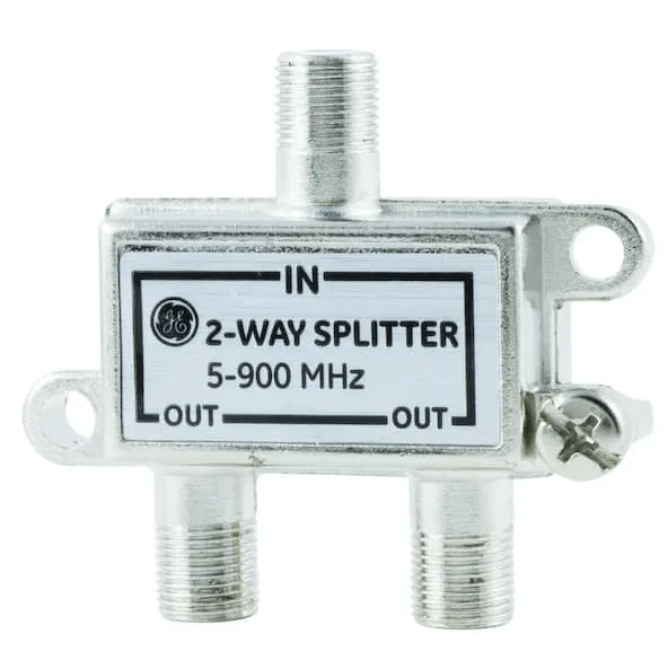
A splitter in terms of coaxial cable is a passive device that divides a single incoming radio frequency signal into multiple outputs, allowing several devices such as televisions, modems, or receivers to share the same signal source. It maintains a standard impedance of 75 ohms to prevent signal reflection and distortion, ensuring stable performance across…
-
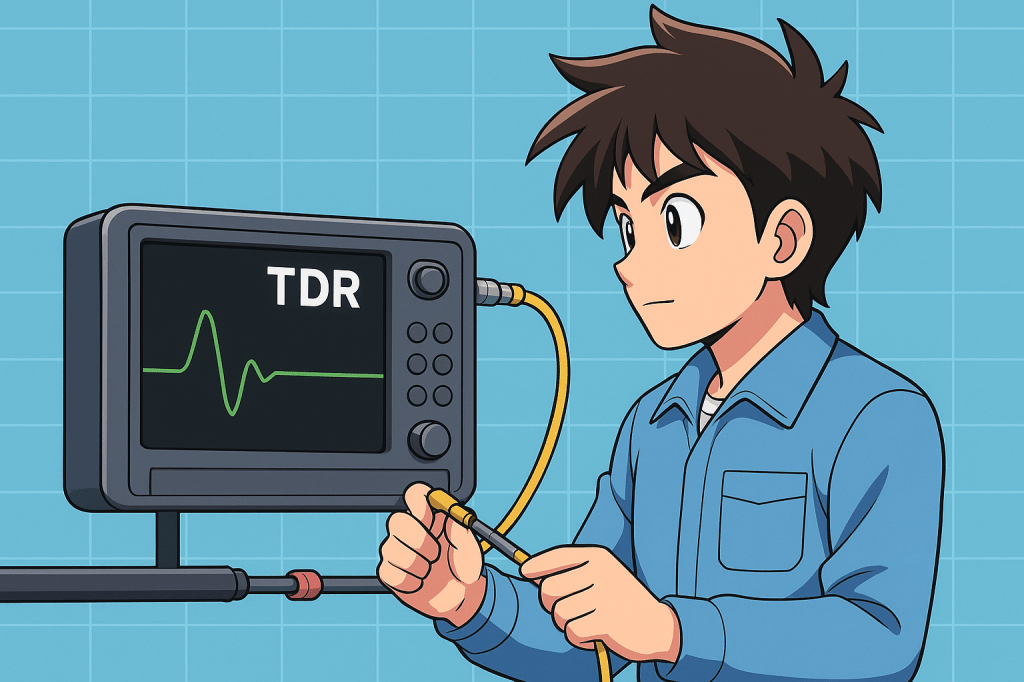
A Time Domain Reflectometer (TDR) is a diagnostic instrument used to detect faults, breaks, and impedance mismatches in coaxial cables by sending a signal pulse down the line and analyzing the reflections that return. When the pulse encounters a change in impedance—such as a splice, open, short, or damaged section—it reflects back to the TDR,…
-

A coaxial cable is a specialized electrical cable designed to carry high-frequency signals with minimal interference. Its name comes from its concentric structure—each layer shares the same axis, which helps preserve signal integrity. Coaxial cables are widely used in applications like cable television, internet service, radio transmission, and closed-circuit video systems. At the center of…

