Trending News
-
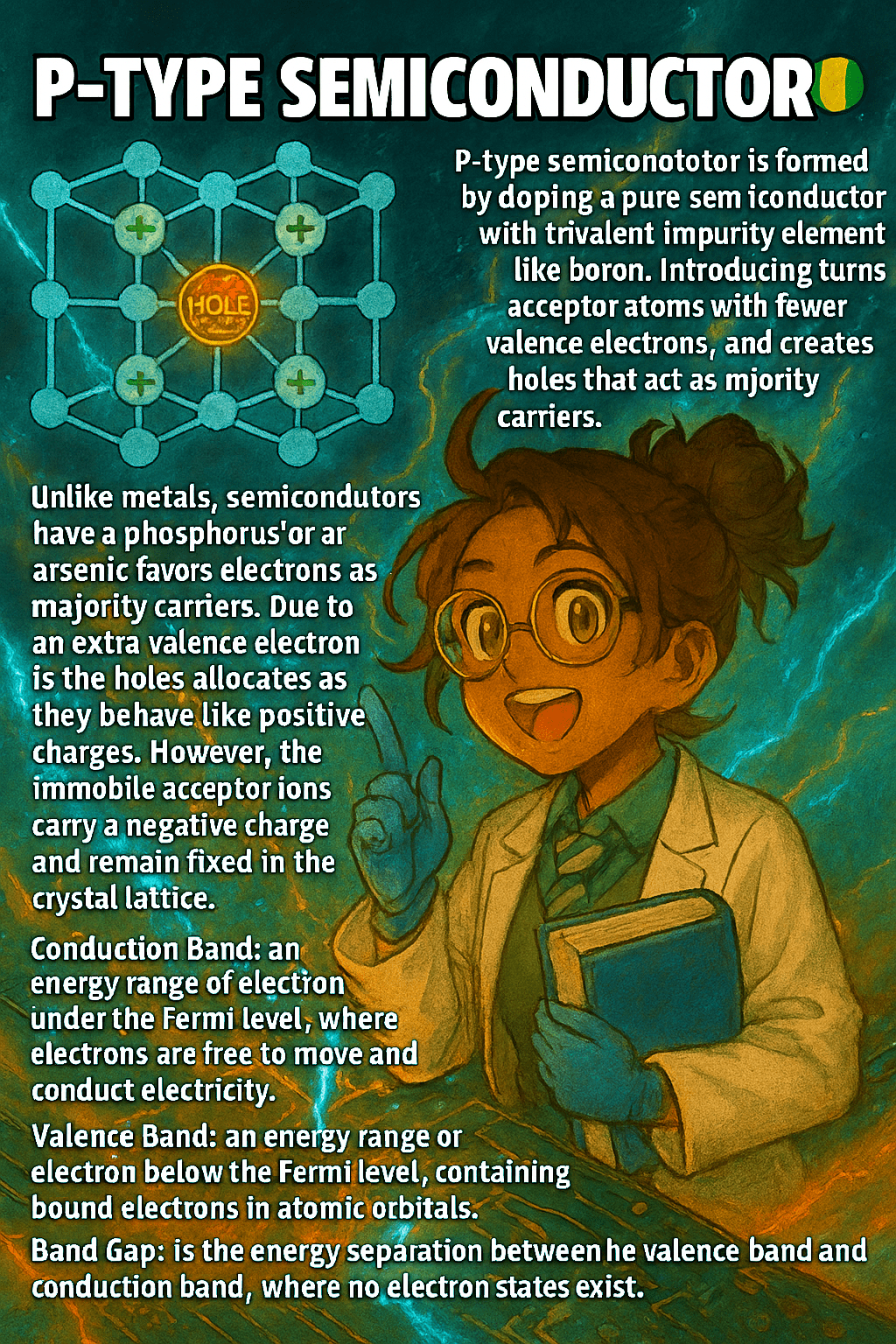
A p-type semiconductor is formed by doping a pure semiconductor, such as silicon, with trivalent elements like boron, gallium, or indium. These dopants have only three valence electrons, one fewer than silicon, which creates a vacancy or “hole” in the crystal lattice. Holes act as positive charge carriers because electrons from neighboring atoms can move…
-

The valence band is the highest range of electron energies in a solid where electrons are normally present at absolute zero temperature. These electrons are bound to atoms and participate in chemical bonding, such as covalent or metallic bonds. In crystalline solids, the valence band is formed by the overlap of atomic orbitals, creating a…
-
An n-type semiconductor is created by doping a pure semiconductor, such as silicon, with pentavalent elements like phosphorus, arsenic, or antimony. These dopants have five valence electrons, one more than silicon, and the extra electron becomes loosely bound and available for conduction. As a result, electrons become the majority charge carriers in n-type materials, while…
-

Silicon is a chemical element with atomic number 14, belonging to Group 14 of the periodic table, and it is the most widely used semiconductor material. Its electron configuration is [Ne] 3s² 3p², meaning it has four valence electrons available for bonding. In its crystalline form, silicon adopts a diamond cubic lattice structure, where each…
-

Semiconductors are materials whose electrical conductivity lies between that of conductors and insulators, and they are unique because their properties can be controlled and modified. Semiconductors are chemically diverse materials whose electrical conductivity lies between that of conductors and insulators, and their behavior can be precisely engineered. The most common elemental semiconductors are silicon (Si),…
-
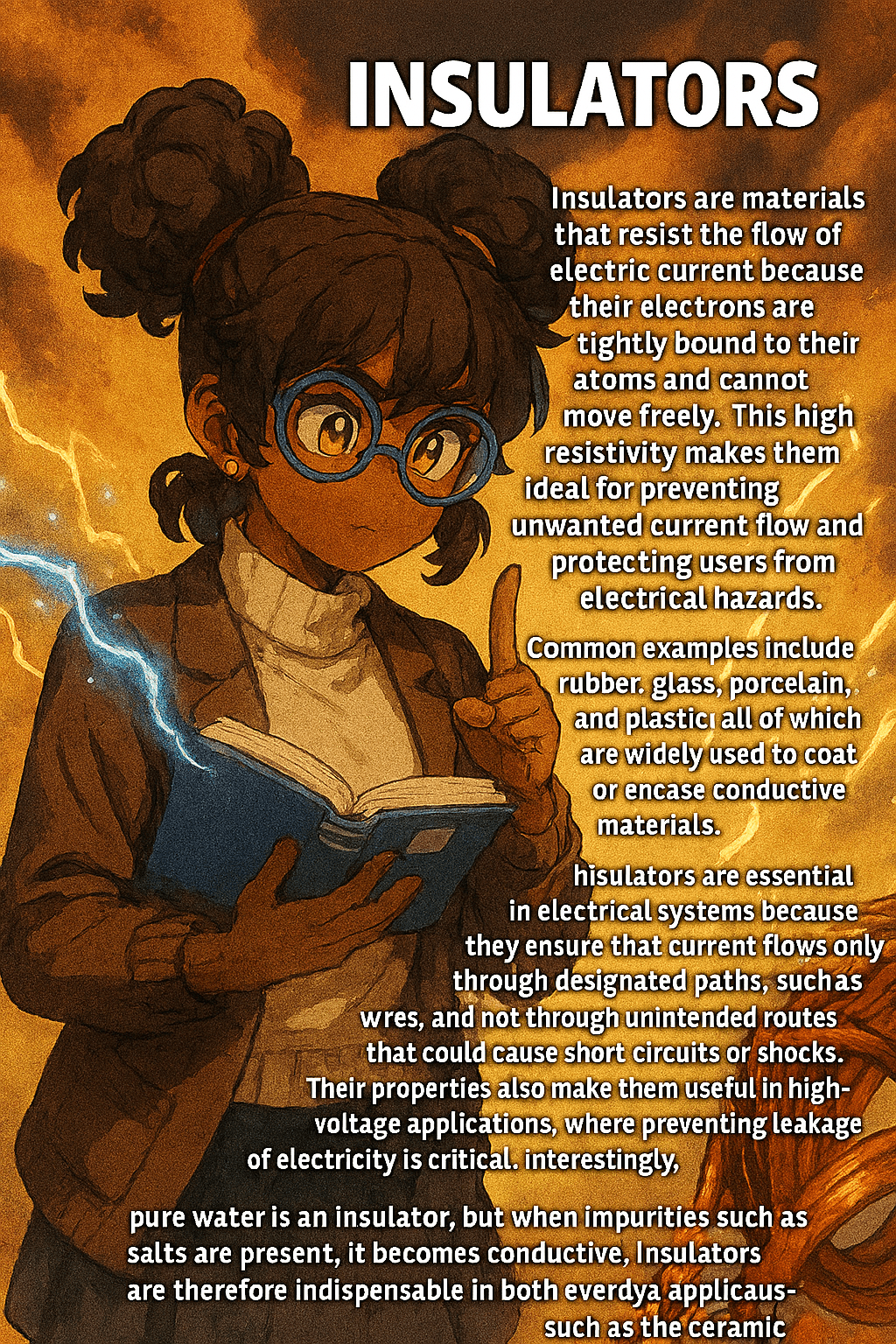
Insulators are materials that resist the flow of electric current because their electrons are tightly bound to their atoms and cannot move freely. This high resistivity makes them ideal for preventing unwanted current flow and protecting users from electrical hazards. Common examples include rubber, glass, porcelain, and plastic, all of which are widely used to…
-
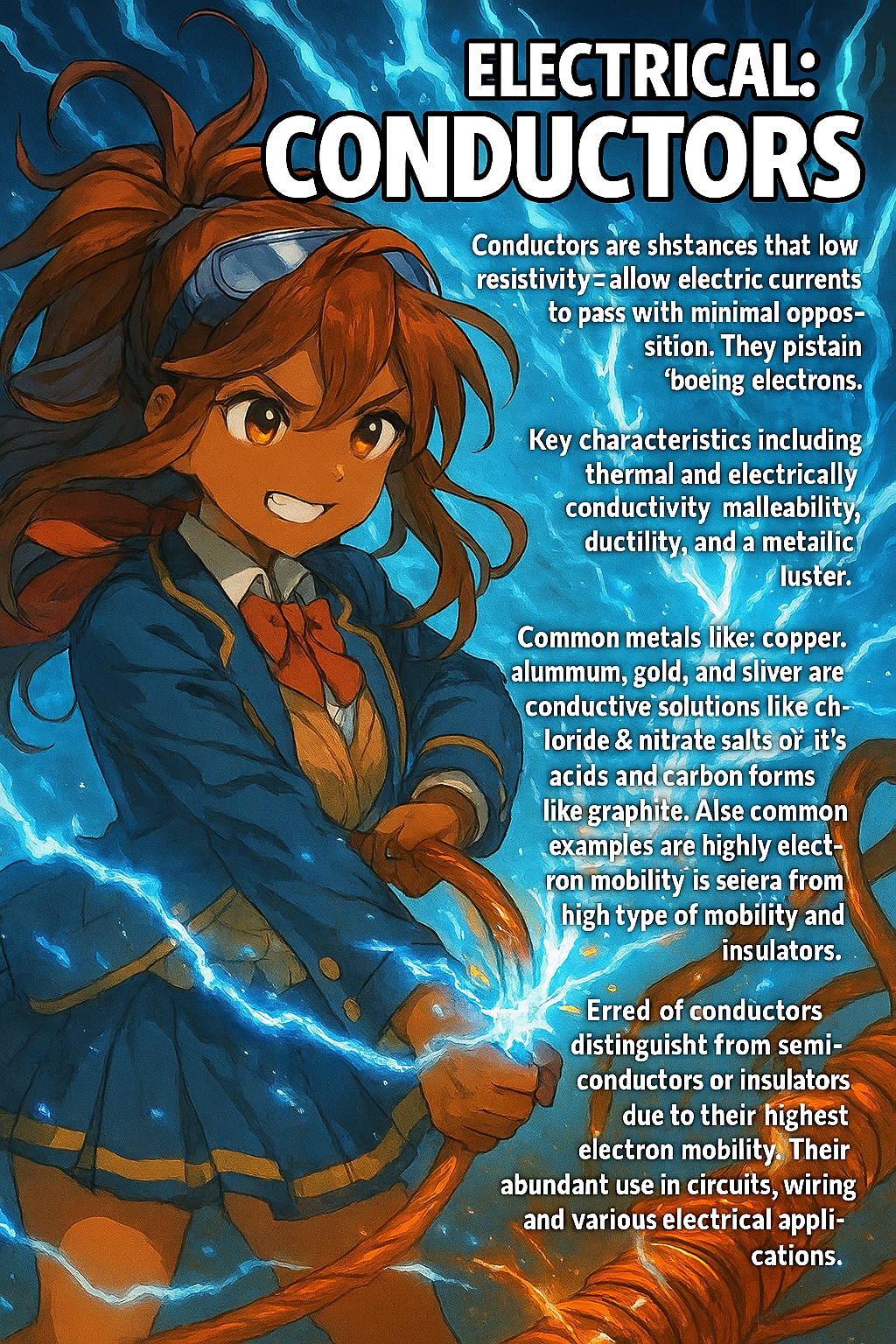
Conductors are materials that permit the easy flow of electric current due to the presence of free or loosely bound electrons in their atomic structure. In metals such as copper, silver, and aluminum, the outermost electrons are not tightly attached to their atoms, allowing them to move freely when a voltage is applied. This mobility…
-

Resistivity is a fundamental property of materials that describes how strongly they oppose the flow of electric current. Unlike resistance, which depends on the dimensions of a conductor, resistivity is an intrinsic characteristic that remains constant for a given material under specific conditions. It is mathematically expressed as, where is the resistance, is the cross-sectional…
-

Photon absorption and emission are fundamental processes in semiconductor physics that enable the operation of optoelectronic devices like solar cells, LEDs, and lasers. Absorption occurs when a photon strikes the semiconductor and excites an electron from the valence band to the conduction band, leaving behind a positively charged hole. This transition creates an electron–hole pair,…
-

In solid‑state physics, energy bands describe the ranges of energy that electrons in a material can occupy. The two most important are the valence band, where electrons are bound to atoms, and the conduction band, where electrons are free to move and conduct electricity. The band gap is the energy difference between these bands. Conductors…
-

Mobility measures how quickly charge carriers move through a semiconductor when an electric field is applied. Electron mobility (μe): the speed of electrons per unit electric field. Hole mobility (μh): the speed of holes per unit electric field. High mobility means faster current flow and better device performance. Mobility depends on factors such as temperature,…
-

Carrier statistics describe how electrons and holes are distributed among energy states in a semiconductor. Using Fermi–Dirac statistics, scientists calculate the probability that a given energy level is occupied. These probabilities determine the carrier concentration (number of electrons in the conduction band and holes in the valence band) under different conditions such as temperature or…

