Clarifying the Language Behind Power Efficiency Theory
Power Efficiency Theory is built on ideas borrowed from physics, but it is important to be precise about how those ideas are used.
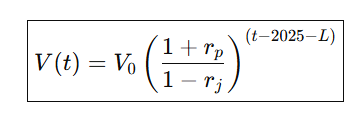
In physics, force describes the ability of a system to cause or resist acceleration. It tells us what a structure can withstand or exert under load.
A building, for example, has force capacity in its beams, walls, and foundation. This force capacity exists even when nothing is moving.
Power, in the strict physics sense, is different.
Power = Work/Time
Power measures how quickly work is done. It only exists when force is applied over time while motion occurs.
Power = Force * Velocity
A machine producing output, a motor spinning, or an engine driving a load all have power because work is actively being performed. If nothing is moving, power in the physics sense is zero, even if the system is large or strong.
Capacity, on the other hand, describes stored physical capability.
It refers to the amount of usable space, structure, or physical potential embedded in a system. Square footage, volume, load-bearing structure, and material mass all fall into this category. Capacity exists regardless of whether work is currently being done.
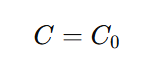
This distinction matters when applying physics concepts to economics. A home does not continuously perform work, and it does not move.
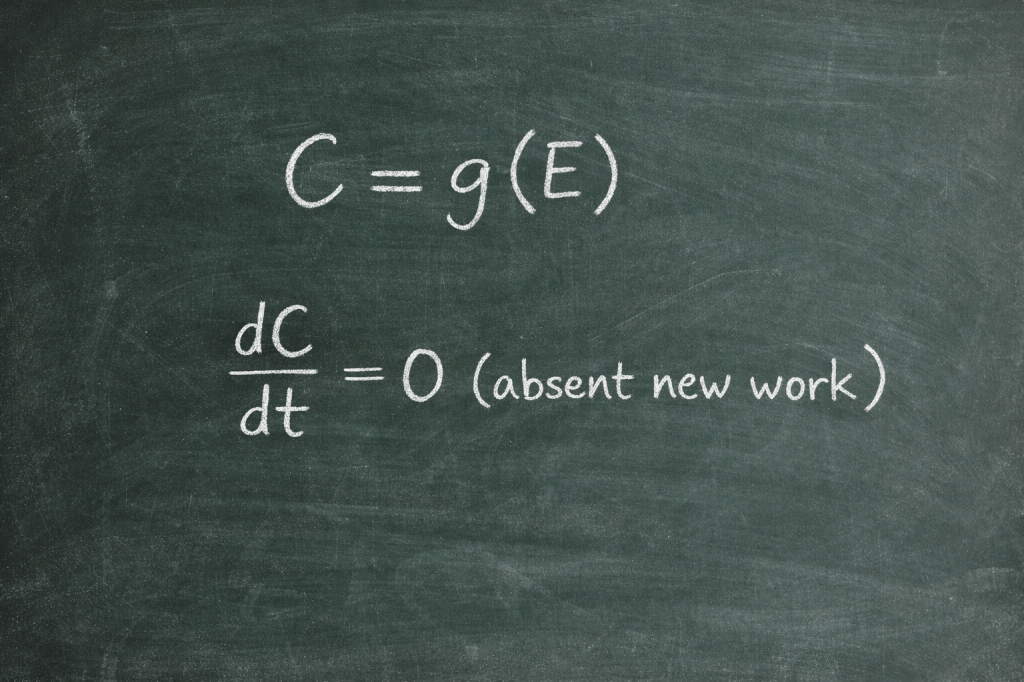
From a strict physics perspective, it has force capacity but essentially no power output. However, economically, we still need a way to describe how much physical capability the home contains.
This is where Power Efficiency Theory introduces a carefully defined abstraction.
In Power Efficiency Theory, the term power is used as a practical analogy for capacity in static systems.
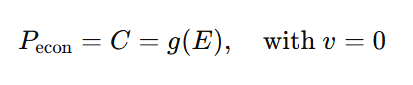
It is not used as a physics variable, but as an abstraction that represents stored physical capability. When discussing housing, “power” refers to the amount of usable space, structural capacity, and physical scale embedded in the home.
This allows the same conceptual framework to be applied consistently across both static systems like housing and dynamic systems like machinery or computing.
Efficiency then describes how well that capacity is executed.
In housing, efficiency reflects material quality, structural design, insulation, durability, and energy performance.
Two homes may have the same capacity in terms of square footage, but differ significantly in efficiency due to construction quality or materials. Under Power Efficiency Theory, those efficiency differences directly affect intrinsic value.
By separating capacity from efficiency, the framework avoids redefining physics while still capturing economic reality. Capacity describes how much physical capability exists. Efficiency describes how effectively that capability performs its intended function. Real value emerges from the combination of both.
This approach also explains why price alone cannot define value. If neither capacity nor efficiency changes, the physical system has not improved.
In that case, any sustained increase in price reflects external forces such as credit conditions, monetary policy, or market narratives rather than true physical value creation.
Power Efficiency Theory therefore uses the language of physics carefully and transparently.
Force remains a structural concept. Power remains a rate-based concept in physics.
Capacity is the correct physical analogue for stored capability.
The term “power” is used interchangeably for capacity only where explicitly defined.
This preserves scientific rigor while allowing the framework to function across markets.
Ultimately, Power Efficiency Theory contends that real value increases only when a system gains more physical capability or uses that capability more efficiently. If neither changes, value does not grow, regardless of what the price does.
That principle holds whether the system is a house, a machine, or a computational network.
BitcoinVersus.Tech Editor’s Note:
We volunteer daily to ensure the credibility of the information on this platform is Verifiably True. I
If you would like to support to help further secure the integrity of our research initiatives, please donate here: 3C9o19EH5HSiwEPyCTmEKzxhNCbo2X6TTb
 Bitcoin Versus
Leave a comment